Air Force Body Fat Calculator
Estimate tape-method body fat, waist-to-height ratio, and planning margins for Air Force body-composition preparation.
📌Presets
Presets fill realistic sex, age, height, neck, waist, hip, and unit combinations, then run the calculator.
⚙Calculator
Air Force body-composition snapshot
Enter measurements to estimate tape body fat and WHtR planning margin.
📊Fitness Metrics
📑Reference Tables
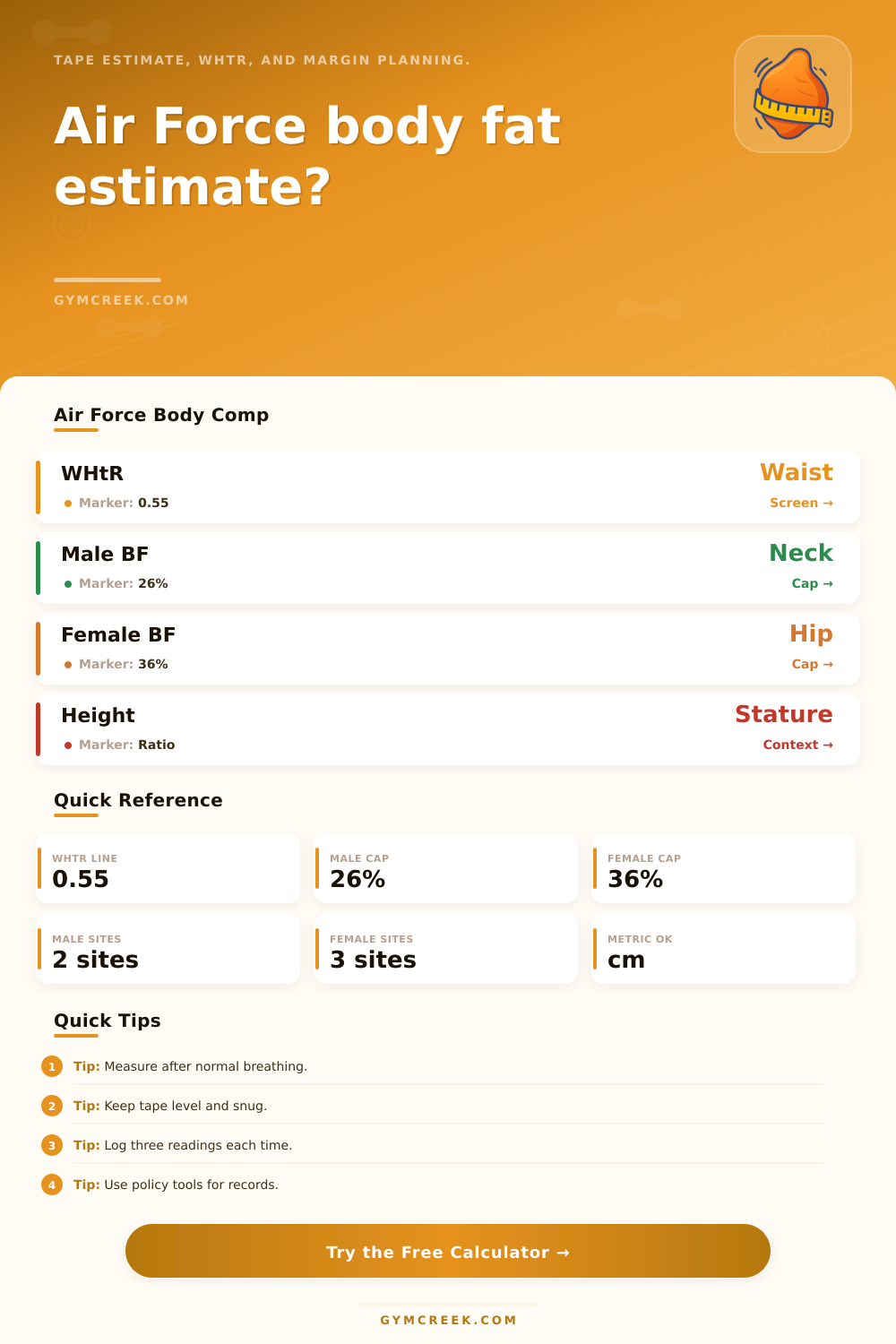
| WHtR Result | Planning Meaning | Common Action | Formula |
|---|---|---|---|
| Below 0.50 | Lower ratio | Maintain habits | Waist / height |
| 0.50-0.54 | Close watch | Track trend | Waist / height |
| Below 0.55 | Meets line | Keep margin | Waist / height |
| 0.55 or higher | High risk flag | Confirm process | Waist / height |
| Sex | Body-Fat Cap | Calculator Sites | Planning Use |
|---|---|---|---|
| Male | 26% | Height, neck, waist | Secondary estimate |
| Female | 36% | Height, neck, waist, hip | Secondary estimate |
| Any | Policy driven | Official assessor | Records only |
| Any | Trend useful | Same tape method | Self-checks |
| Measurement | Imperial | Metric | Notes |
|---|---|---|---|
| Height | ft + in | cm | Shoes off |
| Neck | inches | cm | Level tape |
| Waist | inches | cm | Normal breath |
| Hip | inches | cm | Female formula |
| Formula | Variables | Output | Best Use |
|---|---|---|---|
| WHtR | Waist, height | Ratio | Air Force screen |
| Male tape BF | Waist, neck, height | Percent | Estimate |
| Female tape BF | Waist, hip, neck, height | Percent | Estimate |
| Mass split | Weight, BF% | lb or kg | Planning only |
💡Tips
Body comp testing is more than just a test; it’s a lifestyle audit. You know there are variables outside your control, like the number itself. Yet, you still walk onto scale with thin socks inside your shoes because you know a tiny difference might mean something else to someone else. Although it’s just a moment in time, there’s a lot at stake.
While Airmen obsess over the bottom line number (body fat percent), they don’t realize that the waist number is often what matters. Central fat is closely linked to metabolic health, which means it drive most of the risk flags, even if you’re not looking directly at it. This is why the Air Force screen use the waist-to-height ratio first: it’s a crude proxy that helps distinguish between fat vs. It helps distinguish between fat and lean muscle mass without using expensive equipment or underwater weighing.
How to Measure Your Body Correctly
Once you grasp how that ratio function, it turns into planning instead of guesswork. After you plug in your raw numbers into calculator (above), it crunches the numbers for you, no need to convert and play with coefficients yourself. Once you input your height, waist, neck, and hips (if applicable), it will calculate your current ratio and your estimated body fat percentage.
It’s a great way to isolate variables. Even if your waist size is shrinking and your overall weight remains the same, you’re improving your risk profile. That’s where many of our fit Airmen tend to get hung up. When they crash diet, they both gain and lose muscle/fat about equally, so their percentage remain unchanged but their strength plummets dramatically. Recomposition, not just weight loss, should of been the goal. Trim away the extra insulation without weakening your engine.
Most self-assessments also fail because of improper measurement technique. People tend to wrap the tape too tightly (so that they’re sucking in their stomachs and looking concave) or too loosely (so it rests across some clothing seam). This doesn’t reflect your true bodily state. According to the standard, you should be standing comfortabley, relaxed, with normal breathing. The measurement you record is supposed to be the one you carry around all day, while eating and chatting with friends, not the one you get after holding your breath for ten seconds.
In other words, consistency is more important here then perfection. If you measure yourself at home, do so consistently, using same tape, standing on the same floor, etc., and taking a normal breath each time. Better yet, track the trend line over time: that will give you better data than trying to chase the perfect reading on a given random morning.
For example, here’s the reference table from the page that shows the planning actions for each range of ratios. When your ratio falls under 0.55, it’s go time (green light). But if you’re hovering right on the line, there’s no wiggle room. You’ll be pushed right over the edge with the smallest change in digestion or hydration.
That’s why it makes sense to set yourself a personal buffer. Shoot for a waist size with some breathing room until you reach the max allowable limit. This way, when life gets hectic and you start to panic, you have a safety net to catch small things that don’t trigger any administrative consequences.
But we should consider that there’s an element of gender in interpreting these numbers on a biological level. Because women have a higher percentage of necessary fat (for healthy hormones), their cap and formula are different than those of men. This means that if you’re female, you shouldn’t expect yourself to follow their guidelines, it won’t make sense, and you’ll only stress yourself out unnecesarily. Thankfully, the tool does factor in our physiology: There are distinct equations for hips and neck based on male/female measurements.
So regardless of where you fall on the spectrum, you don’t have to battle against your body to achieve these standards; you simply has to work within your framework. Concentrate on things you can control. Like eating nutritious food, getting enough sleep, and maintaining regular activity. These actions will move the needle quicker then fretting over exactly how hard you squeeze the measuring tape.
At the end of the day, these numbers aren’t judgments about who you are as a person; they’re data points used to make decisions. They represent what you have right now in order to determine how to get better in the future. If your diet isn’t perfect, use it to improve. If your training doesn’t feel right, use it to make changes. A number does not dictate the value of your life or performance as an Airman.
Log those measurements accurately, keep the tape taut but loose, and believe in yourself. This isn’t about getting by this week; it’s about preparing for the long haul. Focusing on lasting solutions (instead of quick-fixes) will cause the numbers to take care of themselves. You’ll develop resilience that outlasts the yearly test, and that’s when you know you’ve won.