Air Force Academy PFT Score Calculator
Estimate USAFA cadet PFT points for pull-ups, standing long jump, sit-ups, push-ups, and the 600-yard run using published anchor standards.
📌Presets
Presets load realistic event mixes so you can see how one strong or weak event changes the total PFT estimate.
⚙Calculator
USAFA PFT snapshot
Enter your five event marks to estimate total PFT points.
📊Fitness Metrics Grid
📑Reference Tables
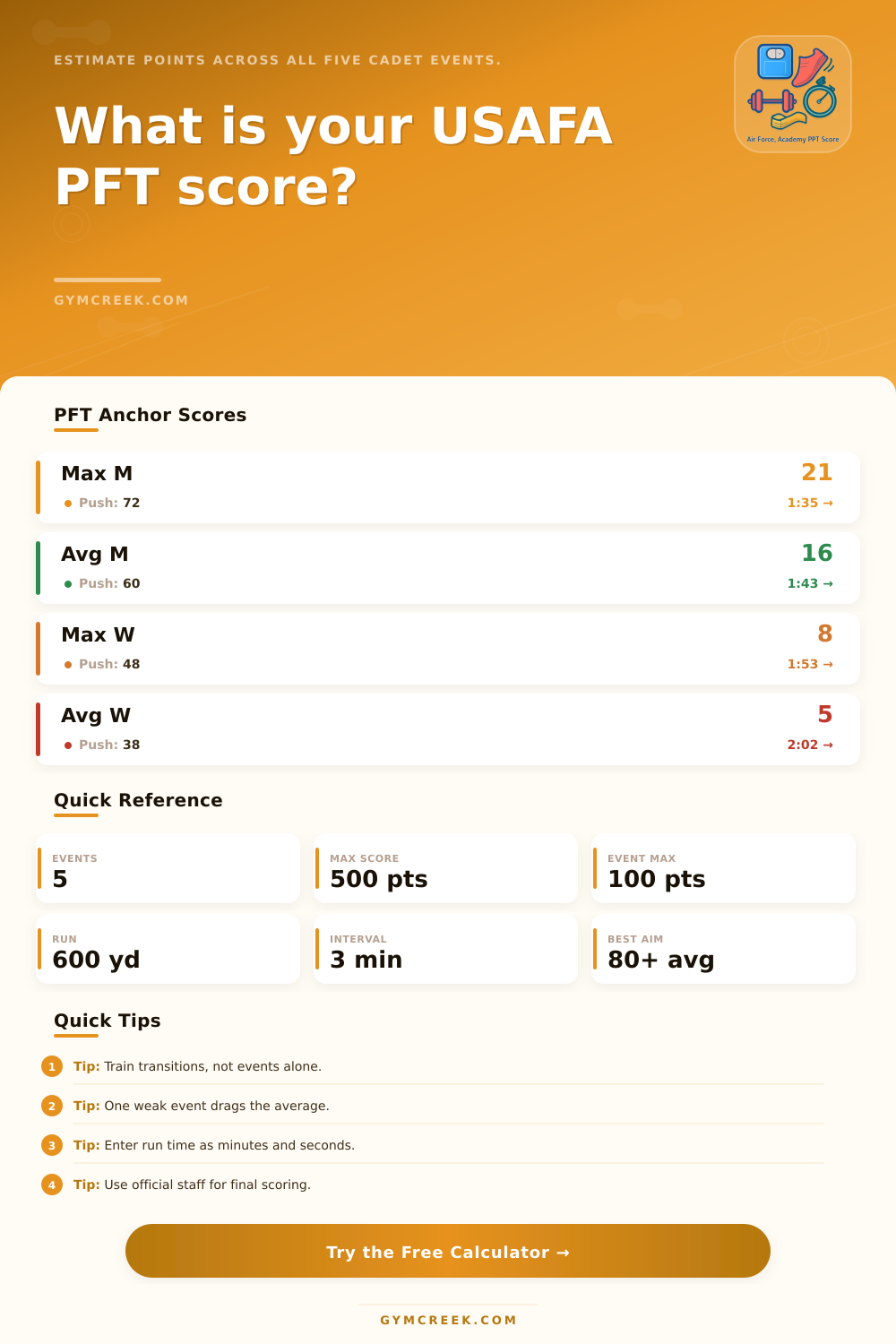
| Men's anchor | Pull-ups | Long jump | Run |
|---|---|---|---|
| 100 points | 21 | 8 ft 8 in | 1:35 |
| About 75 | 16 | 8 ft 1 in | 1:43 |
| 50 points | 12 | 7 ft 7 in | 1:53 |
| 25 points | 7 | 7 ft 0 in | 2:03 |
| 0 points | 0 | 6 ft 1 in | 2:13 |
| Women's anchor | Pull-ups | Long jump | Run |
|---|---|---|---|
| 100 points | 8 | 7 ft 2 in | 1:53 |
| About 75 | 5 | 6 ft 8 in | 2:02 |
| 50 points | 3 | 6 ft 3 in | 2:12 |
| 25 points | 1 | 5 ft 9 in | 2:23 |
| 0 points | 0 | 5 ft 0 in | 2:34 |
| Strength anchor | Men's sit-ups | Men's push-ups | Women's push-ups |
|---|---|---|---|
| 100 points | 95 | 72 | 48 |
| About 74 | 83 | 60 | 38 |
| 50 points | 71 | 48 | 29 |
| 25 points | 58 | 35 | 18 |
| 0 points | 42 | 18 | 4 |
| Formula item | How this calculator handles it | Use | Limit |
|---|---|---|---|
| Event points | Linear interpolation | Between anchors | Estimate |
| Run scoring | Lower time is better | 600-yard run | Seconds |
| Jump conversion | Feet, inches, or cm | Long jump | Rounded |
| Total score | Five events summed | 500 max | Unofficial |
💡Tips
The Physical Fitness Test is a series of physical event that will measure the fitness of each USAFA cadet. While the Physical Fitness Test is not a means of measuring the health of the cadet, the test is used to measure the physical readiness and standing of each cadet within an Air Force Academy. One must understand that strength gained within the gym is not the same than the strength required to meet the Physical Fitness Test requirements.
Each of the events of the Physical Fitness Test are to be completed in a certain sequence, and each of the events will test the physical strength of the cadet while the cadet is exhausted from having completed previous event. Many people tend to make the mistake of performing each of the events separately and on separate days, which will not provide an accurate measurement of a cadet’s score on the Physical Fitness Test. Instead, each cadet should perform each of the events in succession; for instance, completing the events of sit-ups while the cadet is already tired from performing pull-ups and push-ups.
How the Physical Fitness Test Works
Each of the events will require the cadet to utilize a calculator to input his or her score for each exercise to determine the cadet’s score on the Physical Fitness Test. The calculator utilize anchor points for each physical fitness level to determine the score of the cadet. By understanding where a cadet falls in between each of these anchor point will help the cadet to understand how many more exercises he or she can perform to reach the next fitness level.
One of the events within the Physical Fitness Test is the standing long jump. The standing long jump measure the explosive strength of the cadet. Many cadets neglect this event in particular, as a low score in this event will lead to a lowered total score on the Physical Fitness Test.
A low score in this event may mean that the cadet’s fast-twitch muscles is not functioning correctly. For this event, the cadet can use either imperial or metric unit to calculate his or her score, as the power of the standing long jump is the same regardless of these units. The final event for the Physical Fitness Test is the 600 yard run.
This event tests the anaerobic threshold of the cadet. For this event, many people do long-distance running to prepare for the 600-yard run event. However, long-distance running and the 600-yard run use different energy system for the run.
For instance, long-distance running utilizes the slow energy system, while the 600-yard run utilizes the high intensity energy system. Thus, if a cadet only trains in long-distance running, he or she may not have a strong performance in the 600-yard run event. For each cadet, the cadet should primarily focus upon the score of the weakest event for improvement.
For instance, if a cadet has high score for his pull-ups and push-ups events, but has a low score in his sit-up event, the cadet’s total score will be relatively low. Therefore, it is more efficient for the cadet to improve in his weakest event rather than improve in an area that he already has a high score in. Thus, the cadet can make the greatest improvements in his greatest weakness.
For each of the events within the Physical Fitness Test, there are certain transitions between each exercise. During these transitions, a cadet must learn to manage his or her breathing and the amount of lactic acid present in his or her arm. By mastering these transitions between each of the five events of the Physical Fitness Test, each cadet will be able to perform better in each of the five events.
Because the Air Force require its leaders to be strong and capable of meeting all type of physical demands, it is recommended that each cadet work to establish a balanced body and to avoid becoming specialist in strength for only one type of physical event within the Physical Fitness Test. Cadets must remain consistent in there performance of each of the events, continue to track their score for each event, and continue to work on their weakest events. By remaining consistent and tracking their numbers for each Physical Fitness Test event, cadets will be able to understand their standing within the Physical Fitness Test before they ever begin to perform the test.