Aerobic Threshold Heart Rate Calculator
Estimate your AeT heart-rate range from max HR, resting HR, LTHR, talk-test response, cardiac drift, sport type, training age, weekly aerobic volume, and current field-test context.
📌AeT Field-Test Presets
Presets load realistic endurance profiles. Edit the values after loading to match your own heart-rate strap data, talk-test cue, drift test, and sport.
⚙Calculator Inputs
Aerobic threshold snapshot
Your AeT range, target HR, LTHR gap, and confidence update as inputs change.
📊Metrics Grid
📑Reference Tables
| Method | Rule used | Best when | Weakness |
|---|---|---|---|
| HR reserve | Resting HR + 62-74% of HR reserve, adjusted by training age and field cues | You know resting HR and max HR reasonably well | Bad max HR or fatigue can shift the result |
| Max HR percent | About 70-78% of max HR after sport and context offsets | You only know max HR or need a quick check | Less personalized than HR reserve |
| LTHR anchor | About 80-88% of LTHR, capped well below threshold | You have a recent hard 30-60 minute field test | Overestimates if LTHR is stale or inflated |
| Maffetone context | 180 minus age, then adjusted for training history and return-to-training risk | You want a conservative aerobic ceiling | Ignores individual max HR and LTHR |
| Talk and drift check | Short controlled speech plus less than 5% drift supports the target | You can repeat steady field sessions | Weather, hills, dehydration, and pacing matter |
| Sport | Default shift | Why it changes | Practical note |
|---|---|---|---|
| Running | 0 bpm | Large muscle mass and upright posture make HR relatively high | Flat routes make talk and drift tests cleaner |
| Cycling | -5 bpm | Seated posture and local leg fatigue often lower HR at the same metabolic load | Use power and drift when available |
| Triathlon brick | -3 bpm | Prior sport fatigue can raise drift while bike posture can lower HR | Separate bike and run AeT caps if possible |
| Rowing or ski erg | -2 to -3 bpm | Large muscle demand, technique, and erg cooling alter HR response | Repeat on the same machine and damper setup |
| Hike or swim | -4 to -8 bpm | Grade, buoyancy, breathing pattern, and cooling change HR expression | Use sport-specific tests instead of copying run zones |
| Field signal | Result | Calculator response | Training read |
|---|---|---|---|
| Full sentences feel easy | Probably below AeT | Allows a small upward nudge if drift is also low | Good recovery or low aerobic work |
| Short sentences, controlled | Near practical AeT | Best confidence signal when drift is under 5% | Useful steady-zone target |
| Broken phrases | Likely above AeT | Lowers target and widens the range | Back off until breathing settles |
| Cannot talk comfortably | Too intense for AeT | Strong downward adjustment | Probably tempo or threshold work |
| Drift above 8% | Cardiac cost rose fast | Lowers target and confidence | Check heat, hydration, fueling, and pacing |
| Training age | Expected AeT behavior | Confidence note | Retest rhythm |
|---|---|---|---|
| 0-1 year | AeT is often farther below LTHR and less stable day to day | Use conservative caps and simple talk-test validation | Every 2-3 weeks during base training |
| 1-3 years | Drift improves quickly with consistent easy volume | Use repeatable routes and similar weather | Every 3-4 weeks |
| 3-7 years | AeT may sit closer to LTHR when volume is steady | LTHR and drift anchors become more useful | Every 4-6 weeks |
| 7+ years | Small changes in fatigue, heat, and altitude can matter more than formula error | Prioritize clean field data over generic percentages | Every 4-8 weeks or after a block |
💡Tips
Finding an aerobic threshold allow a person to understand how the aerobic threshold function. The aerobic threshold is the specific heart rate zone where a person build their endurance. This threshold also dont lead to excessive fatigue for an individual.
Many people struggle to find the correct levels for activities like running or cycling, but determining the aerobic threshold will provide an exact heart rate measurement for an individual. The calculator on this page will use specific number to determine the aerobic threshold for you. An aerobic threshold exist below the lactate threshold but also exists above the recovery pace for an individual.
How to Find Your Aerobic Threshold
An aerobic threshold exists at the highest level of effort for an individual while using fat as fuel source for there body. Additionally, an individual’s breathing should remain steadily enough for them to have conversations during the effort required for the aerobic threshold. Aerobic threshold training will help improve the mitochondrial density for an individual’s body and the capillary networks for the muscles used for exercise.
However, training at this threshold will not provide the same recovery as the individual put in for more challenging workouts. If the effort level for an individual fall outside of the aerobic threshold, then the individual may be training too easy or too hard on their muscles. Training too easy with the lack of effort for an individual will not allow their body to create the stimulus needed for performance improvement.
However, training too hard will make their easy days become medium days for performance. The inputs for the calculator will provide an exact measurement for the aerobic threshold. An individual’s resting heart rate will allow the calculator to find their heart rate reserve.
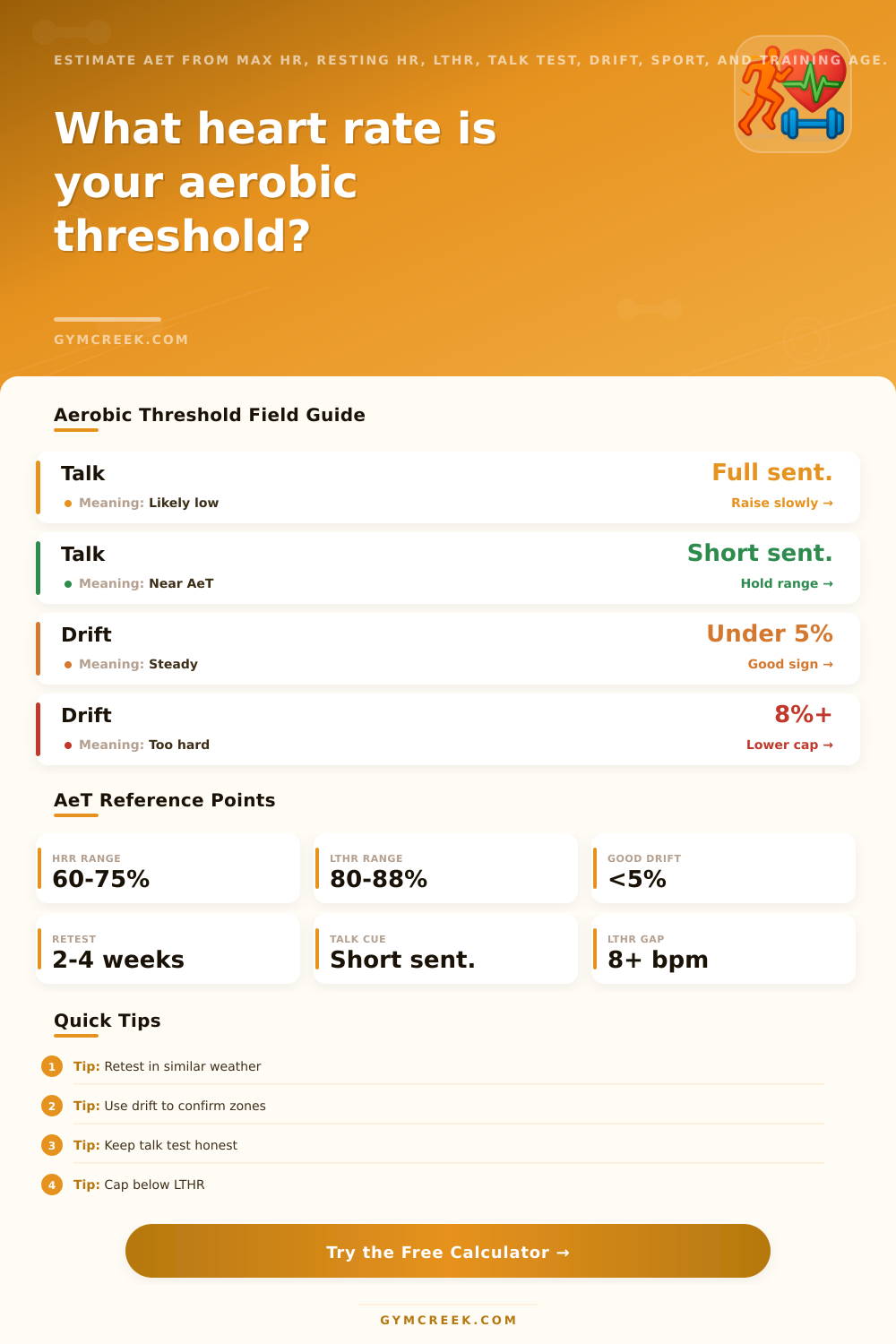
The lactate threshold heart rate will help to determine the upper limit for their aerobic threshold. An individual’s training age and volume will help to account for the number of year that they have trained with consistency versus those who have not trained for as long. Additionally, inputs for cardiac drift and talk test for an individual will allow the calculator to account for any increases in heart rate by more than five percent or if an individual cannot speak in full sentence during the workout, which would require an adjustment to their aerobic threshold.
An individual’s choice of sport will impact their heart rate and their aerobic threshold. For instance, cycling will provide lower heart rates than running because an individual does not have to worry about cooling their body during cycling like they would on the running course. Rowing and hiking will yield heart rates in between cycling and running.
The calculator will account for these sports. This threshold will also be adjusted to account for an individual’s specific sport. Context for an individual’s workout can also impact their aerobic threshold.
Factors like heat in the weather, sleep, and illness can all increase an individual’s heart rate even if they are not performing any additional exercise. The dropdown menu associated with the context for the workout tests will also account for these factors. A widened range for an individual’s aerobic threshold will prevent them from having to aim for the target heart rate when the context of the exercise isnt ideal for performance.
The reference table will allow an individual to understand the result from the calculation of their aerobic threshold. One table will provide information for how various estimation of aerobic threshold change with the loss of information regarding an individual’s data. The other table will provide information regarding talk test and how they relate to the confidence of an individual’s aerobic threshold calculation.
These tables will not provide rules for an individual’s aerobic threshold, but they will provide a reminder of the impact of exercise context on the measurement of aerobic threshold. With the calculation of an individual’s aerobic threshold, they should of repeat this test every few weeks with similar condition. An individual’s weather conditions, level of fatigue, and fueling of the body will all change their heart rate.
These factor will also impact their aerobic threshold. The aerobic threshold calculated for cool weather may need to be lowered if an individual plan to exercise in high temperatures. Thus, even with the calculator for aerobic threshold, an individual must still perform these test to determine their threshold.
Knowing the aerobic threshold for an individual will allow their easy days to remain easy while their hard days will be challenging but with fresher legs. The difference between an individual’s performance in a day and their recovery will stabilize. This is, therefore, the reason why an individual must find their aerobic threshold.