Aerial Silks Calorie Calculator
Estimate calories burned in aerial silks from climbs, inversions, drops, static holds, sequence duration, rest ratio, skill level, and adjusted MET plus strength-load logic.
📌Presets
Presets load realistic aerial silks sessions and recalculate from time aloft, climb volume, static strength, and practice density.
⚙Calculator
Aerial silks calorie snapshot
Enter session structure to estimate calories, active work, and strength density.
📊Session Metrics
🧮Formula Cards
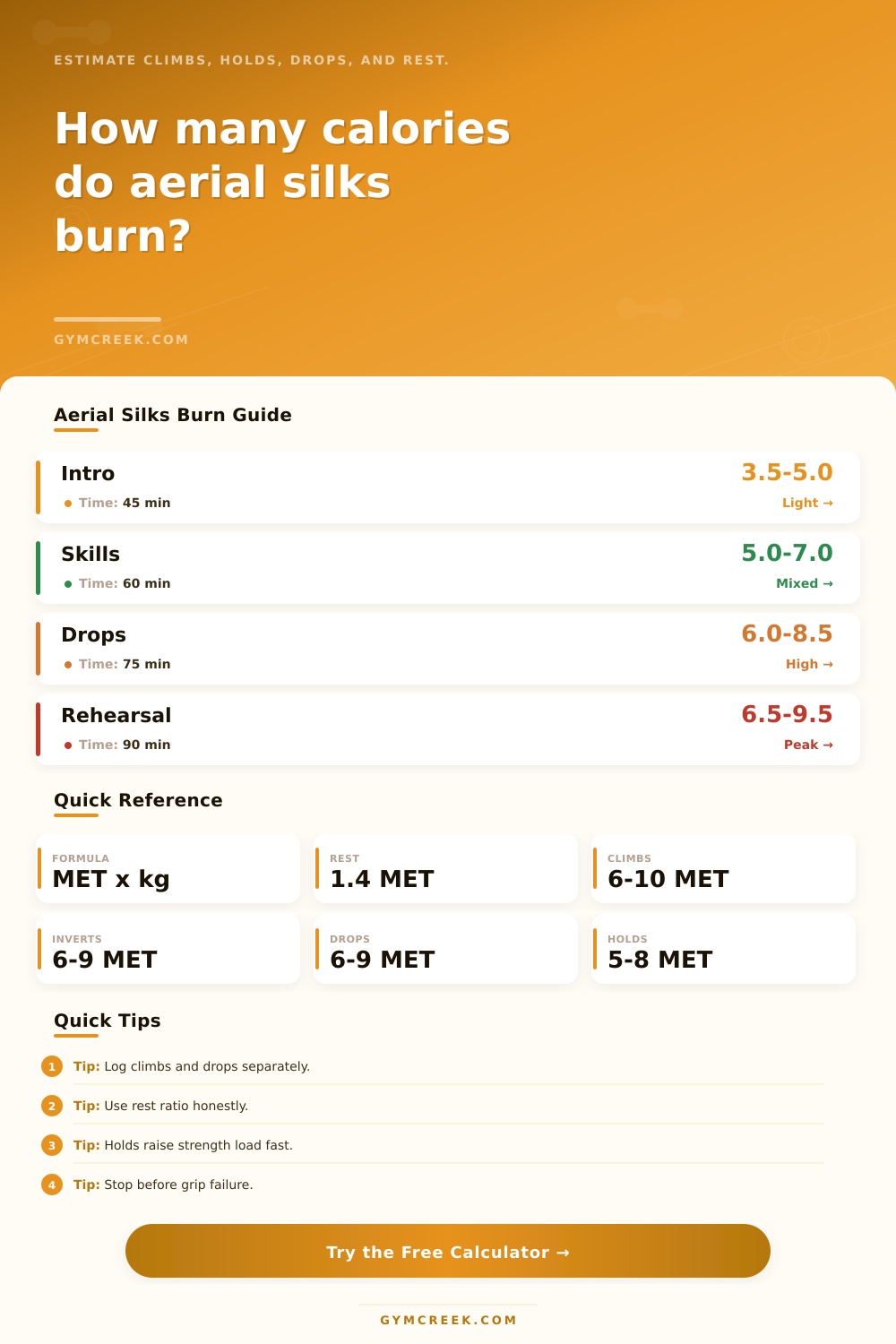
Calories per minute = MET x 3.5 x body weight in kg / 200. The calculator applies separate MET values for sequence work, climbs, skills, holds, and rest.
Climb volume, inversion count, drop reps, and hold seconds are converted into a strength index so short but demanding sessions do not look too easy.
Total time is split by rest ratio first, then work minutes are allocated to sequences, climbing, inversion and drop practice, holds, and technical practice.
Mifflin-St Jeor estimates BMR from age, height, weight, and gender. The activity multiplier estimates TDEE so the session can be compared with a full day.
📑Reference Tables
| Focus | Base MET | High MET | Main Driver |
|---|---|---|---|
| Technique class | 4.2 | 6.2 | Skill time |
| Conditioning | 5.8 | 8.6 | Circuits |
| Climb practice | 6.2 | 9.5 | Ascents |
| Inversions | 5.8 | 8.8 | Core pull |
| Drops | 6.0 | 9.0 | Set resets |
| Rehearsal | 6.4 | 10.2 | Runs |
| Skill Level | MET Mod | Strength Mod | Note |
|---|---|---|---|
| Beginner | 1.08x | 1.12x | Less efficient |
| Improver | 1.03x | 1.06x | Learning |
| Intermediate | 1.00x | 1.00x | Balanced |
| Advanced | 1.05x | 1.08x | Dense work |
| Performer | 1.12x | 1.15x | Show pace |
| Component | Time Rule | MET Range | Best Input |
|---|---|---|---|
| Climbs | Height pace | 6-10 | Count |
| Inverts | 0.45 min | 6-9 | Attempts |
| Drops | 0.40 min | 6-9 | Reps |
| Holds | Seconds | 5-8 | Hold time |
| Rest | Ratio | 1.3-1.8 | Percent |
| Formula | Variables | Output | Use |
|---|---|---|---|
| MET kcal | MET, kg, min | Calories | Main burn |
| Climb load | kg, height | Index | Strength |
| Hold load | sec, reps | Index | Isometric |
| TDEE share | kcal, TDEE | Percent | Context |
💡Tips
When you take aerial silks classes, you learn how to use your muscles to lift your entire body weight off ground and climb the silk fabric. Your arms shakes and your shoulders burn. A lot. But when you look at your average fitness tracker, it says that you didn’t burn many calories. That’s because most general calculators don’t understand the unique movement of aerial arts: it’s not only aerobic (you’re moving) but isometric (you’re in static positions). And as you move, your core has to stabilizes your spine. The calculator on this page does factor in this combination of strength and endurance. In other words, it can distinguishes between the metabolic cost of hanging in one place versus the cost of climbing up. General calculators don’t even make this attempt.
Rather than an average intensity, these are the inputs that represent how a typical session is structured. There are fields for static hold time, drop reps, climb count and attempts at holding inversions. Because each exercise draws on different energy system, this specificity makes a difference. Isometric exercises like holding a knee hook or crucifix are burning calories via muscular tension, not cardiovascular output. Dynamic exercises like climbing gets your heart going fast.
Why This Calculator Is Different
If you just log your overall time spent in the studio, the algorithm could underestimates how many calories you’ve burned, particulary if you’re resting between attempts for twenty minutes. Once you input your session structure, the calculator does the math for you. It divides up your time into active work versus recovery. Then it assigns different metabolic equivalents to each piece of the puzzle.
This is why the rest ratio slider matters. In aerials, there’s not a ton of continuous movement. You’re waiting for your turn, you’re spotting and coaching, you’re chalking (there are breaks in your workout). If you ignore these breaks, it will make it seem like you burned more calories in that class then you actually did. By being honest with these pauses, you get a better idea of what kind of effort you put into the session.
Interestingly, your skill level also impacts calorie burning, but not in the intuitive way you’d expect. In fact, beginners tend to burn more calories per minute up there than seasoned practitioners. Why? Physics. Less experienced flyers aren’t as efficient. They’re fighting the fabric more; they’re engaging stabilizing muscles that advanced aerialists know to keep relaxed.
The calculator accounts for this inefficiency. If everything else is the same, your Burn Estimate will be higher for the same routine than an advanced practitioner’s. As you strengthen, though, your body becomes a more efficient machine. You become more fluid. There’s less wasted energy used when you move. That helps improve your performance, but it also means you’ll need to make the routine more complex or train longer (i.e., increase the volume) to achieve the same caloric output. The reference table on the page shows how these metabolic modifiers change as you advance from novice to performer.
Grip strength is a major factor that limits you when doing aerial silks. Usually, your forearms gets tired before your shoulders do. That’s why there is a grip demand setting on the calculator. If you lack grip, then you lose form. If you lose form, then you waste energy or put yourself at risk of injury. Monitoring this will give you an idea of how dense your practice was. For instance, a high-grip workout with less climbing can be as tiring as a low-grip workout with lots of climbs. The strength load index accounts for this.
Even though your heart rate may remain consistent, this gives you a sense of how hard your muscles are working. This is key to help you balance out your practice. If you don’t account for strength, you run the risk of burning out your cardio system. You also risk leaving out muscular endurance required to maintain safe holds. And with that, nutrition and recovery are to be aligned.
Aerial silks are not just cardio; they are also a form of heavy resistance training. To recover from those micro-tears in your back and shoulders? Protein. For those anaerobic bursts when you invert and drop? Carbohydrates. Refuel accordingly using this information.
How much did I burn, more or less? If you underestimate: fatigued. Overestimate: stalled progress. A base for how hard you work allows you to tweak your diet accordingly, or plan for rest days as needed.
That’s the thing about the fabric, though. It doesn’t care how hard you worked. Only how much you weighed, and how well you were able to hang on. And your body cares about both things. If you know your approximate burn for every drop and wrap, you’ll know how to honor both.
You cling. You grip. You let go. The numbers, however, would of only help you figure out the cost of the journey.