Activity Multiplier Calculator
Estimate your personal activity multiplier by combining BMR, job movement, steps, lifting, cardio, sport sessions, and tracking confidence into one TDEE factor.
◎Presets
Presets load realistic movement profiles and recalculate instantly.
⚙Calculator
Activity multiplier snapshot
Enter movement data to estimate your TDEE factor.
▦Fitness Metrics Grid
▣Reference Tables
| Category | Typical factor | Movement pattern | Use with caution when |
|---|---|---|---|
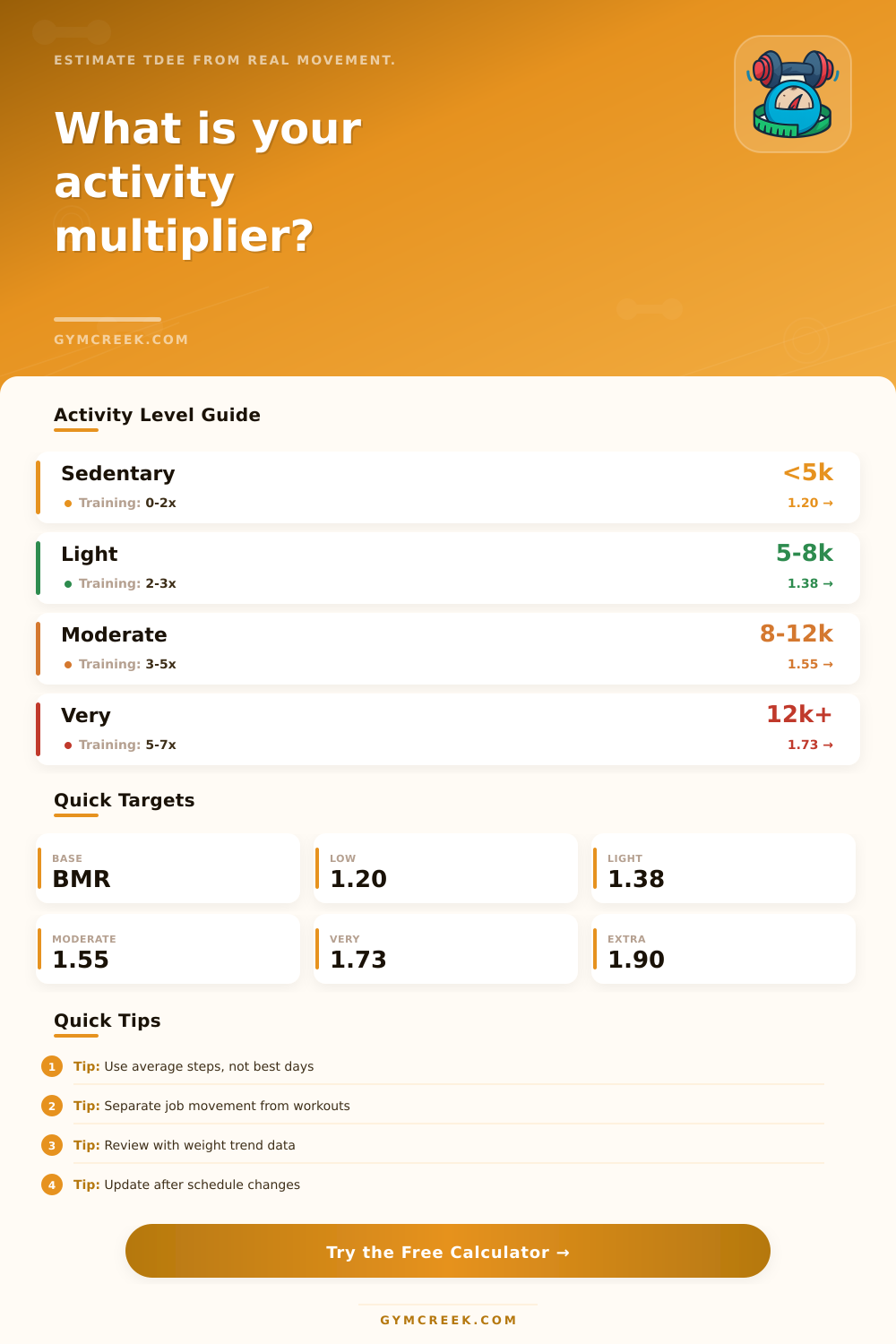
| Sedentary | 1.20 | Desk job, low steps, little training | Weekend sport is not counted |
| Lightly active | 1.35-1.45 | Some steps or 2-3 workouts weekly | Steps vary by several thousand |
| Moderately active | 1.50-1.65 | Regular training plus daily movement | Workouts are short or inconsistent |
| Very active | 1.70-1.85 | High steps, physical job, or frequent sport | Recovery or appetite is changing |
| Extra active | 1.90+ | Hard labor plus high training volume | Only a few days match that load |
| Daily steps | Activity signal | Common multiplier effect | Notes |
|---|---|---|---|
| Under 5,000 | Low daily movement | Keeps factor near sedentary | Training may still raise TDEE |
| 5,000-8,000 | Light activity | Adds a modest bump | Often matches office lifters |
| 8,000-12,000 | Moderate activity | Supports 1.50+ factors | Good baseline for recomp |
| 12,000-16,000 | High movement | Often very active | Check hunger and recovery |
| 16,000+ | Very high movement | May exceed 1.80 | Use trend data to confirm |
| Training type | Approx MET | Best input choice | Adjustment note |
|---|---|---|---|
| Easy walking or mobility | 2.5-3.5 | Steps or easy cardio | Avoid double counting walks |
| Strength training | 4.0-6.0 | Resistance fields | Rest periods lower average MET |
| Moderate cardio | 5.0-7.0 | Moderate intensity | Good for steady rides or jogs |
| Hard intervals or sport | 8.0-10.0 | Sport intensity field | Cap if sessions are very stop-start |
| Race effort endurance | 10.0+ | Race effort cardio | Use only for true hard sessions |
| Formula piece | Inputs | Used for | Why it matters |
|---|---|---|---|
| Mifflin-St Jeor | Age, sex, height, weight | BMR baseline | Standard calorie estimate |
| Katch-McArdle | Lean mass from body fat | BMR alternate | Useful when body fat is known |
| MET equation | MET, kg, minutes | Workout calories | Scales exercise to body size |
| Step energy | Steps and body mass | Daily movement | Personalizes walking cost |
| TDEE factor | TDEE divided by BMR | Multiplier | Converts movement into a factor |
◇Tips
Instead, the activity multiplier has become a personality quiz, most people select whichever label from a list looks cool, slap it onto their basal metabolic rate, then cross there fingers for the best outcome. But all these common buckets are crude tools in a finely tuned spectrum of moving around every day: Someone who works out three days a week by lifting weights while taking 5,000 steps burns significantly more energy than a person who sit behind a desk all day without exercising, but might both get labeled lightly active on some generic chart.
Which is why we break things down. Once you determine what sort of movement profile fits your schedule, you don’t have to guess at the vague categories we described. The calculator do all the math for you (the one above).
How The Calculator Works
Starting with the obvious: Your resting engine size determines how much fuel you require before standing up. That’s based off a base metabolism estimate fed by age, sex, height and weight. If you know your body fat percent, the calculator will use a lean-mass based formula, which is a little more precise; but most folks simply don’t have this information handy. It’s a small tweak but could of help if you’re squeezing into very narrow margins.
After that comes the actual meat of it: distinguishing between intentional exercise and occupational movement. Sure, your job might require standing on your feet all day, but does that mean a nurse who spends a dozen hours per shift on her feet burns more calories then a warehouse worker who’s constantly lifting heavy boxes? To account for this, the tool separately requests how much movement is required at your job (so you don’t accidently include your commute to work as high-intensity exercise time).
And finally, you tack on your average number of steps, since non-exercise activity thermogenesis tends to contribute far more than an hour at the gym. You are hovering around eight thousand steps. That adds a consistent background burn that maintains your overall energy use above what a strictly sedentary model suggests.
Intensity also ranges widely. A half-hour of slow running isn’t going to have the same metabolism impact as a half-hour doing hard intervals on treadmill. To do that, the calculator uses metabolic equivalent. That means a larger person will burn more calories moving around than someone smaller. The calculator factors that into the equation and reflects it in the final tally.
Log resistance training separately from sports and cardio, which lets you get a better picture of your whole week. A lot of folks over-estimate here, thinking they’re getting credit for resting between sets. If you want an accurate picture, enter only the minutes you were actualy working, otherwise, how can the result be anything but what you put in?
After all those parts get collected together, the tool spits out your unique multiplier. That’s your personal answer for how many times faster your body burns through energy compared to your resting metabolism. A value of 1.55 indicates that your current lifestyle costs about fifty-five percent more then just staying alive in bed.
To understand how that lines up with the normal range, there’s a chart on the page that gives you an idea where you land based off common activities. Then you can take that value and see if it matches up with how much you’ve been gaining or losing weight during the past several weeks. If you want to lose weight but scale isn’t moving, make sure to match your food input to that value instead of changing the multiplier.
Remember: consistency wins over perfection when determining your metabolic rate. Now we get to interpret it: How does that number apply to your goals? That’s the starting point for calculating daily calories if you want to cut fat, gain muscle, or simply maintain. Because this isn’t an eternal edict (jobs change), life happens, training load shifts, come back to the inputs once you settle in to a new routine. You don’t need to find the magic number; you’re after a reasonable starting point that can support sustainable habits.
Don’t guess from labels. Measure by how things move.