Activity Level Calculator
Estimate your activity multiplier from body size, job movement, daily steps, weekly training, sitting time, and recovery context.
📌Activity Presets
Presets load realistic weekly movement patterns. Edit any field to match your normal two-week average.
⚙Calculator Inputs
Activity level snapshot
Enter your normal movement and training week to estimate an activity multiplier.
📊Activity Metrics
📘Reference Tables
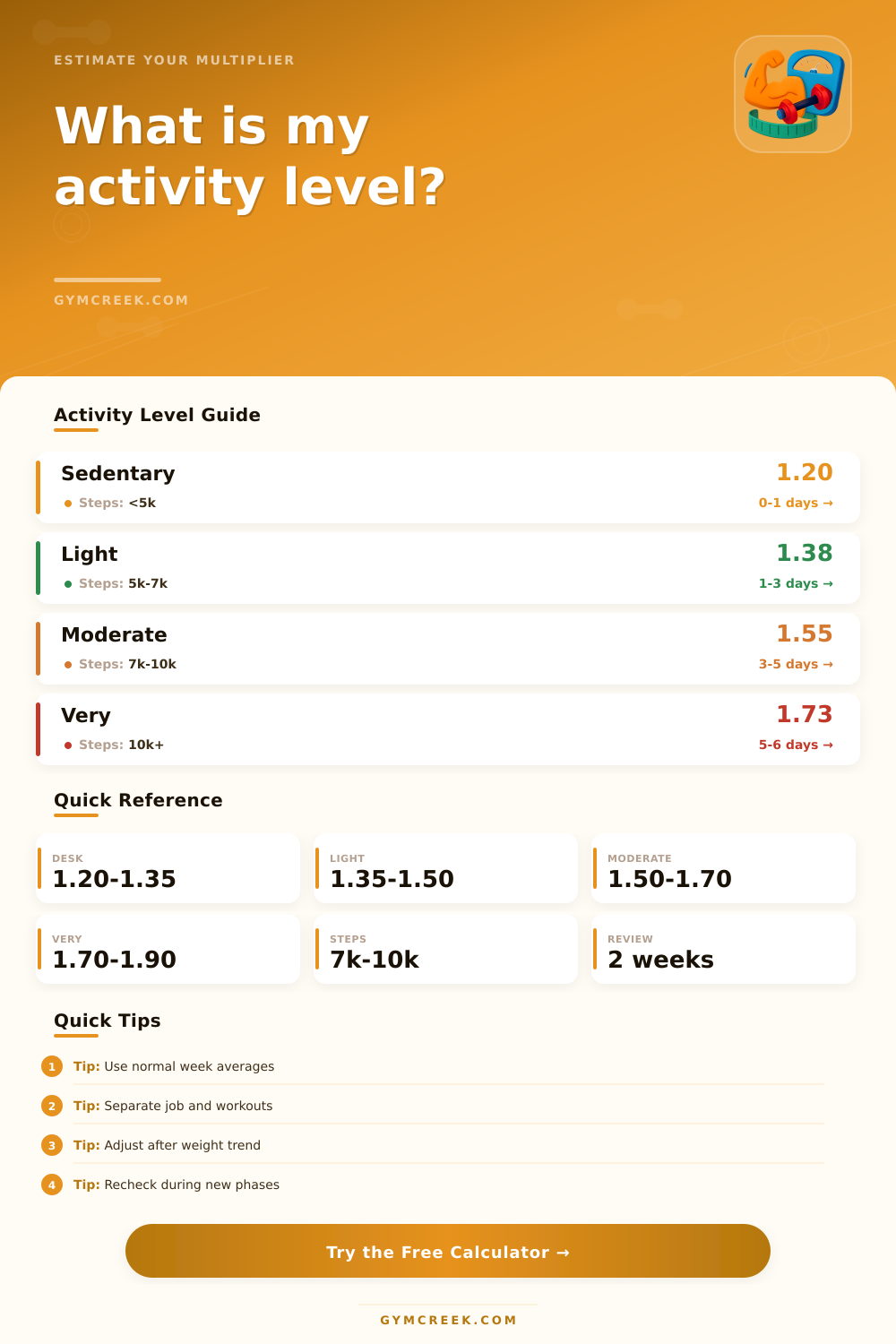
| Level | Multiplier | Typical steps | Typical training |
|---|---|---|---|
| Sedentary | 1.20 to 1.35 | Under 5,000 per day | Little planned exercise |
| Lightly active | 1.35 to 1.50 | 5,000 to 7,500 per day | 1 to 3 easy sessions weekly |
| Moderately active | 1.50 to 1.70 | 7,500 to 10,000 per day | 3 to 5 mixed sessions weekly |
| Very active | 1.70 to 1.90 | 10,000 to 14,000 per day | 5 to 6 solid sessions weekly |
| Extra active | 1.90 to 2.20 | 14,000 plus per day | Daily training or physical job |
| Daily steps | Movement signal | Factor add | Planning note |
|---|---|---|---|
| Under 4,000 | Low daily movement | 0.00 to 0.03 | Do not overstate activity from workouts alone |
| 4,000 to 7,000 | Light movement | 0.04 to 0.12 | Matches many desk-plus-walk weeks |
| 7,000 to 10,000 | Moderate movement | 0.13 to 0.22 | Often supports moderate activity labels |
| 10,000 to 14,000 | High movement | 0.23 to 0.32 | Review recovery and food trend |
| 14,000 plus | Very high movement | 0.33 to 0.42 | Common with active jobs or athletes |
| Input | MET estimate | Examples | Use when |
|---|---|---|---|
| Easy cardio | 4 MET | Easy bike, incline walk | You can talk comfortably |
| Moderate cardio | 6 MET | Steady jog, class | Breathing is controlled but elevated |
| Hard cardio | 8 MET | Tempo run, hard intervals | Only short phrases feel easy |
| Moderate lifting | 5 MET | Normal gym session | Rest periods are present |
| Dense circuit | 8 MET | Weighted circuit | Minimal rest and high heart rate |
| Component | Formula idea | What it changes | Limit |
|---|---|---|---|
| BMR | Mifflin-St Jeor | Resting calorie base | Needs accurate body size |
| Steps | Scaled NEAT add | Daily movement factor | Step length varies |
| Exercise | MET x kg x hours | Average daily burn | Intensity is approximate |
| Job movement | Role-based add | Non-exercise activity | Workdays vary |
| Recovery | Small modifier | Conservative estimate | Not a diagnosis |
💡Tips
Let’s say you grab a granola bar. You read the label and it says four hundred calories. Is that too much? Is that enough? That’s where another variable in all of this sneaks up: how much do you move around during the day?
It’s actualy a hidden variable in every nutrition plan, which is where confusion come from. Being active sounds easy enough, sedentary or active, and yet real life doesn’t fit in tidy boxes. We tend to overestimate how much we move around every day by roughly fifteen percent (hence why you eat careful but remain the same weight).
Why Daily Movement Matters More Than Just Exercise
By inputting what works for you specifically, calculator does the math. No need to guess at coefficients and try converting things, that will only lead to frustration. But activity isn’t something you can toggle on like a light switch. It’s a collection of different factor, many of which conflict with one another. Sure, you may do structured exercise four days per week, so you think you’re being active, but then you sit in a chair for ten hours a day. That’s paradoxical: you burned some calories lifting weight, but your lack of movement throughout the rest of the day means you used fewer calorie overall than expected.
The tool breaks out “deliberate” training (like workouts) and “non-exercise activity thermogenesis,” or NEAT (the calories you burn through normal activities). What matters isn’t just when you hit the gym; it’s how much you move around during the day, plus all those fidget. Most estimates don’t distinguish between two.
First think about how many step you take each day. Seven-thousand steps per day may seem low compared to someone who runs ten miles every day, but over a whole week, this really starts to add up. Take a peek at the reference table on the page which shows the effect of steps towards your multiplier. For example: if you take an average of six-thousand steps per day but exercise two times a week, then you’re probably more in the lightly active category and not moderate.
A lot of people see high-impact gym days and forget about their low-activity time spent outside of the gym. Consider it across the entire week. Then the calculator will average those numbers out into a multiplier that represents what your actual starting point is, not just what your peak performance day look like.
Surprisingly enough, your occupation also factors into this equation. Even with identical exercise regimens, a teacher who spends their day standing will burn more calories from background activity (also known as “NEAT”) than one who codes away at a computer all day long. Occupational NEAT. The tool accounts for this hidden burn when you plug in your job title. That way, when you forget about the movement you perform during a typical office day, including that daily commute. You won’t accidentally under-eat for the day. You don’t need to count steps throughout your working hours; just knowing they happen changes the final number.
Most calculators don’t account for recovery, either. When you’re stressed out or sleeping poorly, your body doesn’t operate as efficienty. That’s why there’s a recovery modifier in the tool: it makes sure whatever calorie target it provides is something your body can safely sustain given its present physical condition. You’ll never get better results by pushing a higher activity multiplier while running on four hours of sleep… You just end up burned out. Better to be slightly conservative than chronically overtrained.
Your ideal activity level isn’t really about reaching a certain number; it’s about getting familiar with where you spend your energy. It’s about stepping back from the notifications on your workout apps and taking inventory of what your day look like. From here, tweaking your food will be easier. You’ll stop guessing at what to do, and you’ll begin noticing patterns. You won’t aim for perfection, after all, this is a baseline. But you’ll get closer to real life, and you can adjust it to match. Use this number as a starting point, then pay attention to your body’s response, making tweaks as necessary. This makes things clear.