Active Metabolic Rate Calculator
Estimate active metabolic rate from BMR or RMR, activity multiplier, daily steps, NEAT, workout frequency, exercise minutes, and your current goal.
📌Active Metabolism Presets
Each preset loads a realistic body profile, formula method, steps, workout load, activity factor, and goal so you can compare scenarios quickly.
⚙Calculator Inputs
Active metabolic rate snapshot
Enter your stats, movement, workouts, and goal to estimate active burn.
📊Metrics Grid
📑Reference Tables
| Method | Inputs | Best use | Output |
|---|---|---|---|
| Mifflin-St Jeor | Age, sex, size | Most adults | BMR |
| Revised Harris | Age, sex, size | Legacy compare | BMR |
| Katch-McArdle | Lean body mass | Known body fat | RMR |
| Manual measured | Lab or device | Known RMR | RMR |
| Multiplier | Steps | Training | Typical context |
|---|---|---|---|
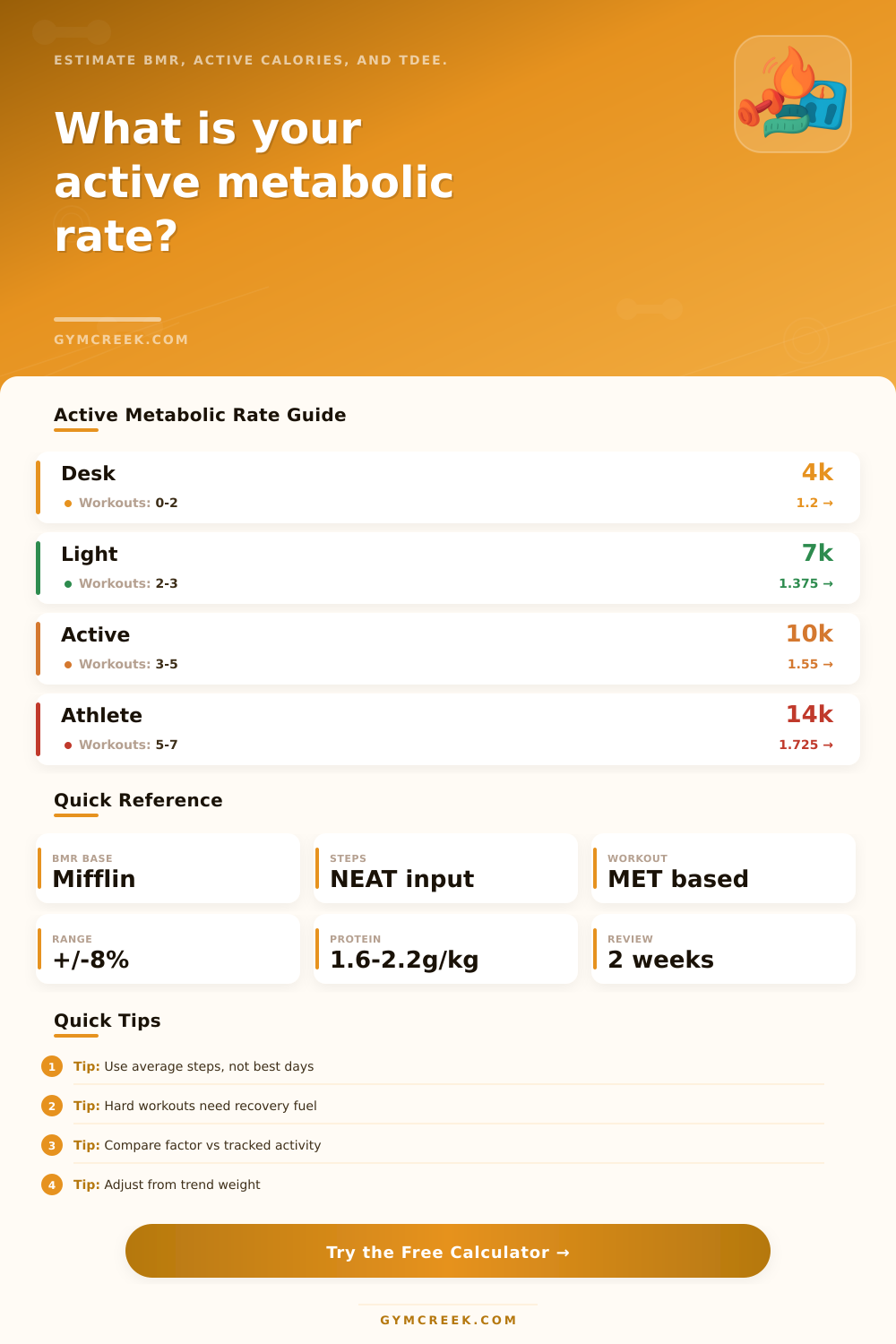
| 1.20 | Under 5k | 0-2 light | Desk or low NEAT |
| 1.375 | 5k-8k | 2-3 weekly | Lightly active |
| 1.55 | 8k-12k | 3-5 weekly | Moderate routine |
| 1.725 | 12k-16k | 5-6 weekly | Very active |
| 1.90 | 16k+ | Hard daily | Labor or athlete |
| Goal | Calorie cue | Protein | Carb cue |
|---|---|---|---|
| Fat loss | -20% | High | Train support |
| Slow cut | -10% | High | Moderate |
| Maintenance | 0% | Moderate | Stable |
| Recomp | -5% | High | Lift days |
| Lean gain | +8% | Moderate | Higher |
| Performance | +5% | Moderate | Priority |
| Intensity | MET | Examples | Use when |
|---|---|---|---|
| Easy | 3.5 | Mobility, easy bike | Recovery work |
| Moderate | 5.0 | Lifting, cycling | Steady sessions |
| Hard | 6.5 | Intervals, hard lift | High effort |
| Sport pace | 8.0 | Run, class, sport | Sweaty sessions |
| Very hard | 10.0 | Racing, long hard | Demanding work |
💡Tips
While many believe that the type of exercise an individual performs is the determining factor in their calorie needs, the factors that actualy determines the calories that an individual needs are a combination of several factor. The active metabolic rate of an individual is a measurement of the calories that the individual burns when they are at rest and when they are performing various movements. These movements can include both the workouts that an individual performs as well as the movement that they perform in the remainder of there day, such as walking around the house.
It is important for an individual to understand their active metabolic rate, because this rate will determine whether an individual’s eating and training routine will help them to reach there goal, or if those eating and training routines will prevent them from reach there goal. Within these parameter, two individual who appear to be alike in many ways may have different calorie needs. For instance, one individual may sit at there desk for the majority of their day, whereas another individual walks regular during their day.
How to Find Your Daily Calorie Needs
Thus, even if they performs the same workouts, the individual who walks more during the day will burn more calorie than the individual who sits more during the day. These movement habits can be accounted for in a calculator that estimate an individual’s calorie needs. The formulas for calculating an individual’s resting calories use different assumptions in their calculations, leading to the different result of each formula.
For instance, many consider the Mifflin-St Jeor formula to be effective for the majority of adults, as that formula was developed using a broad set of moddern data from various population. Additionally, the Katch-McArdle formula calculate the calories based off the lean mass of the individual’s body, which the individual can determine through the individual’s body fat percentage. Because these two method use different assumptions for the same calculation, it is expected that the results of each method will differ by some number of hundred calories.
Furthermore, if the individual uses either of these calculator to calculate resting calories, the individual may use an average formula for those calculation. Activity multiplier are often used to calculate the calories that an individual must burn throughout the day. However, activity multipliers are often imprecise; they make assumption about the individual’s activities throughout the day.
For example, an individual who has a desk job may have few step during the day, but may walk regular to perform other activities or to get to work. The activity multiplier and the calculation of the calories from explicit workouts will have different results for the same individual; the actual calories that the individual burns will be somewhere in between those two calculated value. In addition to the calories burned from performing workouts, other factors that impact the total calories that burn by an individual during a day include the intensity of the workout and the length of the workout.
For instance, a lifting routine may have a lower calorie burn per minute than a high intensity workout, but both contribute to the total calorie burn for the individual during a week. The calorie calculator for workouts calculates the calories burned based upon the MET level of the workout, and then average those calories over the week. The average number of calories that are burned during the week is the most important number for the individual relative to the number of calories that are burned during a single workout.
The target of protein that should be included in an individual’s diet may change based upon the goal that the individual has for there body and there physical performance. For instance, if the individual is attempting to lose body fat, the body require more protein to retain muscle than if the individual is gaining lean body mass or maintaining their current body composition. Thus, protein target should range between 1.6 and 2.2 grams of protein per kilogram of body weight.
Higher amounts of protein are beneficial for fat loss, while the average amount is required for maintenance or lean gain. The suggestion of protein will be correlated with the individual’s selected goal for there body. Overall, the most important way to use the calculation of the calories that an individual burns each day is to compare that calculation to the results of the individual’s body.
For example, if the individual’s weight drops at a faster rate then that which is calculated for the individual, they may need to increase the calories that they consume. However, if the individual’s weight remains the same when attempting to gain lean body mass, the calorie estimate may be too low for that individual. Thus, while the calculator will indicate how many calorie an individual should consume, it is up to the individual and their body to provide feedback as to whether or not the calorie target that the calculator calculated is accurate.
You should of listened to the data.