NEAT Calculator
Estimate non-exercise activity thermogenesis by combining your step total, average step length, standing hours, walking minutes, job demands, and off-hours movement so ordinary days stop using flat calorie guesses.
📌Preset Movement Days
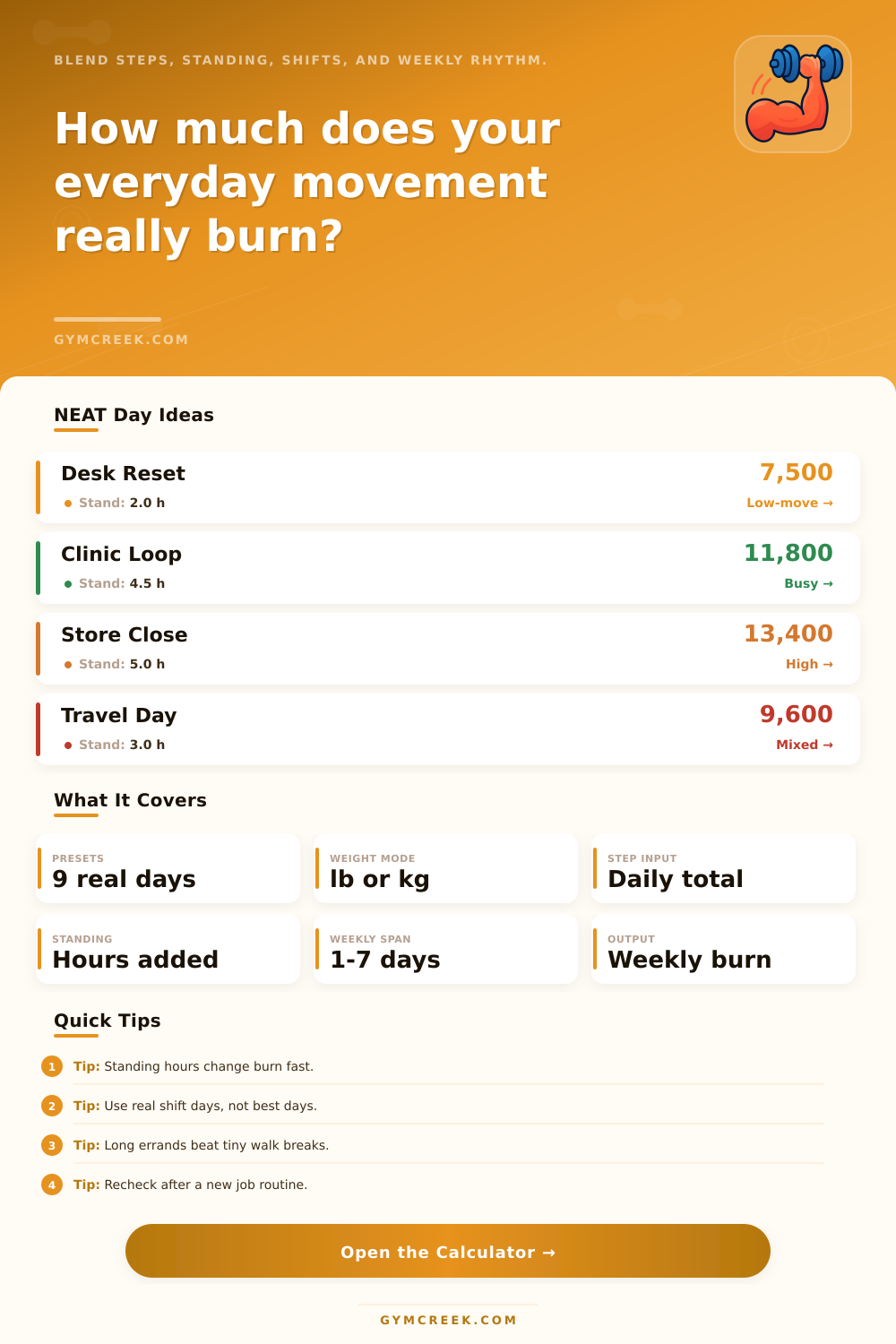
Each preset represents a believable real-world day so you can compare desk-heavy routines, travel, floor shifts, coaching, and warehouse movement without rebuilding the assumptions every time.
⚙NEAT Inputs
Current day NEAT snapshot
Adjust steps, standing hours, movement style, and weekly repetition to see how non-exercise activity adds up beyond workouts.
📊Movement Metrics
📑Reference Tables
| Days | Weekly kcal | Monthly | Read |
|---|---|---|---|
| 3 | 0 | 0 | Light week |
| 5 | 0 | 0 | Work week |
| 6 | 0 | 0 | Busy week |
| 7 | 0 | 0 | Daily pace |
| Steps | Miles | Daily kcal | Read |
|---|---|---|---|
| 6,000 | 0 | 0 | Baseline |
| 9,000 | 0 | 0 | Average |
| 12,000 | 0 | 0 | Active |
| 15,000 | 0 | 0 | High |
| Job type | Factor | Stand lift | Best fit |
|---|---|---|---|
| Desk anchor | 0.92x | 0.88x | Computer-heavy days |
| Front counter | 1.02x | 1.00x | Retail or reception |
| Classroom rover | 1.08x | 1.05x | Teaching and coaching |
| Clinic rounds | 1.15x | 1.12x | Frequent hall movement |
| Warehouse loop | 1.24x | 1.18x | Constant floor travel |
| Pace | MET | MPH | Typical use |
|---|---|---|---|
| Easy | 2.8 | 2.6 | Casual loops |
| Commute | 3.5 | 3.1 | Purposeful walking |
| Brisk | 4.3 | 3.6 | Errands and rounds |
| Hustle | 5.0 | 4.1 | Fast floor movement |
💡Field Tips
NEAT changes most when your normal week changes, so a realistic shift mix or family routine will beat a heroic once-a-month step total every time.
Two people can log the same steps but land very different daily movement burn if one stands longer, carries gear, and keeps moving between short tasks.
Non-exercise activity thermogenesis (NEAT) is the number of calories that a person burn through the movements that they make throughout their day that are not relate to there exercise routine. While fitness applications may use categories like “sedentary” or “lightly active” to calculate the calories that a person burns, those category are often inaccurate due to not accounting for the different movement of each individual throughout the day. For instance, two individuals may each take 10,000 steps throughout the day, but one may be a warehouse worker that is constantly lift and moving heavy tools, while the other may be a desk job who only walks to carry there laptop to different part of the office.
In these cases, the individual who must move their extra weight will burn more calories than that of the desk job. Thus, NEAT is an important consideration in the total number of calories that an individual burn each day due to there daily routine. Unlike the calories that are burned during exercise or cardio routine, NEAT refer to the calories burned during non-exercised movements of the body, such as fidgeting, pacing, standing, or walking to the job.
What NEAT Is and How It Affects Your Daily Calories
Researchers have found that NEAT can change an individual’s total daily calories by 300 to 800 calories per day. Considering that 300 calories can be burned through NEAT alone, it is possible for an individual to lose weight or maintain their weight without changing there diet or exercise routine. For instance, a teacher may walk more throughout the day than an individual who remain in one seated position for many hours.
There are various factor that influence the amount of NEAT that an individual can produce throughout the day. For instance, the standing of an individual can impact there NEAT; standing require more muscle engagement than remaining seated. Thus, individuals that stand for two extra hours will exhibit increased NEAT in comparison to individuals that remain sitting for long period of time.
Additionally, the factor of how much an individual is carrying can influence there NEAT; the more weight that an individual is required to move throughout the day, the more calorie that they will burn. Furthermore, step counts are not an accurate measure of NEAT due to the fact that step counts do not factor in standing or the weight of the load that an individual is carrying. Additionally, the pace at which an individual walks can influence the calories that they burn; the faster that an individual walks, the more calorie will be burned compared to slow walking.
In order to understand the true level of NEAT that an individual produces, there are various factor that must be considered. For instance, individuals that stand more throughout the day (such as nurses that walk the halls of a hospital) will have different NEAT level than those who sit the majority of there days (such as computer programmers). Additionally, an individual’s off hours can impact there NEAT level; individuals who walk their dog or complete other chores will exhibit higher NEAT levels than those who do not perform these task.
Additionally, an individual whose body frame allow them to weigh more will exhibit different NEAT levels than those with a lighter body frame, indicating that different load of movement will require more energy to be expended. Each of these factor, when considered together, will give an accurate understanding of an individual’s NEAT level. Many individual make mistakes when calculating there NEAT levels due to focusing only on their step.
For instance, an individual may reach there goal of 12,000 steps, but if they are sitting for the remainder of the day, there NEAT will be low. Additionally, an individual may only consider there days with high NEAT levels and ignore those days when they were sitting for long period. Instead, individuals should focus on finding there real NEAT level.
For instance, individuals that have a backpack will have higher NEAT level than those that do not carry any load. These small movement are the basis of an individual’s NEAT level throughout the day. There are various way to measure and analyze an individual’s NEAT.
For instance, calculating the total number of steps that an individual walks each day will provide an indication of the number of calories burned during walking. Additionally, measuring the NEAT level each week will indicate the power of performing the same amount of movement each day for a few day in comparison to a few days of performing one intense exercise routine. Additionally, measuring the active hour of an individual will provide the total number of hours that an individual is up and moving during the day.
Finally, providing a breakdown of an individual’s NEAT will allow for the individual to understand whether there NEAT come from walking or standing. An individual can increase there NEAT by making a few small change to there life. For instance, using the stairs instead of the elevator, walking to another destination instead of taking a car to the same destination will all lead to increased NEAT level.
Additionally, using a standing desk will increase an individual’s NEAT due to the fact that they will not be sitting for long period of time. Even if an individual who is physically fit requires less energy to perform the same movement as an individual that is not physically fit, there are still many change that an individual can make to there environment and life to increase there NEAT. Thus, an individual’s NEAT is correlated to the life that they live.
Through understanding there NEAT, an individual can better understand the impact that NEAT have upon there total daily calorie expenditure.