Cutting Calculator
Set a realistic calorie deficit, protect lean mass, and map your path to a cleaner cut with practical bodybuilding-style planning.
Cut Plan Snapshot
Calories, pace, macros, and target weight are estimated from your current size, activity, and lean mass assumptions.
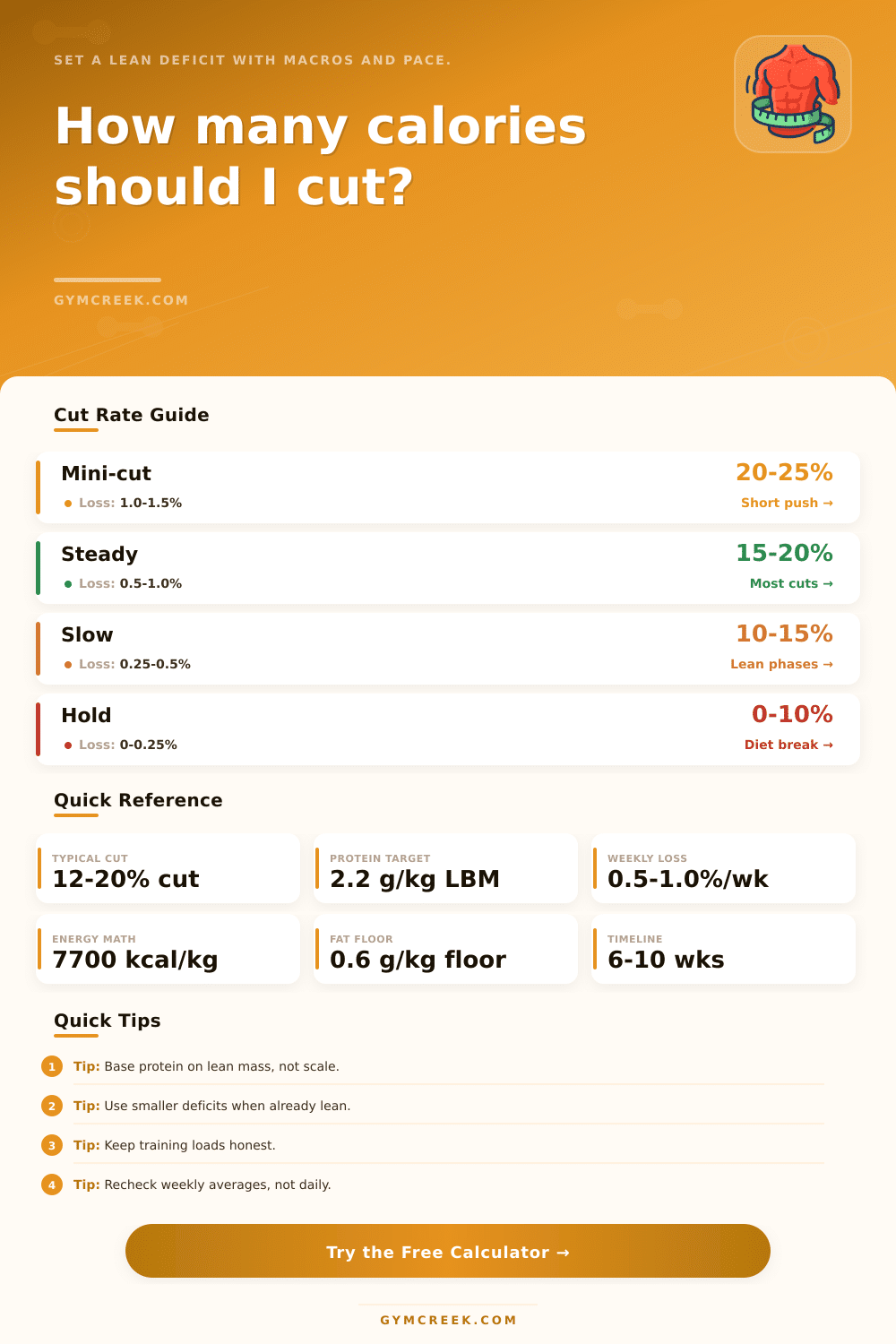
| Phase | Deficit | Weekly loss | Best for |
|---|---|---|---|
| Mini-cut | 20-25% | 1.0-1.5% | Short push, fast trim, strict recovery focus |
| Steady cut | 15-20% | 0.5-1.0% | Most physiques, balanced performance, muscle retention |
| Slow cut | 10-15% | 0.25-0.5% | Already lean lifters, longer dieting windows, higher training load |
| Diet break | 0-10% | 0-0.25% | Recovery, adherence reset, maintenance rehearsal |
| Activity level | Multiplier | Typical pattern | Cut note |
|---|---|---|---|
| Sedentary | 1.20 | Desk job, low steps | Use conservative cuts first |
| Lightly active | 1.375 | Some walking, 2-3 lifts | Standard deficit works well |
| Moderately active | 1.55 | Most training schedules | Good balance of speed and recovery |
| Very active | 1.725-1.90 | High steps, frequent sessions | Protect carbs around training |
| Situation | Protein | Fat floor | Carb fill |
|---|---|---|---|
| Higher body fat | 2.0 g/kg LBM | 0.6 g/kg LBM | Fill the rest |
| Mid-lean cut | 2.2 g/kg LBM | 0.7 g/kg LBM | Prioritize training days |
| Very lean cut | 2.4 g/kg LBM | 0.7-0.8 g/kg | Conserve performance |
| Mini-cut | 2.4 g/kg LBM | 0.7-0.9 g/kg | Keep carbs around lifts |
| Profile | Suggested pace | Protein cue | Notes |
|---|---|---|---|
| Desk worker | 15% | 2.0-2.2 g/kg LBM | Use step count to set realistic maintenance |
| Runner | 10-15% | 2.2 g/kg LBM | Watch recovery and keep carbs higher |
| Strength athlete | 10-20% | 2.2-2.4 g/kg LBM | Use a slower cut near heavy blocks |
| Lean finisher | 10% | 2.4 g/kg LBM | Small deficits preserve fullness better |
| Formula | Inputs | Output | Use |
|---|---|---|---|
| Mifflin-St Jeor | Weight, height, age, sex | BMR estimate | Best when body fat is unknown |
| Katch-McArdle | Lean body mass | BMR estimate | Best when body fat is known |
| Maintenance | BMR x activity | TDEE | Starting point for the cut |
| Target weight | Lean mass + target BF | Goal scale weight | Helps define the finish line |
Cutting is a fat loss phase that bodybuilders and gym-goers use to shed body fat while they try to keep as much muscle as possible. Usual cutting lasts 6 to 12 weeks and commonly helps bodybuilders lower the body fat from around 15-18% to even 4-7% It can be a mental and emotional grind. Many folks too low estimate the amount of body fat they genuinely carry.
The advised weight loss during cutting is 0.5 to 1.5% of the body weight each week. The thinner you are, the bigger risk to lose muscles. During cutting you feel hunger, gym time becomes hard and the strength can stop or sharply drop.
How to Cut Body Fat and Keep Muscle
Even so, if you do it well, it results in weight lso and fat loss, which gives a nicer look.
One way to count calories is multiply the body weight in pounds by 11 to 13 and then eat that many calories daily. Training 3 to 4 days weekly and 7,000 or more steps daily help a lot. You commonly start with a 500 calorie deficit.
If you expand the everyday steps from 8,000-10,000 to 14,000, keeping calories same, it boosts the progress, but too fast diet fatigue sets in and you risk on a long-term basis to lose strength and muscles.
High protein in the diet, together with lot of water and precise calorie intake, is the best strategy for the most people. It is important to keep at least 1 gram of protein for pound of body weight. Up to 1.2 grams is good, but no more.
Changing the everyday calories help against metabolic adaptation, so even during cutting it is a good idea to range the amount each day. Avoid ready foods and fast food. Lower carbs and use low-calorie vegetables make a big change.
Remove grains from the diet for 30 days can tighten the waist.
During cutting the training stress intensity and lifting until failure. Programs like Arnold’s Blueprint to Cut or the 12-week plan of Kris Gethin commonly pop up. A common mistake is to eat freely during bulking and later sharply reduce the food intake for cutting.
That method usually ends with the same size and shape.
Cutting before bulking is widely smarter. Starting the season at a higher body fat percentage only makes the final cutting longer and harder. First lower to a reasonable fat level, then lean bulk and finally cut again, here is the cycle.
A 250 calorie deficit is enough for those who want to keep the output. When the weight loss stops, recalculate and add another 250 calorie deficit to keep progress moving. Cutting must be sustainable over time.
A two-day refeed every week can help keep your sanity without hurting the fatloss much.