⚖️ BMI Calculator Canada
Calculate your Body Mass Index using Health Canada guidelines — metric & imperial units supported
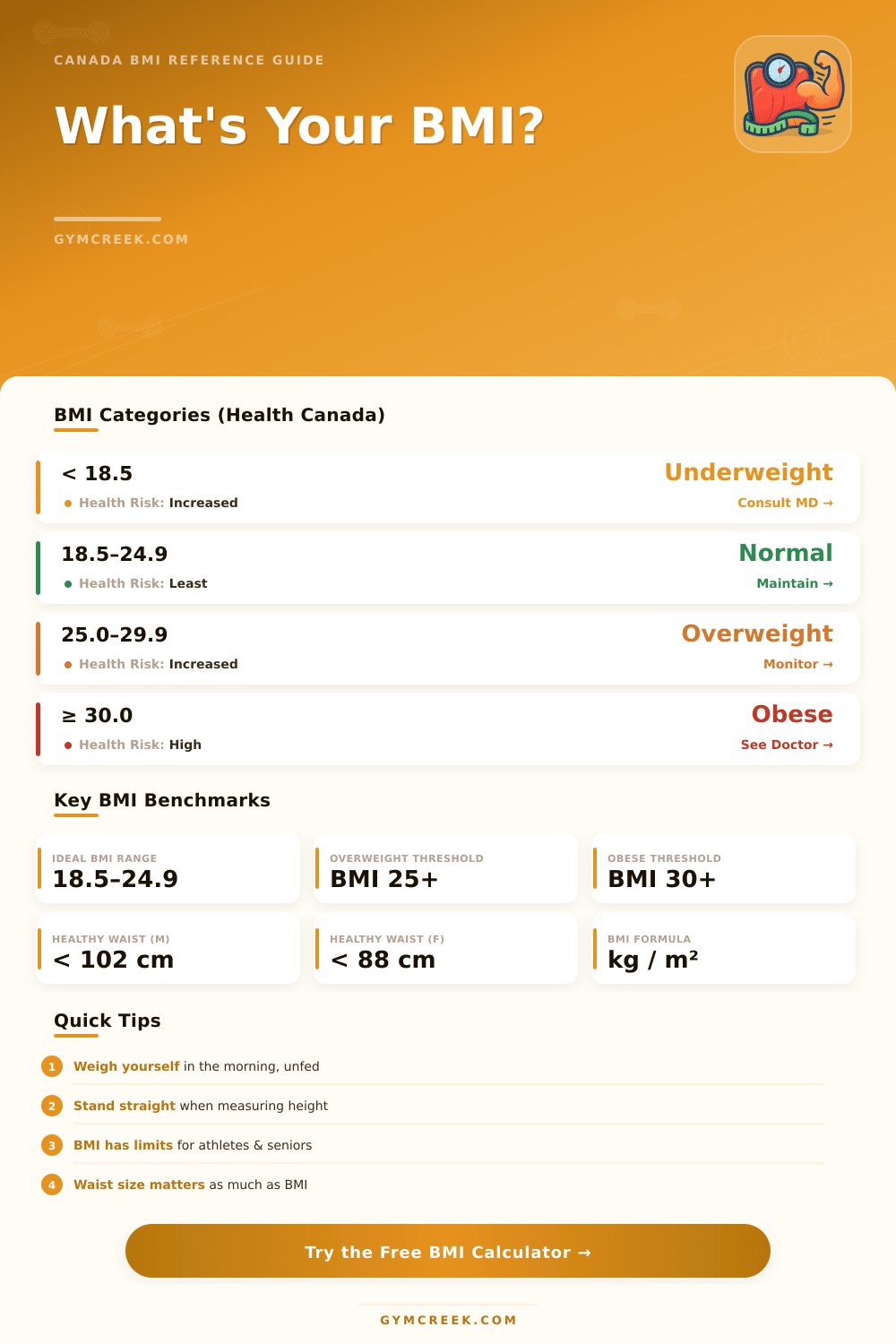
| BMI Range | Category | Health Risk | Action Recommended |
|---|---|---|---|
| < 18.5 | Underweight | Increased (nutritional) | Consult healthcare provider |
| 18.5 – 24.9 | Normal Weight | Least risk | Maintain healthy habits |
| 25.0 – 29.9 | Overweight | Increased risk | Lifestyle modifications |
| 30.0 – 34.9 | Obese Class I | High risk | Medical consultation advised |
| 35.0 – 39.9 | Obese Class II | Very high risk | Medical supervision needed |
| ≥ 40.0 | Obese Class III | Extremely high risk | Urgent medical care |
| Sex | Low Risk | Increased Risk | High Risk |
|---|---|---|---|
| Male | < 94 cm (37") | 94 – 102 cm (37–40") | > 102 cm (40") |
| Female | < 80 cm (31.5") | 80 – 88 cm (31.5–34.6") | > 88 cm (34.6") |
| Population Group | Overweight Threshold | Obese Threshold | Notes |
|---|---|---|---|
| General / Caucasian | 25.0 | 30.0 | Standard Health Canada |
| South Asian / East Asian | 23.0 | 27.5 | WHO Asia-Pacific guideline |
| Indigenous / First Nations | 25.0 | 30.0 | Standard used; consult MD |
| Population | BMI Issue | Better Indicator |
|---|---|---|
| Athletes / Bodybuilders | Overestimates fatness (muscle = weight) | Body fat percentage, DEXA scan |
| Elderly (65+) | Underestimates fat (muscle loss) | Waist circumference, body fat |
| Pregnant Women | Normal BMI gain expected | Gestational weight gain charts |
| Children & Teens | Adult BMI does not apply | BMI-for-age percentile charts |
| South / East Asians | Standard cutoffs underestimate risk | Adjusted thresholds (23 / 27.5) |
| Height (cm) | Height (ft/in) | Min Weight | Max Weight |
|---|---|---|---|
| 155 cm | 5' 1" | 44.4 kg (98 lbs) | 59.9 kg (132 lbs) |
| 160 cm | 5' 3" | 47.4 kg (104 lbs) | 63.8 kg (141 lbs) |
| 165 cm | 5' 5" | 50.4 kg (111 lbs) | 67.8 kg (149 lbs) |
| 170 cm | 5' 7" | 53.5 kg (118 lbs) | 72.0 kg (159 lbs) |
| 175 cm | 5' 9" | 56.7 kg (125 lbs) | 76.3 kg (168 lbs) |
| 180 cm | 5' 11" | 59.9 kg (132 lbs) | 80.7 kg (178 lbs) |
| 185 cm | 6' 1" | 63.3 kg (139 lbs) | 85.2 kg (188 lbs) |
| 190 cm | 6' 3" | 66.8 kg (147 lbs) | 89.9 kg (198 lbs) |
Body Mass Index, or BMI, is a number made from the height and weight of people. It helps check whether a person has a healthy weight. The calculation itself is very simple: you divide the weight in kilos by the square of the height in metres.
This gives you a number that roughly links to the percentage of body fat.
What is Body Mass Index (BMI)?
For adults, the BMI values fall into various groups: underweight, healthy weight, overweight and obesity. Obesity is split into three levels. For most adults, the ideal values sit between 18.5 and 24.9.
Under 18.5 you are considered underweight. For children and young people from 2 to 18 years the calculation also includes age and sex.
The term “Body Mass Index” became known because of an article from 1972 in the Journal of Chronic Diseases. However the formula itself dates almost 200 years before. A Belgian scientist invented it to describe what he called the “ideal average male body”.
So the scale is quite old and a bit subjective.
Body Mass Index works only as a screening tool. It does not measure body fat directly. It also does not consider muscle volume, bone density or the spread of fat in the body.
Here is its main weakness. People with lots of muscles can appear in the overweight group, although their body fat is low. More than 25 percent of male athletes classify themselves as overweight according to Body Mass Index, but less than 4 percent truly have too much body fat.
Most bodybuilders are techincally considered overweight according to the standards of Body Mass Index.
On the other hand, older adults may have normal Body Mass Index, but carry more fat, because they lost muscle over the years. Body Mass Index does not apply during pregnancy and nursing, because body makeup changes a lot in those periods. It can be wrong for around 15 too 20 percent of the population because of differences in body structure and muscle.
Body Mass Index can also differ with ethnic background. For black Americans, it commonly marks folks as overweight too early, when the higher value comes from muscle mass instead of extra fat. The percentage of body fat gives a more reliable sign about general health than Body Mass Index alone.
The ratio of height to waist is another better option. Deep belly fat around the organs most strongly affects brain aging, which touches reasoning, memory and processing speed. That gives extra reasons to gobeyond only the weight and height.
Still, Body Mass Index gives a solid sign about health risks for the whole population. High Body Mass Index relates to bigger risk of death overall. It works as a good starting point, but things like blood pressure, cholesterol levels and other metabolic measures describe a fuller picture of health.
The best way to find your Body Mass Index is during a visit to a doctor.