🏃 Fitness Age & VO2 Max Calculator
Estimate your biological fitness age and aerobic capacity using validated formulas
| Age Group | Poor | Below Avg | Average | Good | Excellent | Superior |
|---|---|---|---|---|---|---|
| Males | ||||||
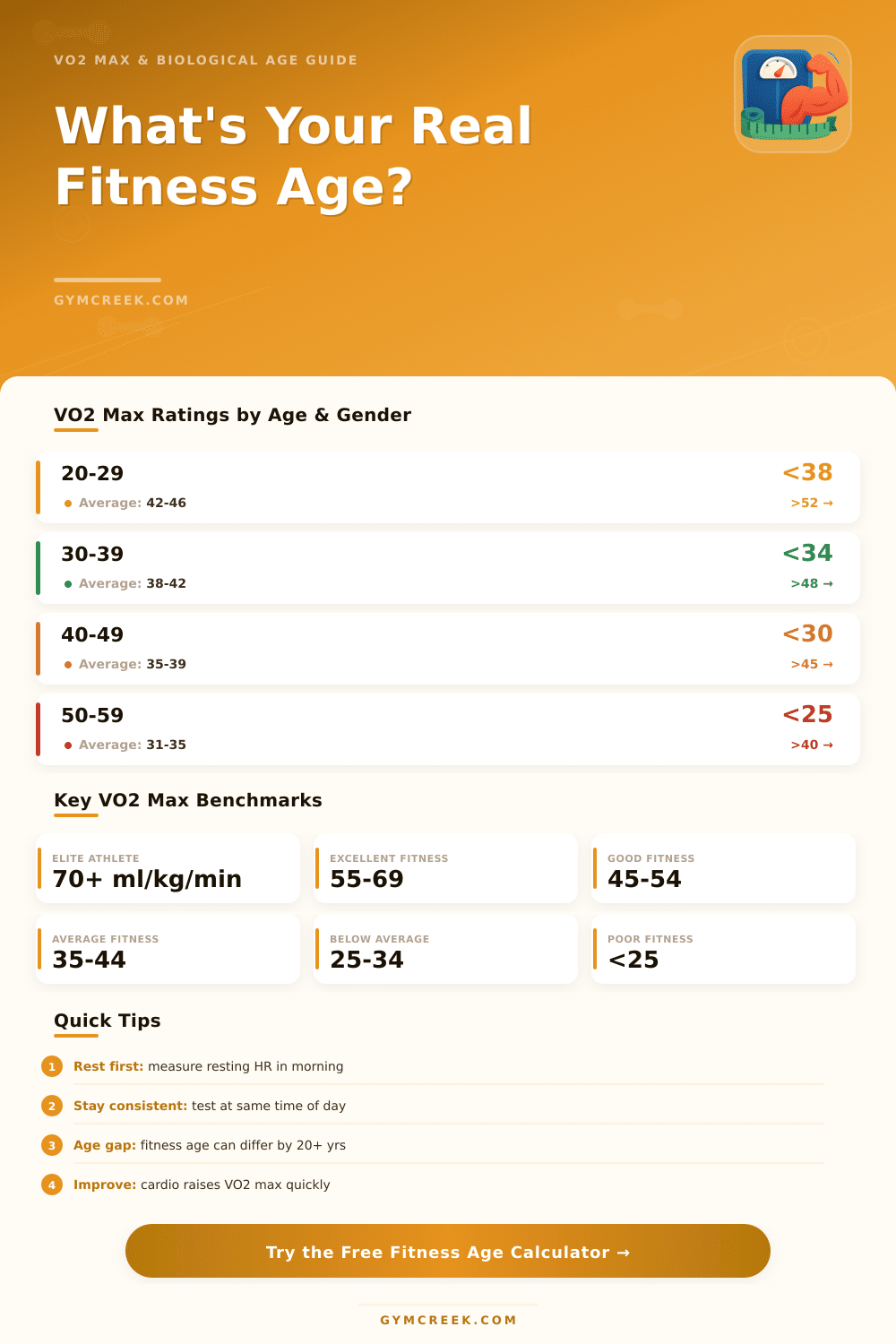
| 20–29 | <38 | 38–41 | 42–46 | 47–51 | 52–60 | >60 |
| 30–39 | <34 | 34–37 | 38–42 | 43–47 | 48–56 | >56 |
| 40–49 | <30 | 30–33 | 34–38 | 39–43 | 44–52 | >52 |
| 50–59 | <25 | 25–28 | 29–33 | 34–38 | 39–46 | >46 |
| 60–69 | <21 | 21–24 | 25–29 | 30–34 | 35–42 | >42 |
| Females | ||||||
| 20–29 | <32 | 32–35 | 36–40 | 41–44 | 45–52 | >52 |
| 30–39 | <28 | 28–31 | 32–35 | 36–40 | 41–48 | >48 |
| 40–49 | <24 | 24–27 | 28–32 | 33–37 | 38–45 | >45 |
| 50–59 | <21 | 21–23 | 24–28 | 29–32 | 33–40 | >40 |
| 60–69 | <17 | 17–20 | 21–24 | 25–29 | 30–36 | >36 |
| Zone | Name | % Max HR | Benefit | Example Activity |
|---|---|---|---|---|
| Zone 1 | Recovery | 50–60% | Active recovery | Easy walking |
| Zone 2 | Fat Burn | 60–70% | Aerobic base, fat oxidation | Brisk walk / easy jog |
| Zone 3 | Aerobic | 70–80% | Cardiovascular endurance | Steady-state running |
| Zone 4 | Threshold | 80–90% | Lactate threshold, speed | Tempo runs, HIIT |
| Zone 5 | VO2 Max | 90–100% | Max aerobic capacity | Sprints, race pace |
| Fitness Level | Resting HR (Male) | Resting HR (Female) | Fitness Age Impact |
|---|---|---|---|
| Athlete | 40–50 bpm | 44–54 bpm | –10 to –15 years |
| Excellent | 51–58 bpm | 55–61 bpm | –5 to –10 years |
| Good | 59–65 bpm | 62–67 bpm | –2 to –5 years |
| Average | 66–72 bpm | 68–75 bpm | 0 (chronological age) |
| Below Average | 73–82 bpm | 76–85 bpm | +2 to +5 years |
| Poor | >82 bpm | >85 bpm | +5 to +15 years |
Beyond the basics of knowing how many miles you can run or how many reps you can do in a single workout, a number that most people would not even think of as a potential health indicator can describe your level of fitness, your VO2 max. Known as “fitness age,” this number represent how old your body seems from a fitness perspective compared to your actual age.
It is surprising to many to discover that their fitness age could possibly be quite different from their chronological age. For example, a 45-year-old might have the cardiovascular system of a healthy 30-year-old, yet someone who appears to be active might actualy have the fitness of someone who is ten year older than themselves.
Fitness Age Calculator VO2 Max
What is VO2 Max?
VO2 max represent the maximum amount of oxygen that your body can utilize during intense exercise. The higher the number, the more better your cardiovascular system is. Additionally, researchers have proven that those with higher VO2 max levels live longer and enjoy better lives after the middle of their life years. Yet, one can improve VO2 max by as much as 15% with the implementation of proper training routines into one’s lifestyle. Additionally, VO2 max decline with age by 1% per year after the age of 30. Yet, the retention or even improvement of VO2 max can decline with exercise, the reason that two individuals of the same age can have dramatic different fitness ages.
The strength of the correlation between VO2 max and fitness age allows individuals to more easily understand their fitness status with respect to their age. For example, if one has a lower fitness age, it suggests that their cardiovascular system is performing as a younger individual’s would perform. In contrast, a higher fitness age suggests that the individual’s body is performing more effort than those of individuals of the same age would need to perform.
Individuals who wish to more precise determine their VO2 max or fitness age can also consider their resting heart rate. For instance, athletes and individuals who are fit have resting heart rates as low as the low 40s, while individuals who sit most of the day have resting heart rates that top at 70 beats per minute or higher. These factors work in conjunction with age and gender to provide a more precise calculation of an individual’s VO2 max and there fitness age.
The fitness age calculator included above allows individuals to determine their fitness age from a variety of different factors. As such, individuals may be surprised to discover, for example, that increasing an individual’s level of activity and lowering their resting heart rate can lead to a younger fitness age. Furthermore, individuals who wish to improve their fitness can use these results as a means of providing guidance to their training regimen. Those who discover that their fitness ages suggest a need for improvements in their current physical abilities can take a variety of approaches to their fitness. For instance, individuals who are just beginning their fitness journeys may find the best initial start to their fitness program is with increasing their aerobic fitness level. Yet, individuals who are already active may benefit from incorporate intervals of high intensity into their programs to improve there VO2 max.
When an individual understands the strength and function of their VO2 max, it becomes possible to begin to manage their training programs around that number. For instance, individuals can utilize heart rate training zones to increase the effectiveness of their training. Zones as low as Zone 2 are beneficial for increasing fat burning and mitochondrial density. Zones 4 and 5 provide the best improvements to an individual’s VO2 max, though require more recovery periods.
Many individuals focus exclusively on strength and high intensity training programs for their bodies. While these types of training programs are beneficial, focusing exclusively upon these types of programs will lead to poor improvements in fitness ages. A program that focuses upon all types of training, with the majority of the bodys time spent in Zones 1 and 2, along with a few periods of high intensity into the Zone 5 range, will yield the best results in creating improvements in fitness ages that can be maintained over time.
An individual’s nutrition, sleep, and stress levels play the greatest influence on their VO2 max levels and fitness ages. Insufficient sleep or high levels of stress will have the same negative effect upon their VO2 max levels as poor nutrition. Proper nutrition and rest will lead to the best improvement of fitness ages and VO2 max levels with the same amount of training effort from the individual.
Individuals who wish to truly understand the effectiveness of their training programs should assess their fitness ages over a period of several months instead of a few weeks. For instance, VO2 max and fitness ages typically improve with the dedication of training programs after the period of 8 to 12 week, and typically after 6 to 12 months with time. By periodically retesting these ages, an individual can adjust their training programs to ensure the best possible improvements in their fitness ages and VO2 max levels. Furthermore, improving an individual’s VO2 max by just 5 ml/kg/min can significantly reduce their mortality risks. Thus, even these efforts will have a significant impact upon health, and are within the reach of almost all individuals to begin to achieve.
While the best method of determining an individual’s VO2 max levels is through laboratory tests, estimates based off resting heart rates, ages, gender, and activity levels provide remarkably accurate estimations of each individual’s VO2 max levels. Furthermore, these estimates are correlated with the results of lab tests of VO2 max levels. Thus, while not the most accurate means of measuring VO2 max levels, these estimates are among the best means of providing each individual with an understanding of their levels of fitness and the amount of improvement that they could potentially experience through the implementation of even the most basic training programs to improve those levels.
By focusing upon lowering an individual’s fitness age, they can experience a positive reinforcement of their fitness. For instance, an increase in fitness leads to increased energy, decreased recovery times, and increased enjoyment in physical activities. Thus, individuals can increase their focus upon increased physical activity and continued improvements in their fitness. Furthermore, the use of fitness ages as a goal for individuals can lead to the development of a program that is realistic in their potential to attain these goals, yet still allows for the body to experience dramatically increased improvements over time with commitment to such programs.
Yet, fitness age is just one of many factor that relates to the strength and health of an individual’s body. Factors like body mass, strength, mobility, mental health, and medical checks are just as important to an individual’s health. Yet, VO2 max and fitness age is one of the best indicators of an individual’s health, especially regarding cardiovascular strength and overall fitness.
Improving VO2 max and fitness ages is one of the best forms of investment that individuals can make in their health. Whether returning to fitness for the first time or attempting to increase the benefits of an existing fitness program, improving one’s fitness ages is one of the most effective means of enabling individuals to feel younger and perform better in their bodies at any age.