🌡️ Heat Adjusted Running Pace Calculator
Find your safe, effort-matched running pace for hot & humid conditions
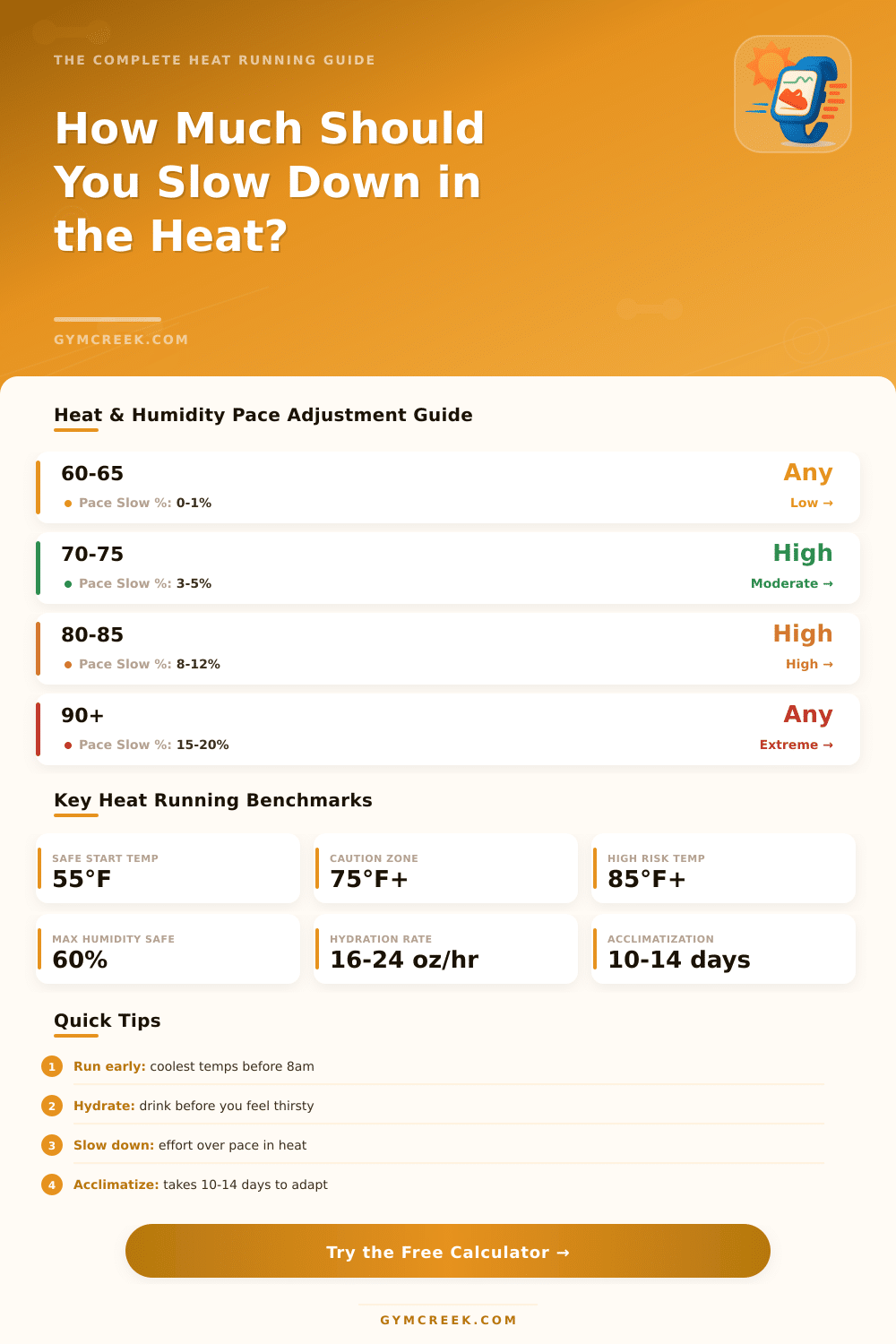
| Temp (°F / °C) | Humidity | Slow Pace By | Risk Level | Recommendation |
|---|---|---|---|---|
| Below 60°F / 15°C | Any | 0% | Low | Ideal running conditions |
| 60–65°F / 15–18°C | Any | 0–1% | Low | Comfortable; light adjustment |
| 65–70°F / 18–21°C | <60% | 1–2% | Low | Slight warmth; hydrate well |
| 70–75°F / 21–24°C | Any | 3–5% | Moderate | Slow down, extra water |
| 75–80°F / 24–27°C | >60% | 5–8% | Moderate | Run by effort, not pace |
| 80–85°F / 27–29°C | >60% | 8–12% | High | Slow significantly; walk breaks |
| 85–90°F / 29–32°C | >70% | 12–17% | High | Consider postponing race/run |
| Above 90°F / 32°C | Any | 15–20%+ | Extreme | Avoid racing; danger zone |
ℹ️ Based on research from the American College of Sports Medicine and Sweat Science studies by Alex Hutchinson.
| Heat Index (°F) | Heat Index (°C) | Risk Category | Running Advice |
|---|---|---|---|
| Below 80°F | Below 27°C | Safe | Normal pace; routine hydration |
| 80–90°F | 27–32°C | Caution | Ease pace; drink every 15–20 min |
| 90–103°F | 32–39°C | Extreme Caution | Slow 10–15%; reduce distance |
| 103–124°F | 39–51°C | Danger | Do not race; heat illness likely |
| Above 124°F | Above 51°C | Extreme Danger | Do not run outdoors |
ℹ️ Heat index formula from NOAA. Applicable when temperature is above 80°F (27°C) and relative humidity is above 40%.
| Condition | Pre-Run Hydration | During Run | Post-Run |
|---|---|---|---|
| Cool (<65°F) | 16 oz (480ml) 2hr before | 6–8 oz every 20 min | 16 oz per lb lost |
| Warm (65–75°F) | 20 oz (590ml) 2hr before | 8–10 oz every 15 min | 20 oz per lb lost |
| Hot (75–85°F) | 24 oz (710ml) 2hr before | 10–12 oz every 15 min | 24 oz per lb lost |
| Very Hot (>85°F) | 24+ oz 2hr before + 8 oz 30min before | 12–16 oz every 10–15 min | 24+ oz per lb lost |
ℹ️ For runs over 60 minutes in heat, consider electrolyte drinks (sodium 300–600mg/hr) alongside water. Source: American College of Sports Medicine Position Stand.
Easy Running Pace simply said is the time that it requires to cross a set distance. The basic rule is made up of dividing the time by the distance. Like this, if one requires 30 minutes to run 5 kilometers the standard Running Pace shows as 6 minutes each kilometer.
This helps runners plan their training and control how they progress.
Easy Running Pace Explained
Running Pace differs from simple speed. Really it deals about care about energy reserve. If one runs too quickly at the start of a contest, that can lead to total exhaustion.
Starting too slowly makes it hard for a runner to reach his personal record. Finding the right balance between holding back and finishing fast is key. The secret of a good contest is that the second half goes more quicly than the first.
A fast calculator is useful as a practical tool. It gives results for Running Pace, time or distance, when one knows two of those values. That means to estimate target times, set contest Running Pace and arrange more precise training for events like 10K, half marathon or full marathon.
Charts help also quickly check Running Pace in kilometers and miles, and what speed one must have to reach particular targets.
Various contest distances require different Running Pace values. For instance, if the basic 5K Running Pace is 8:30 each mile, then for 10K it will be around 8:50, and for half marathon about 9:10. Even so those values are not strictly set.
Adding an extra 10 or 20 seconds for the longer efforts entirely works. The real risk does not lay in going too slowly. Too fast a step puts won to injury.
Running in 5K Running Pace is almost without oxygen. In 10K Running Pace it means keeping a fairly high effort. Between those two there is a big contrast.
Easy Running Pace has big value. Running in easy Running Pace forms a strong base for harder training later. A runner can shift by up to 20 seconds each mile of the planned easy Running Pace on any day, and that is entirely normal.
The goal should be something that feels relaxed and pleasant. A good method is to run around 80 percent of the total miles in slow easy Running Pace, while 20 percent must be more facing hardwork.
For newcomers the wisest step is not to push to grow the Running Pace too early or add too much distance too soon. Progress comes slowly. Growing the long run by around 500 metres each week builds strength step after step.
Starting with a mix of running and hiking works well. Choose a Running Pace so slow that one does not stay without breath, that proves wise.
Running Pace ranks between the safest modes to estimate running strength. It follows just after power as a measure, but it is much more simple to use. Unlike copying any other person, finding his own Running Pace leads to real progress.
Thinking about training volume according to time instead of distance is also useful, because faster runners cover more ground in equal time compared to slower ones.