🏃 Running Pace Calculator (km)
Calculate your pace per km, predict race finish times & find your training zones
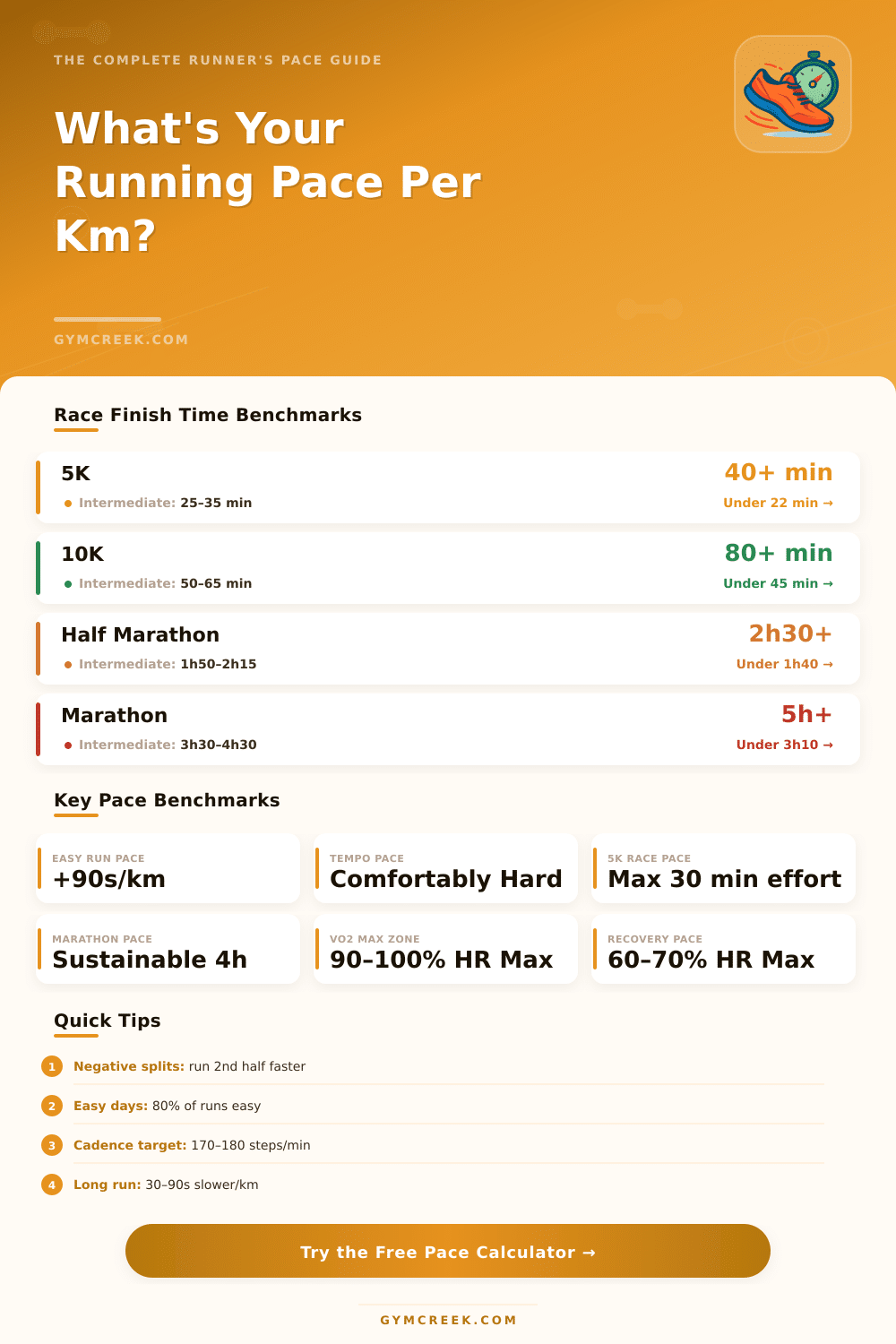
| Race Distance | Beginner Pace | Intermediate Pace | Advanced Pace | Elite Pace |
|---|---|---|---|---|
| 1 km | 6:30–8:00 /km | 4:30–6:00 /km | 3:30–4:30 /km | Under 2:40 /km |
| 5K | 7:00–9:00 /km | 5:00–6:30 /km | 3:45–5:00 /km | Under 3:00 /km |
| 10K | 7:00–8:30 /km | 5:10–6:30 /km | 4:00–5:10 /km | Under 3:10 /km |
| Half Marathon | 7:30–9:00 /km | 5:30–7:00 /km | 4:15–5:30 /km | Under 3:20 /km |
| Marathon | 7:45–9:30 /km | 5:45–7:15 /km | 4:30–5:45 /km | Under 3:30 /km |
| Race | Beginner | Intermediate | Advanced | Elite (Male) |
|---|---|---|---|---|
| 5K | 35–45 min | 25–34 min | 19–24 min | Under 13:30 |
| 10K | 60–75 min | 50–65 min | 38–50 min | Under 27:00 |
| Half Marathon | 2h30–3h | 1h50–2h25 | 1h25–1h50 | Under 59 min |
| Marathon | 4h30–5h30 | 3h30–4h30 | 2h50–3h30 | Under 2h02 |
| Parkrun (5K) | 30–45 min | 20–29 min | 17–20 min | Under 15 min |
| Zone | Name | Intensity | Pace (vs Race Pace) | Purpose |
|---|---|---|---|---|
| Zone 1 | Recovery | 50–60% HR Max | +2:00 to +3:00 /km | Active recovery |
| Zone 2 | Easy / Aerobic | 60–70% HR Max | +1:00 to +2:00 /km | Base fitness, fat burn |
| Zone 3 | Moderate | 70–80% HR Max | +0:30 to +1:00 /km | Aerobic capacity |
| Zone 4 | Tempo / Threshold | 80–90% HR Max | Race pace –0:20 /km | Speed & endurance |
| Zone 5 | VO2 Max / Interval | 90–100% HR Max | Race pace –0:30 /km | Max speed, intervals |
Use a GPS watch or running app (Strava, Garmin, Nike Run Club) over a flat, measured course. Treadmill distances can vary by 1–3% from GPS. For race pace planning, use recent 5K or 10K times — your half marathon pace is typically 10–20 sec /km slower than your 10K pace, and your marathon pace 30–60 sec /km slower.
Intermediate pace shows how many time it takes to cover a certain distance. The main rule is easy: it matches time shared by distance. Like this, if one runs 5 km.
In 30 minutes, the average Running Pace is 6 minutes per kilometer. This helps to estimate how quickly the runner moves and it is useful for planning training and tracking results.
What Is Running Pace and How to Use It
Even so Running Pace does not deal only about speed. Really it concerns the usage of energy. If one starts too quickly in a contest, that can cause fast tiredness.
Start too slowly can hurt reaching the personal record. Finding the right balance between endurance and finishing sprints is key. Actually the secret of good run is end the second part more quickly than the first.
With a fast calculator one can find pace, time or distance, if two from those values already are known. It is useful for planning finish time, keep a certain Running Pace and prepare more precise training for events like 10 km., half marathon or full marathon. Charts also allow to quickly check Running Pace in kilometers and miles, and right away sea what speed is needed to reach certain targets.
Various race distances require different Running Pace values. Run at 5 km. Speed is almost anaerobic, while 10 km.
Speed implies more steady aerobic effort of medium until high intensity. For instance, if the basic 5 km. Pace is 8:30 per mile, then for 10 km.
It will be around 8:50, and for half marathon about 9:10. Those values are not strict rules. Add 10 or 20 seconds to the Running Pace of long distance is entirely reasonable.
Too fast a pace can lead to injury.
During easy training runs the Running Pace should feel free and nice. It is medium speed, and one can go a bit more quickly or slowly, if it stays easy on that day. Easy run forms a strong base for more hard exercises later.
In some any day, difference of until 20 seconds per mile regarding the intended easy Running Pace is entirely usual.
Running Pace adjusts according to age, fitness and experience. For young folk a Running Pace of 8:30 per mile works for running 30 minutes five or six times weekly. For beginners 12 until 15 minutes per mile is the ideal training limit.
Regular run with balanced preparation is the best method, and progress comes slowly. Better to estimate training volume according to time than according to distance. A faster runner does more distance in an hour than a slow one, so totalrun time shows the real work.
Slowdown helps to build distance. Running 80 percent at easy Running Pace and 20 percent at high speed gives good results. That combination makes the training lasting and efficient.