❤️ Zone 2 Cardio Heart Rate Calculator
Find your personalized Zone 2 heart rate range and all 5 training zones using your age and resting heart rate.
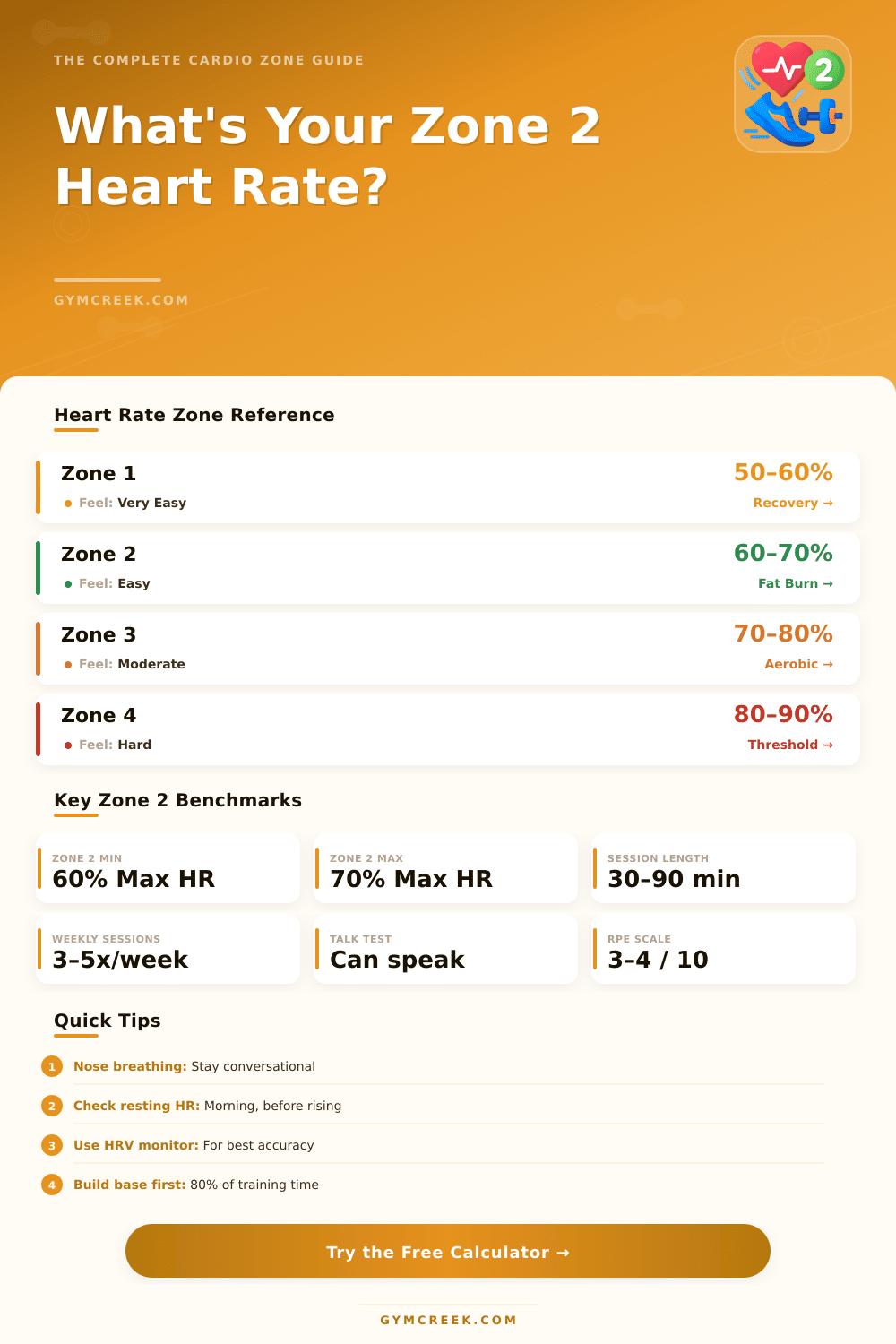
| Zone | % Max HR | Intensity Feel | Primary Benefit | RPE (1–10) | Duration |
|---|---|---|---|---|---|
| Zone 1 | 50–60% | Very Light | Active Recovery | 1–2 | 20–40 min |
| Zone 2 ⭐ | 60–70% | Light / Conversational | Fat Burn & Aerobic Base | 3–4 | 30–90 min |
| Zone 3 | 70–80% | Moderate | Aerobic Fitness | 5–6 | 20–60 min |
| Zone 4 | 80–90% | Hard | Lactate Threshold | 7–8 | 10–30 min |
| Zone 5 | 90–100% | Maximum | VO2 Max / Speed | 9–10 | Under 10 min |
| Category | RHR (bpm) – Male | RHR (bpm) – Female | Fitness Implication |
|---|---|---|---|
| Athlete | 40–50 | 44–54 | Excellent cardiovascular efficiency |
| Excellent | 51–58 | 55–61 | Very good aerobic conditioning |
| Good | 59–65 | 62–69 | Above average fitness |
| Average | 66–73 | 70–77 | Normal healthy range |
| Below Average | 74–81 | 78–85 | Some fitness improvement beneficial |
| Poor | 82+ | 86+ | Cardiovascular fitness needs work |
| Age | Est. Max HR | Zone 2 Low (60%) | Zone 2 High (70%) | Zone 2 Range |
|---|---|---|---|---|
| 20 | 200 bpm | 120 bpm | 140 bpm | 120–140 bpm |
| 25 | 195 bpm | 117 bpm | 137 bpm | 117–137 bpm |
| 30 | 190 bpm | 114 bpm | 133 bpm | 114–133 bpm |
| 35 | 185 bpm | 111 bpm | 130 bpm | 111–130 bpm |
| 40 | 180 bpm | 108 bpm | 126 bpm | 108–126 bpm |
| 45 | 175 bpm | 105 bpm | 123 bpm | 105–123 bpm |
| 50 | 170 bpm | 102 bpm | 119 bpm | 102–119 bpm |
| 55 | 165 bpm | 99 bpm | 116 bpm | 99–116 bpm |
| 60 | 160 bpm | 96 bpm | 112 bpm | 96–112 bpm |
| 65 | 155 bpm | 93 bpm | 109 bpm | 93–109 bpm |
| 70 | 150 bpm | 90 bpm | 105 bpm | 90–105 bpm |
Zone 2 Cardio belongs to those methods of exercise that sits exactly in the centre of the range of intensity. It keeps your Heart Rate between around 60 and 70 percent of your maximum, quite comfortable for long activity, yet serious work. In the scale of five zones that many use, Zone 2 sits in the bottom half.
Zone 1 simply helps you move easily (for instance during slow hiking), on the other hand Zone 5 requires full sprints or intervals with high intensity. And Zone 2? It is that ideal middle point, neither too soft nor too strong.
What Is Zone 2 Cardio?
The main idea sits in staying under the called aerobic threshold. Here the key turning point, where your body stops depending mainly on fat for fuel and starts to switch to carbohydrates. Training in Zone 2 is stable and low intensity, where the buildup of lactate stays very little.
Charts of zones usually have five bands marked by colours, where Zone 2 commonly stands for fat burning Zone 4 for efforts beside the threshold, and Zone 5 for work at VO2 maximum. Everything becomes clear when you know where every zone sits.
Here what makes Zone 2 like this attractive: it simply feels controlled. One can walk quickly or run gently during an hour or even more, without ending entirely exhausted. Your breathing becomes a bit heavier than usual, but you still can talk without stopping for air.
The challenge is that many push it slightly too high. Commonly the run ends in Zone 3 or even higher, becuase Zone 2 does not seem quite challenging, no burning in the legs, no gasping, no clear pain.
Zone 2 is sometimes called the base of training, and their is good reason for that. It strengthens the aerobic base and the endurance, while the physical stress stays relatively low. Under the skin it happens that your body learns to use fat as the main source of energy, instead of always pushing to stores of glycogen.
One calls that metabolic flexibility, and it genuinely helps. If some intend faster time for 10K, time in Zone 2 helps to extend the distance of good rhythm, what ultimately improves the race result.
The prize genuinely matters. Zone 2 burns fat, strengthens your heart and blood flow, and builds endurance with fewer risk for injuries than in high intensity. Moreover, it forms a strong base, on that you can add heavier exercises.
Ideally, one should first create a solid base in Zone 2, before jumping into intervals or fast training. Funny cause: the more fit you become, the less easily one reaches that same intensity of Zone 2.
A healthy routine usually has two to three hours of Zone 2 weekly, tied to one session for VO2 maximum. Some stress the amount, five or six sessions in Zone 2; and then mix with heavy exercises or intervals. A simple mode is walking on a treadmill with 10-percent incline for around 50 minutes.
Higher intensities work also well. Zone 2 commonly was ignored when HIIT ruled the trends of training, but now it receives attention. Part of that comes from that it does not hamper the repair as much as strongerCardio, what makes it ideal when one eats less and the body already has to hardly bounce.