800m Pace Calculator
Build a two-lap 800m race plan from target time, split strategy, start allowance, wind, traffic, track setting, fatigue profile, and split tolerance.
📌800m Race Presets
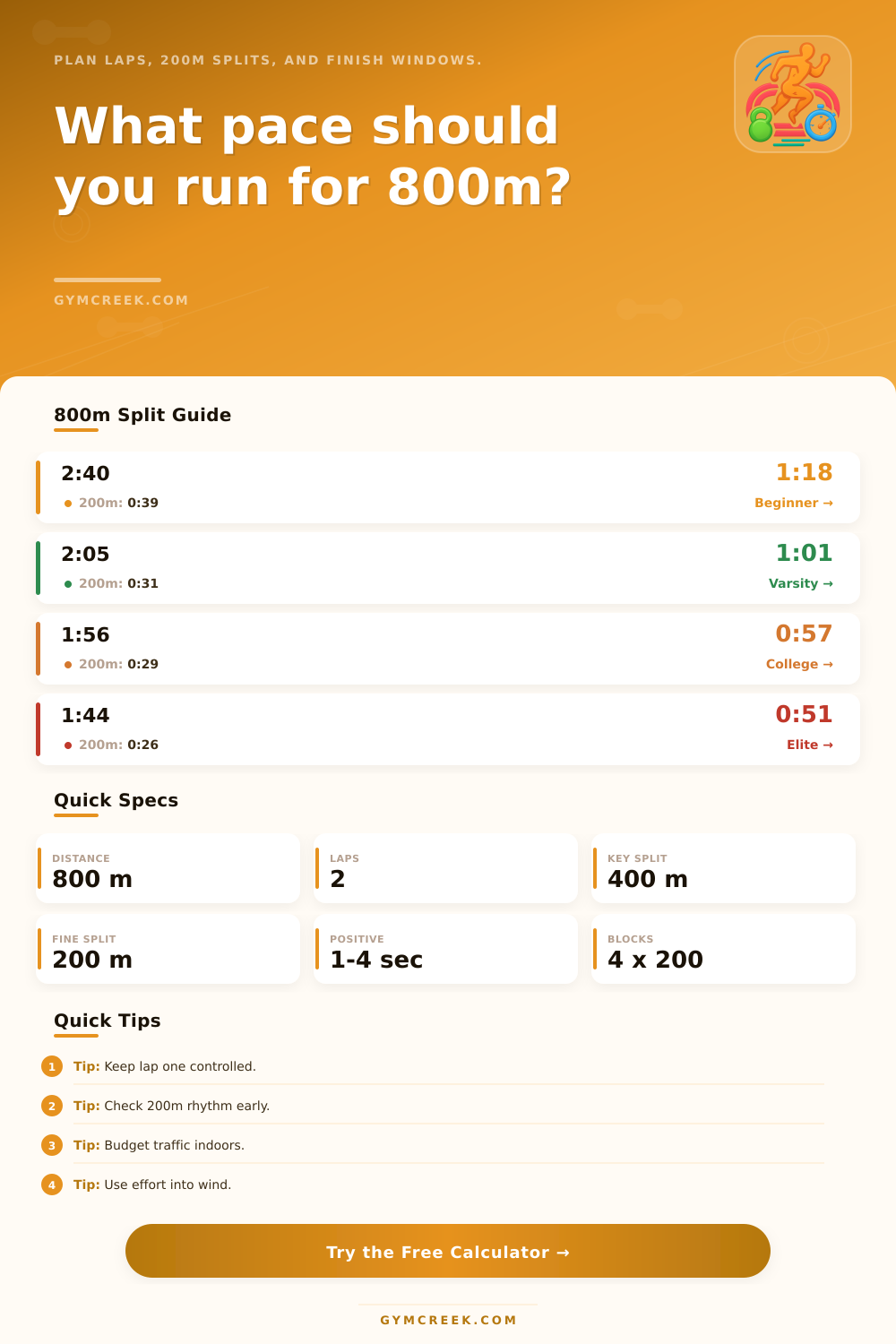
800m pacing usually uses a controlled positive split: lap one slightly faster than lap two, with smaller checks at 200m and 600m.
⚙Race Inputs
Two-lap race snapshot
Enter a target to calculate 200m, 400m, 600m, lap, speed, tolerance, and strategy notes.
📊800m Metrics Grid
📑Split Planning Tables
| Checkpoint | Target Split | Cumulative | Allowed Range |
|---|---|---|---|
| --- | --- | --- | --- |
| Model | Lap Bias | Best For | Risk Note |
|---|---|---|---|
| Even | 0 sec | Time trials | Needs patience |
| Level | 800m Time | 400m Split | Race Feel |
|---|---|---|---|
| Recreational | 2:40-3:20 | 1:18-1:38 | Controlled effort and strong form matter most. |
| School competitive | 2:05-2:30 | 1:01-1:13 | First 200m rhythm decides the race shape. |
| College competitive | 1:48-2:00 | 0:53-0:59 | Small pacing misses become large late-race costs. |
| Elite | 1:41-1:56 | 0:50-0:57 | Positioning and relaxation are as important as pace. |
| Item | Formula | Used For | Note |
|---|---|---|---|
| Pace | time / 0.8 km | Min/km | Race pace conversion |
💡800m Pace Tips
It is a full race, yet it is only 800m long. This is shortest track distance where it truly feels like a race. While you can’t go flat out right away, neither should you be coasting toward finish line on final lap. It’s a mix of speed and endurance, and any minor mistake with pacing show up vividly during the closing 200 meters.
Every runner know his/her goal time but few know what pace he/she needs on a lap by lap basis. Your splits should be different based off your competition, the track, start allowances, etc. When you input those variable into the calculator, it do the math for you. However, determining which of them are important for your given race is where most of work comes in.
How to Plan Your Pace for an 800m Race
Most importantly, they give you a first-lap bias that’s anywhere from a second to three. A first-lap bias let you get through traffic and then pace yourself with no need to burn your energy reserves until after 500-meter mark. If you’re too biased, you’ll lose time on the final straight. If not enough, you’ll be chasing people for last 200 meters.
Add in lane traffic and wind, and you’ve got your tolerance setting, how wide is that window? Why? Because fatigue profile tells you if your split pattern’s reasonable. A 400/800 specialist can usually handles a faster opening lap than an 800/1500 runner who benefits from patience and a late press. When the calculator’s showing high risk of pacing, that’s typically when you’ve got a gap between your entered bias and longer-race endurance. The risk rating adjust when you adjust your profile. Your target time does not change.
On paper, wind on the home straight is simple to overlook; do I push it early or slow down for a slower finish? You can use allowance field to plan for extra seconds caused by tailwind or headwind. It prevents you from being surprised when last 200 meters feel heavier than the moddern model predicted.
For example, there are 200-meter checkpoints (but not because you should of freak out). Instead, a small mistake on one checkpoint can often be made up with steady pace on next section instead of pushing too hard. You’ll see from reference tables how typical performances pan out, and know whether your target is conservative, aggressive, or mismatched to today’s speed reserve.
You’re not aiming for perfect splits at each spot. You’re trying to figure out what this race SHOULD feel like at these checkpoints. Use those as guideposts when the plan starts to deviate. After that, it’s just a matter of keeping yourself honest about what your goal time demand on race day and using the calculator as a tool.