7 Minute Workout Calories Burned Calculator
Estimate calories per session, calories per minute, total circuit time, weekly burn, and afterburn for the classic 7-minute workout and common modified circuits.
📌7-Minute Workout Presets
Presets load realistic combinations of body weight, rounds, intensity, transitions, substitutions, fitness level, afterburn percentage, and weekly frequency.
⚙Calculator
7-minute workout calorie snapshot
Enter your circuit settings to estimate session burn, pace, workout time, weekly burn, and afterburn.
📊Metrics Grid
📑Reference Tables
| Intensity | Base MET | Best fit | Model note |
|---|---|---|---|
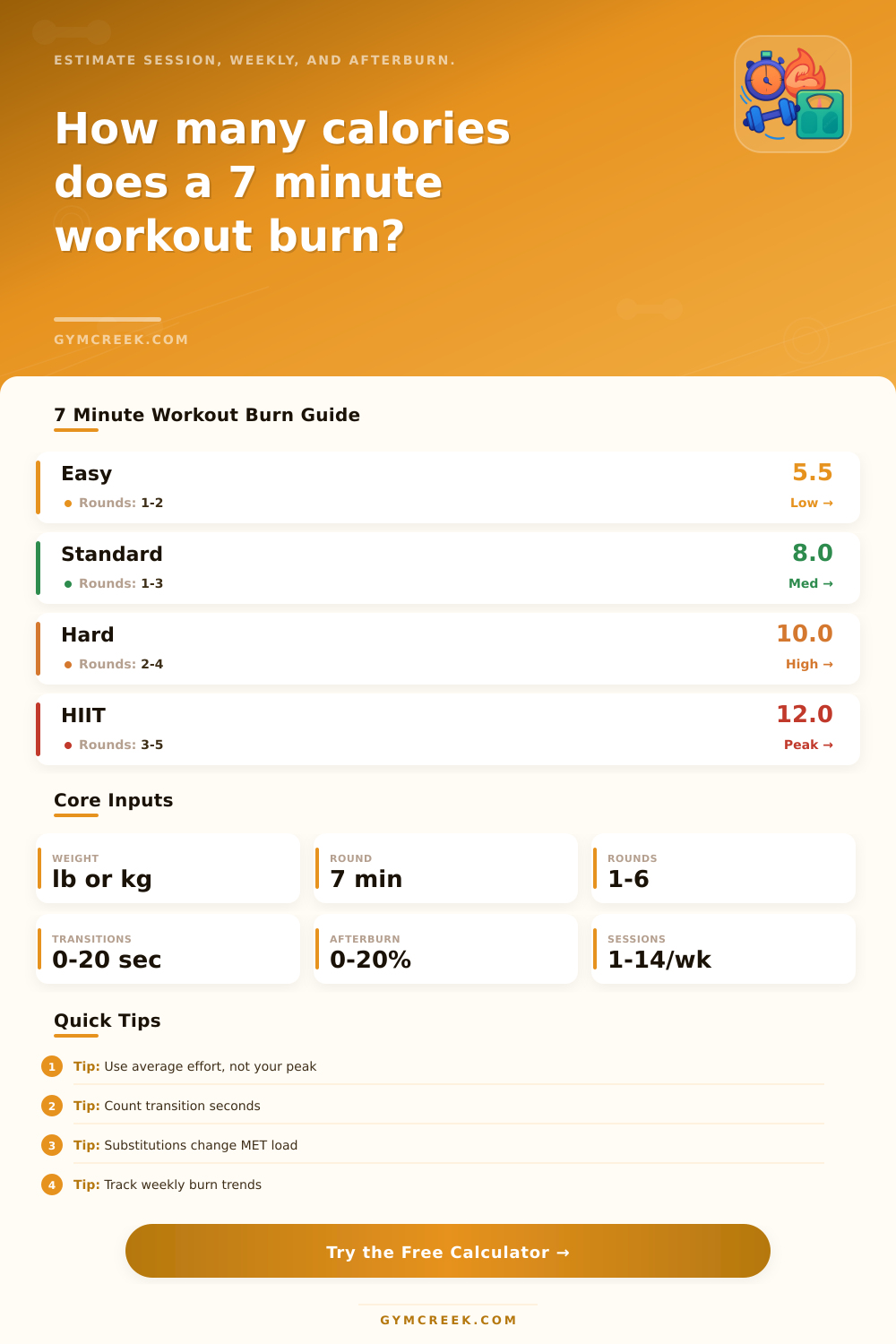
| Technique pace | 5.5 | Learning movements | Controlled reps, lower breathing load |
| Standard vigorous pace | 8.0 | Classic 7-minute app effort | Hard but repeatable bodyweight work |
| Hard bodyweight intervals | 10.0 | Experienced exercisers | Short rests, strong muscular fatigue |
| Max-effort HIIT pace | 12.0 | Athlete finishers | Very high effort, not casual pacing |
| Substitution | Multiplier | Example swaps | Effect |
|---|---|---|---|
| Classic 12-exercise circuit | 1.00 | Jumping jacks, wall sit, push-up | Baseline mix of cardio and strength |
| Low-impact substitutions | 0.82 | Step jacks, incline push-ups | Less jumping and lower peak burn |
| Upper-body emphasis | 0.96 | Push-ups, plank rows, dips | High fatigue with slightly lower MET |
| Lower-body emphasis | 1.06 | Squats, lunges, step-ups | Large muscle groups raise work rate |
| Core-heavy substitutions | 0.90 | Planks, mountain climbers, dead bugs | Steady tension with less locomotion |
| Plyometric substitutions | 1.16 | Burpees, jump lunges, squat jumps | More power and oxygen demand |
| Strength-loaded substitutions | 1.10 | Goblet squats, presses, rows | Added load raises effort per rep |
| Scenario | Rounds | Transition | Typical use |
|---|---|---|---|
| Single micro-session | 1 | 5-10 sec | Quick movement break or travel day |
| Classic workout | 2 | 10 sec | Most repeatable general fitness setup |
| Extended HIIT | 3 | 5-10 sec | Higher weekly burn with more fatigue |
| Low-impact restart | 1-2 | 10-15 sec | Skill practice and easier joint loading |
| Athlete finisher | 2-4 | 0-5 sec | Dense conditioning after strength work |
| Step | Formula | Output | Why it matters |
|---|---|---|---|
| Active calories | MET x 3.5 x kg / 200 x min | kcal | Standard exercise energy estimate |
| Transition calories | Transition MET x kg x minutes | kcal | Includes moving between exercises |
| Circuit time | Work + transitions + round rest | minutes | Finds calories per minute |
| Afterburn | Active kcal x afterburn percent | kcal | Estimates post-workout burn |
| Weekly burn | Session total x weekly sessions | kcal | Shows the repeatable weekly effect |
💡Tips
The seven-minute workout is a workout routine that provides a full-body workout in seven minutes. The seven-minute workout can be performed without the need for a gym and dont require a long period of time to perform the routine. Many peoples find it to be helpful due to the fact that an individual can perform the seven-minute workout during short periods of time in an individual’s schedule.
For instance, an individual can perform the seven-minute workout during a lunch break or between meeting. However, it is important for an individual to understand both the number of calories that will be burned during the routine as well as how the parameters of the workout can alter the number of calories burn. The number of calories that will be burned during the seven-minute workout depend on several specific variables.
How Many Calories Do You Burn in a Seven-Minute Workout?
For instance, an individual’s body weight will play a significant role in the number of calories that is burned. Additionally, the number of rounds that an individual performs during the routine will affect the number of calories that that individual burns. The intensity with which the exercises are performed will affect the number of calories that are burned, as will the number of calories that are burned during the transitions between the different exercise.
Additionally, the amount of rest that is taken between each round of the seven-minute workout will also play a significant role in the number of calories that are burned. Other factors that will play a significant role in the number of calories burned include the amount of extra oxygen that an individual’s body utilize after completing the seven-minute workout. Other variables that will influence the number of calories burned include whether the individual performing the routine is a beginner or an experienced exerciser.
The calculator will handle the mathematical calculations for the number of calories that will be burned. However, it is important for an individual to understand why each of the variables listed above may impact the number of calories that are burned during the seven-minute workout. For instance, the individual’s body weight will have a significant impact on the number of calories that are burned because the body must use fuel to move the heavier mass of an individual that weigh more.
Additionally, the individual’s number of rounds, the length of the transitions, the intensity of the exercises, the substitutions of exercises, and the level of fitness that an individual have will also significant impact the number of calories that are burned during the seven-minute workout routine. Performing the seven-minute workout routine weekly is important because performing the routine once per week is unlikely to provide significant results. For instance, if an individual performs the seven-minute workout routine several times during the seven-day period, it is possible to increase the number of calories that are burned each week by either increasing the number of rounds of the routine or by shortening the length of time that the individual spends performing transitions between the different exercises included in the routine.
Some of the mistakes that may be made while performing the seven-minute workout include the mistake of forgetting to include the calories burned during the transitions between exercises. Some individuals may also underestimate the number of calories that they burn if they reduce the intensity level with which they perform the exercises. Finally, some individuals may ignore the afterburn effect that occurs after they have performed the seven-minute workout routine.
The afterburn effect allow an individual to burn an additional eight to twelve percent of the total calories burned during the seven-minute workout. These mistakes are significant because the number of times that the routine is performed each week can worsen them. The reference tables that are included in the article can display the ranges of intensity and the effects of the substitutions of exercises during the seven-minute workout.
Additionally, the reference tables can display the typical number of rounds and transition time for the seven-minute workout. These tables should not be used to encourage individuals to aim for the highest number of calories that can be burned during the workout. Instead, the tables should allow individuals to understand how to set the settings of the seven-minute workout routine to match the settings for the version of the routine that is to be performed.
The calculator can be used to compare two different versions of the seven-minute workout. To do so, the individual can set the body weight and the number of sessions each week to remain the same. The other variables, such as the intensity levels of the exercises and the substitutions of exercises during the routine, can be altered to allow the individual to compare the number of calories burned during a classic seven-minute workout with the number of calories that would be burned during a low-impact or plyometric seven-minute workout.
Additionally, it is also possible to use the calculator to compare the total number of calories that are burned during the seven-minute workout routine with the number of calories that are burned per minute during the routine. Such comparisons can help an individual to understand whether the version of the seven-minute workout routine that they enjoy performing is also the version of the routine that burn the greatest number of calories that are required by an individual.