60 Yard Dash Calculator
Adjust a 60 yard dash time for start type, surface, wind, timing method, bodyweight context, split quality, acceleration, max velocity, and baseball combine standards.
📌Presets
Presets load realistic baseball combine profiles and auto-calculate adjusted time, splits, sprint phases, and benchmark tier.
⚙Calculator
60 yard dash snapshot
Enter your time, context, and splits to compare against baseball combine standards.
📊Metrics Grid
🏃Sprint Phase Readout
📑Reference Tables
| Level | Elite | Recruitable | Needs Work |
|---|---|---|---|
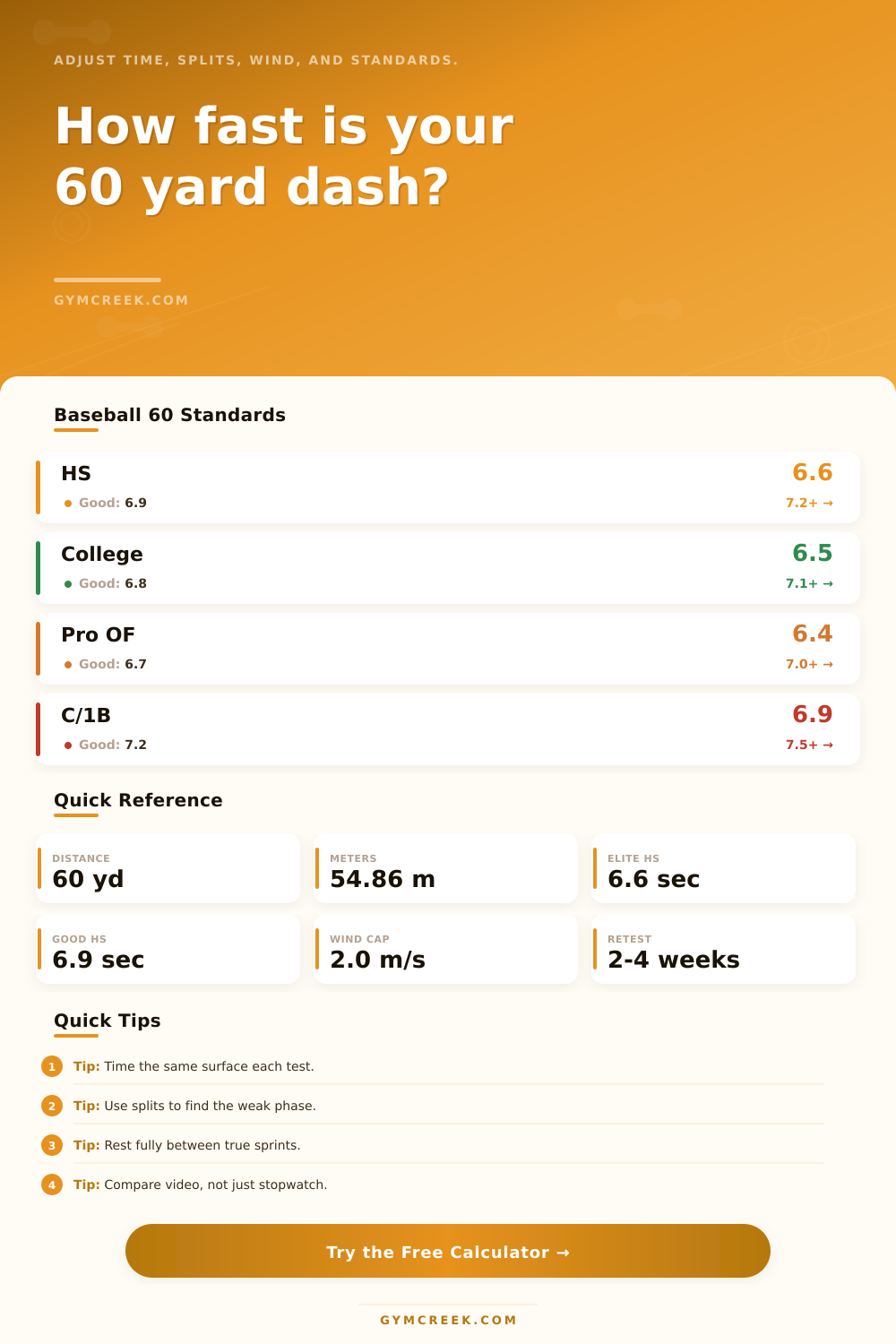
| High school baseball | 6.60 or faster | 6.80 to 7.05 | 7.25+ |
| College baseball | 6.50 or faster | 6.70 to 6.95 | 7.15+ |
| Pro outfield look | 6.40 or faster | 6.60 to 6.85 | 7.00+ |
| Catcher or first base | 6.90 or faster | 7.10 to 7.35 | 7.55+ |
| Split | Excellent | Solid | Improve |
|---|---|---|---|
| 10 yards | 1.55 sec | 1.65 sec | 1.78+ sec |
| 30 yards | 3.70 sec | 3.90 sec | 4.15+ sec |
| 30 to 60 yards | 2.75 sec | 3.00 sec | 3.20+ sec |
| Max velocity | 21+ mph | 19 to 21 mph | Under 18 mph |
| Context | Adjustment | Why | Use |
|---|---|---|---|
| Hand timing | Add time | Reaction bias | Compare fairly |
| Track surface | Add time | Faster footing | Baseball turf view |
| Wet grass | Remove time | Slower footing | Neutral estimate |
| Tailwind | Add time | Wind helped | Legal context |
| Formula | Inputs | Output | Note |
|---|---|---|---|
| Average speed | 54.86 m / time | m/s, mph | Full run pace |
| Final split speed | 30 yd / split | Max velocity | Top-end proxy |
| Accel ratio | 30 split / 60 | Percent | Phase balance |
| Context adjust | Start, wind, turf | Neutral time | Estimate only |
💡Tips
The sixty yard dash is arguably the most scrutinized metric in amateur baseball. A short burst of speed, it speak to a player’s athleticism. But it’s tough to get a consistent number. Your recruiting tier may be defined by a split second, a six point five second run or a six point nine second run.
So while clock is important, the situation behind your sprint are also important. Athletes tend to accept stopwatch as truth, forgetting about all the variables that affect it. Tenths of a second can absorbs… Or added, depending on how surface feels.
Why Your 60-Yard Dash Time Matters
Turf indoors is a hard surface, which rewards speed down the stretch. Dirt on the basepaths or short grass throws some variables on traction, slowing the start. Wet grass means you waste more energy pushing into the ground than moving yourself forward when you runs.
The above calculator accounts for those environmental variables. It adjust the time so we can compare apples-to-apples with the same result under different testing conditions. All you have to do is plug in your own set up and let the tool do the math. You don’t waste time wondering if you ran poorly or just had poor footing.
Similarly important are starting mechanics. Your shin angle and body posture will give it away within first ten yards. In that short of distance, you can’t make up for a poor start.
When you have a slow ten yard split and then go strong the rest of the way, you also know exactly what to train. Adding more top-speed isn’t the answer. Instead, you want to work on initial impulse and drive phase.
The tool works by breaking down those splits. Does your acceleration hurt? Or is your max velocity holding you back? Knowing this difference is huge. You’ll see diminishing returns when you try to get better at something you’re already good at. Getting better at something you’re weak at produce instant gains.
Another variable, and the one we do not measure very well but is hugely significant, is wind. A meter-per-second headwind is resistance and makes your work appear more difficult then it actualy was. Whereas a tailwind assists your speed by one meter per second will make your effort seem easier than it actually was.
Standard combine protocols includes some level of wind adjustment so comparisons remain fair. Regardless of what the weather was like on your test day, adjusting for wind let you know how hard your body worked. It is a small thing. But when margin is measured in hundredths of a second, that’s a big deal.
You should also contextualize your speed with body weight and position. If you’re a two-hundred pound catcher that runs a seven point one, it’s probably going to be more impressive than a center fielder that runs the same time.
In other words, scouts looks at how much demand is placed on a player based off their position and then compare speed accordingly. Middle infielders are looking for explosive first steps and quick ability to decelerate, while corner infielders prioritize raw straight-line speed. Corner infielders are after raw straight-line speed.
All of this is well laid out in the reference table on the page. It shows where you stand in terms of elite, good, and watch for each position. Now you can shoot for realistic goals based off what position you actualy play, as opposed to the generic standard.
But there is also a bias in the way it’s timed. Hand timing often starts late and stops early, which makes the times look faster than laser timing. That gives them an appearance of speed over laser timing. Video can go somewhere in between, but again that relies on frames per second.
If you don’t know whether yours was video or hand timed you could be confused by different ways of measuring it. The calculator compensate for those differences. It makes your time standard.
Running faster isn’t often about being faster in isolation. It’s about learning how to get your body from point A to point B as efficiently as possible. Rest completely between reps so that fatigue doesn’t ruin your avg. Spend less time looking at the timer and more time looking at your video form.
Did you drive hard off the ground? Were you leaning too far forward? You want an efficient runner, not necessarily one with the lowest number.
At the end of the day, the sixty yard dash is just that: a snap shot of how good you are right now as an athlete. It shows how well trained you are, how good your technique is, and how prepared your body is.
You could of adjust for variables and understand the inputs, but more importantly, it will give you a better idea of where you are. Let it help you train. Don’t let it determine who you are as an athlete.
Continue to refine, measure, and push. That’s what separates a decent sprint from an elite one.