5K Distance Converter
Convert a 5K into miles, meters, yards, track laps, lap splits, treadmill speed, stride count, and checkpoint pacing.
📌Presets
Each preset loads a real 5K conversion scenario, including target finish time, track lap length, stride data, and treadmill display preference.
⚙Calculator
5K conversion snapshot
Enter distance and target time to convert your route.
📊5K Metrics Grid
📑Reference Tables
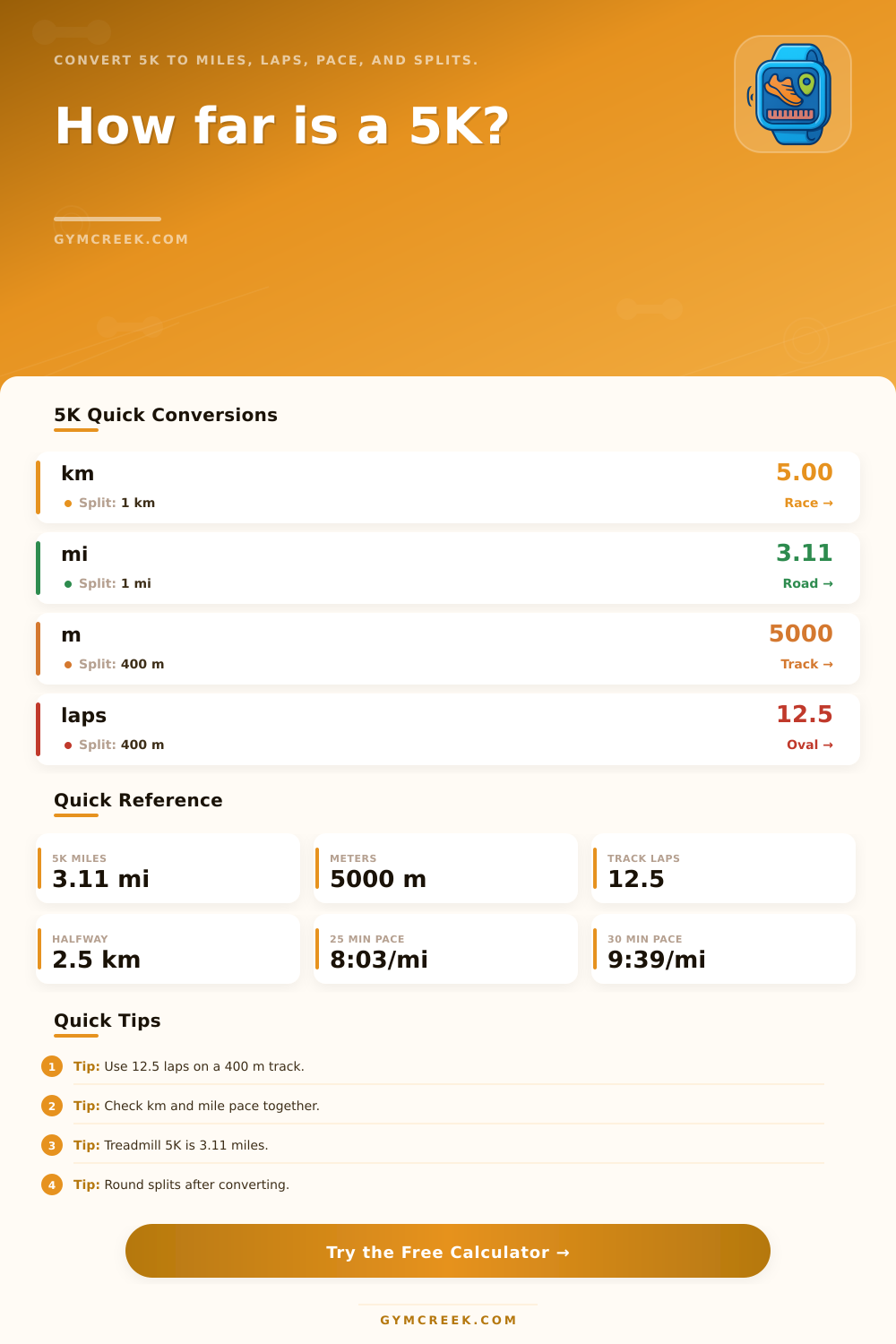
| 5K Unit | Equivalent | Checkpoint | Best Use |
|---|---|---|---|
| Kilometers | 5.000 km | 1 km | Race splits |
| Miles | 3.107 mi | 1 mile | Road pacing |
| Meters | 5000 m | 400 m | Track math |
| Yards | 5468 yd | 440 yd | Old tracks |
| Lap Length | 5K Laps | Halfway | Finish Note |
|---|---|---|---|
| 400 m | 12.50 | 6.25 laps | 12 laps plus 200 m |
| 200 m | 25.00 | 12.50 laps | Indoor oval |
| 300 m | 16.67 | 8.33 laps | Training loop |
| 440 yd | 12.43 | 6.21 laps | Imperial track |
| Finish Time | Pace per km | Pace per mi | Speed |
|---|---|---|---|
| 40:00 | 8:00 | 12:52 | 4.66 mph |
| 30:00 | 6:00 | 9:39 | 6.21 mph |
| 25:00 | 5:00 | 8:03 | 7.46 mph |
| 20:00 | 4:00 | 6:26 | 9.32 mph |
| Checkpoint | Distance | At 30:00 | At 25:00 |
|---|---|---|---|
| Quarter | 1.25 km | 7:30 | 6:15 |
| Halfway | 2.50 km | 15:00 | 12:30 |
| 3K mark | 3.00 km | 18:00 | 15:00 |
| Last km | 5.00 km | 30:00 | 25:00 |
💡Tips
“Five thousand meters” is an exact number, but not very helpful unless you have some reference for what that means. Three point one miles isn’t much better. It’s a number that feels abstract. It becomes real once you see seconds ticking away on your watch. Then suddenly it’s real.
It’s neither a light jog nor a competitive race; it’s somewhere in-between. It is long enough to hurt you if you overdo it right out of the gate, but short enough that you don’t need to linger to long to recover.
Why Numbers Help You Run 5K Better
It is fitness benchmark for most runners, but few knows how to approach it with any thought before starting gun. When you determine your priorities, calculator does the rest. It’ll convert a desired finish time into treadmill speeds, per-mile paces, or track laps. That takes head work out of the middle of running.
When you’re tired, you don’t need to guess whether you should of be going faster, there’s a number you’ve set as your goal. It makes that “feeling” real. Most runners waste time not understanding their splits strategy. In fact, very few runner ruin their 5K during the first kilometre. It’s usually ruined by adrenaline. The checkpoint distribution of finish times (table of references) show this.
Want to get home in half an hour? You’d be right thinking you should hit halfway mark in fifteen minutes. Except… that means running less than six minutes per km. It sounds like a pretty fast pace. Most people think so too. For track runners, however, it’s not as simple as forward motion; rather, they has to contend with laps.
A normal outdoor track is four hundred meters long. This means a 5K runner must run twelve complete laps plus an additional two hundred meters to account for distance between the main line and the finish. Enter the tool: Input whatever lap length applies, such as an older field or an indoor oval that measures just twenty meters. This accounts for any discrepancy.
Having a clear understanding of how many more strides there is left in last lap gives runners a psychological lift when their lungs feel like burning. The disconnect between perceived effort and displayed running speed plague treadmill runners. Wind resistance is replicated by raising the incline to a single percent. But don’t trust what speedometer says.
The calculator converts your desired pace into miles per hour or kilometers per hour, ensuring you do not have to divide minutes by sixty in your head while holding onto handrails. You don’t need to grab the handrail and divide by 60; instead, the calculator does math for you. It even projects your step number by estimating your cadence and stride length.
It’s not precise, more of an awareness tool. A reduced step rate mid-long run frequent shows fatigue before you’re aware of being fatigued. Energy is everything; not power. You might think “oh I’m fine on the first mile, let’s go!” as most newbies do only to crash by kilometer three.
The tool presents an accurate set of scenarios depending off your fitness level… From a competitive race pace (sub-25) through to a leisurely 40 minute jog. Following these benchmarks will give you some idea of what it takes to run at those paces. This helps you avoid running at a pace that require endurance instead.
Running is just as much in the mind as it is the legs. Having an idea about what you’ll do during each kilometer helps you keep going when your legs are ready to call it quits after mile two. You can use your splits (by kilometer) or maybe your cadence, whatever help you forget any doubts during your runs. Knowing precisely how things are going different than your goal helps you make adjustments rather than freak out.
Turning distance to data is turning variables you can’t feel right away into ones you can control. There’s no doubt about it: You can run as slow or as fast as you want, but there’s no arguing with the numbers about where you’ve been and where you’re going. Numbers gives you a framework for consistency you simply won’t get from intuition.
Running 5,000 meters is nothing more than a number on a screen. But when the clock begins ticking, those numbers turn into a compass guiding you across every mile, every lap, until you cross finish line.