505 Agility Test Calculator
Estimate adjusted 505 agility time, change of direction deficit, turn-side symmetry, entry speed, exit speed, and test quality from left and right 180 degree turns.
📌Presets
Each preset fills a realistic athlete profile, test setup, left and right turn times, linear sprint time, surface, and timing method.
⚙Calculator
505 agility snapshot
Enter left, right, and linear 10 m times to calculate turn quality and change of direction metrics.
🧮Formula Cards
📊Agility Metrics Grid
📑Reference Tables
| Athlete Group | Fast Range | Competitive Range | Usually Needs |
|---|---|---|---|
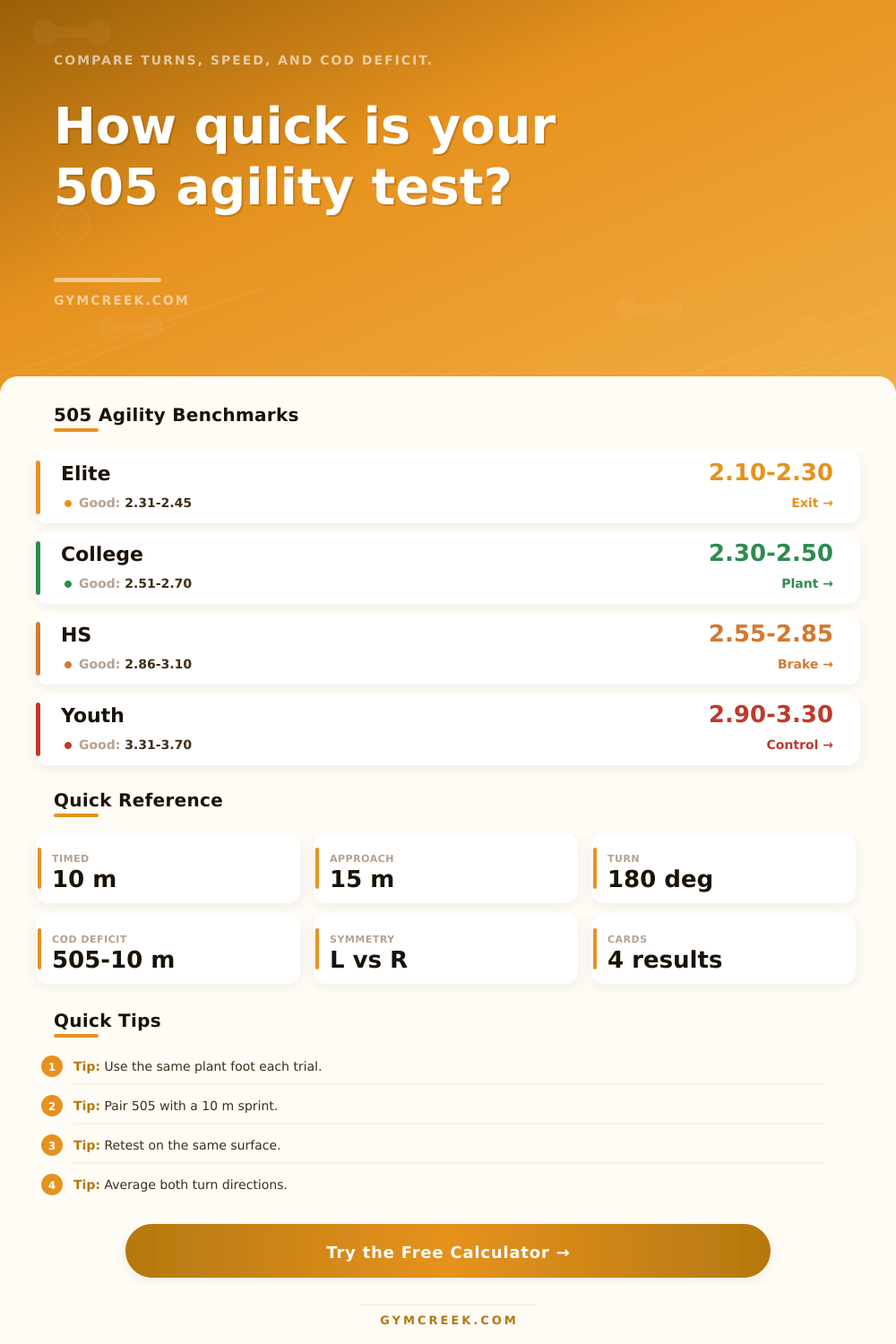
| Elite field athlete | 2.10–2.30 sec | 2.31–2.45 sec | Exit force maintenance |
| College court or field | 2.30–2.50 sec | 2.51–2.70 sec | Braking angle control |
| High school varsity | 2.55–2.85 sec | 2.86–3.10 sec | Plant foot consistency |
| Youth development | 2.90–3.30 sec | 3.31–3.70 sec | Deceleration basics |
| Metric | Strong | Watch | What It Means |
|---|---|---|---|
| COD deficit | 0.45–0.65 sec | 0.90+ sec | Turn efficiency versus linear speed |
| Symmetry gap | 0–3% | 8%+ | Difference between turn directions |
| Exit speed | 4.3+ m/s | Under 3.5 m/s | How well speed returns after the plant |
| Trial spread | 0.00–0.05 sec | 0.15+ sec | Timing and movement repeatability |
| Testing Detail | Calculator Use | Best Practice | Caution |
|---|---|---|---|
| Electronic gates | 0.00 sec add | Place gates consistently | Check beam height |
| Video reviewed | 0.04 sec add | Use clear frame marks | Frame rate can bias |
| Phone timing | 0.08 sec add | Use same reviewer | Start point varies |
| Hand timing | 0.16 sec add | Use only informally | Reaction error is high |
| Formula | Variables | Result | Use |
|---|---|---|---|
| Best 505 | min(left,right) | sec | Main agility score |
| COD deficit | 505 - 10 m | sec | Turn cost estimate |
| Symmetry | gap / best | % | Side difference |
| Exit speed | 5 m / exit time | m/s | Re-acceleration |
💡Tips
That’s what the 505 Agility Test measures. It is that instant decision to go left or right as defender closes on you. You don’t even realize you’re making it, but it’s pure muscle memory combined with physics. It’s not just about how fast you can run in a straight line. Stopping. Changing direction. Accelerating again does. Direction change is where most games is won.
Athletes believe only speed matter. Instead of giving you raw times, this calculator will translate those times into something useful: how well you perform.
How the 505 Test Works
To begin, input your fastest right turn time and your fastest left turn time. Why does this matter? Most people have a dominant leg when they plant their feet. Chances are, if you’re an athlete, one side will almost always feel stronger and faster then the other. What the calculator do is compare the two times to get a gap of symmetry.
Is the number large? That’s telling you that you’re heavily favoring one direction over the other. In sports where we need to move in many different directions, that are not good. It tells you which direction needs to be strengthened. It is not necessarily with more speed work but with strength work on the weaker side.
Your linear ten meter sprint time is another important variable. Your pure speed serve as a starting point in this equation. You add this to the adjusted 505 time, and then take away the linear sprint. This leave us with the change of direction deficit. This number represents how much the turn is costing you. The lower the deficit, the more mechanically efficient you are at changing direction. The higher the deficit, the more momentum you are losing in plant phase.
It does not mean you are slow. That you’re leaking energy trying to stop. Coaches can uses this distinction to determine if they should of focus their attention on mechanics of braking or acceleration.
How accurately does it work? A big factor is testing conditions. Timing methods like hand vs. Electronic gates is also included. Hand time will include the human reaction delay, skewing results noticeably. Small adjustments are made to even out these differences, and thus enable you to more fairly compare one test where you had a stopwatch versus another when you used some high tech piece of gear.
The other variable is surface. If you ran on wet grass, you’ll get different times compared to if you ran on dry turf. By adjusting for all these variables, the numbers represent your ability based off the environment.
The most difficult aspect of any test protocol is consistancy. Each trial must be performed with the same start stance, the same type of shoes, and the same distance to the approach. Any small variation introduce noise into the data.
For context, the reference table found on the page sets a range of benchmarks for different groups of athletes including both elite and youth development levels. Where do you see yourself? What does that mean? How might it help set realistic goals? Does it indicate if you’re lagging behind your peers or exceeding them?
Agility isn’t just about a person’s ability to run faster. Agility is the nervous system’s ability to deal with quick changes in direction. Lots of folks do accelerations drills, but not many work on their braking. They’ll push hard for an hour, but never stop on command. The 505 test highlights that deficiency.
A slow exit indicates you’re not getting good power transfer off the plant leg. In other words, you’re not driving out of the turn; you’re just coasting around it. Plant foot stability and strength during lengthening will close this gap. It makes you better in more ways than one out on the court or field. You get noticed by your speed. You stay relevant with your agility.
And when you break the turn down into its measurable parts, you eliminate the guessing game in your practice. No longer do you chase that feeling of being slow. Instead you target the exact mechanical deficit that needs work.
If you’re a basketball guard attempting to create some space or a soccer winger attempting to blow past a tackle, it doesn’t matter. The same principle applies. Control the stop and the start will follow suit. Focus less on reacting and more on prepared execution for that split second decision.