5 Rep Max Calculator
Estimate your 5 rep max from a recent set, compare multiple strength formulas, adjust for reps in reserve, and turn the result into useful training loads.
📌Presets
Use a recent set of 3 to 8 good reps for the most stable estimate. Presets include different lifts, loads, RPE values, and training goals.
⚙Calculator
5RM strength snapshot
Enter a recent working set to estimate your current five-rep max.
📊Strength Metrics
📑Reference Tables
| Formula | 1RM estimate | Best range | Use |
|---|---|---|---|
| Epley | Weight x (1 + reps / 30) | 3 to 10 reps | Balanced gym estimate |
| Brzycki | Weight x 36 / (37 - reps) | 2 to 8 reps | Conservative near max |
| Lombardi | Weight x reps ^ 0.10 | 5 to 10 reps | Smoother higher reps |
| O'Conner | Weight x (1 + 0.025 x reps) | 3 to 8 reps | Moderate estimate |
| Target | Percent | Feel | Typical use |
|---|---|---|---|
| True 5RM | 100% | Max five | Testing day |
| Top set | 95-98% | Hard clean set | Weekly strength work |
| Backoff | 88-92% | Repeatable | Volume after top set |
| 5x5 | 82-88% | Challenging | Strength volume |
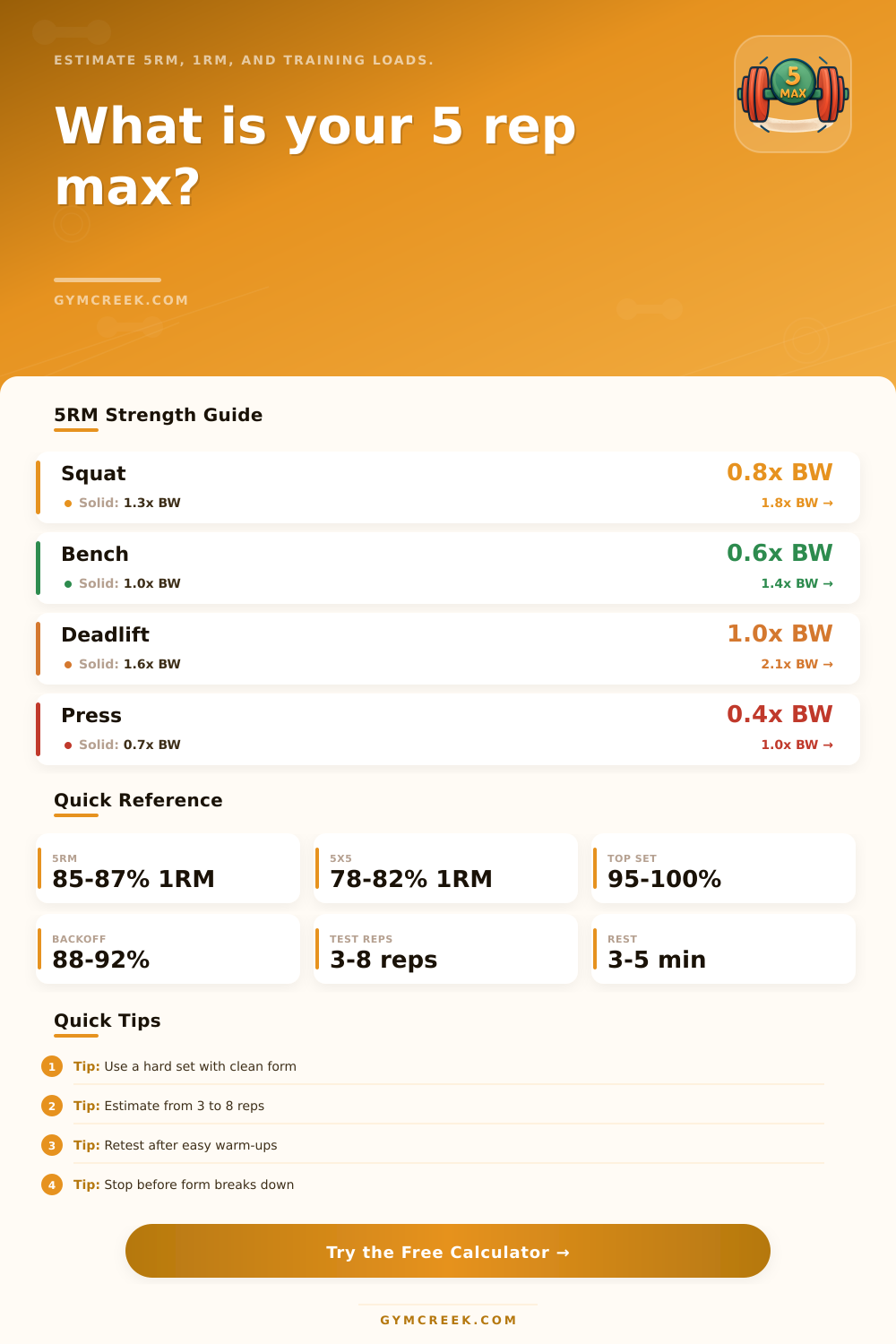
| Lift | Novice | Intermediate | Advanced |
|---|---|---|---|
| Back squat | 0.8 x BW | 1.3 x BW | 1.8 x BW |
| Bench press | 0.6 x BW | 1.0 x BW | 1.4 x BW |
| Deadlift | 1.0 x BW | 1.6 x BW | 2.1 x BW |
| Overhead press | 0.4 x BW | 0.7 x BW | 1.0 x BW |
| Check | Good signal | Risk signal | Adjustment |
|---|---|---|---|
| Reps | 3 to 8 | 10 plus | Retest heavier |
| RPE | 9 to 10 | 7 or less | Add RIR estimate |
| Rest | 3 to 5 min | Under 2 min | Add recovery |
| Form | Clean reps | Form breaks | Use lower load |
💡Tips
A 5 rep max is the weight that a person can lift for exactly five repetitions. A 5 rep max is useful because it is heavy enough to help a person to build strength, yet it is light enough for a person to use proper form and allow for recovery. A 5 rep max can help a person to determine the training loads that should be used in each future training block.
A 5 rep max helps to provide a number that a person can use to avoid guessing the loads that should be lifted during training. The calculator require several different inputs from a person to account for the fact that several factors will change the 5 rep max estimate. Body weight is one of the inputs required by the calculator.
What a 5-Rep Max Is and How to Use It
A persons strength relative to their body weight is a common measurement within training program. Age and activity level is another of the factors that may change the estimate of a 5 rep max. The specific lifts performed is another of the factors that may change the estimate. Rest periods and quality of the performed repetitions is one of the factors that will change the 5 rep max estimate.
Each of these factors is accounted for in the calculator so that the 5 rep max estimate is as close as possible to the strength that a person can actualy lift themselves. A persons physical state will impact the estimate provided by the calculator. If a person tests their 5 rep max while tired or after performing short rest periods, the calculator will provide a low estimate.
If a person tests their 5 rep max while they are fresh and after long rest periods, the calculator will provide a high estimate. These small adjustments to the 5 rep max estimate are one of the ways that a person can ensure that the weights that are used during training are ones that are likely to be useful during training over several week. A person can use the 5 rep max to determine the training loads that should be performed for training goals.
The percentage of 5 rep max loads required for each training goal will vary. A strength block will require high percentages of a 5 rep max load, while a volume block will require lower percentages. A deload period will also require percentages of a 5 rep max that are lower than a strength or volume period.
The calculator provides these percentages so that a person doesnt have to remember the various coefficients for each training goal. The calculator also provides suggestions for the top single load, heavy triple load, and backoff load for training. A 5 rep max can help a person to plan warm-up sets for their training.
A person needs warm-up sets that are heavy enough to effectively warm-up, yet not so heavy as to fatigue their muscles before the main sets of training. The calculator will create a warm-up ramp for a 5 rep max based on the 5 rep max load that is calculated. Warm-up ramps will typically consist of four or five jump in weight for the sets.
The first jump in weight will be light and the last jump will be close to the load that a person will perform for training. If a person finds that the warm-up sets are too slow, they can use the backoff load instead of the top single load that is provided by the calculator. Form and the type of equipement that is used to perform the indicated lifts will affect the 5 rep max estimate.
For example, it is more difficult to perform a paused bench press than a bounce bench press. The adjustment for loads with less than perfect form will not allow a person to overestimate their 5 rep max loads. The same adjustment will also prevent a person from underestimating their 5 rep max loads when they utilize perfect form during performance of the indicated lifts.
The reference tables will allow a person to compare their 5 rep max to other lifter. For example, a squat that is 1.3 times a persons body weight is considered to be a solid squat lift for the majority of lifters. These tables will not allow a person to compare their lifts with strangers, but they will allow a person to understand if they are in a building phase or maintenance phase for there strength.
A 5 rep max should not be considered a permanent number for a person. A 5 rep max that is tested on a fresh day will be different than a 5 rep max that is tested after a long work week or poor sleep. However, a 5 rep max that is calculated on a fresh day and after long rest periods will provide a snapshot of a persons strength.
A person should re-run the calculator after a few weeks of training to determine their progress with their strength. A person should keep the same conditions for testing a 5 rep max so that the progress can be easily seen. A person must also consider reps in reserve when performing a 5 rep max test.
If a person stops a set of lifts while they still have two more sets of reps left in them, the estimate for their 5 rep max will be low relative to their true 5 rep max strength. The RPE field on the calculator allows a person to account for reps in reserve. If a person does not use this field, the weights that are calculated from the 5 rep max may be too light for a persons increased strength after a few weeks of training.
The primary value of a 5 rep max is that it provides a single number that can account for different training goals. A 5 rep max is useful for planning and training for different goals. The calculator makes it easy for a person to account for the details of their last hard training set and still allow the 5 rep max to account for the training loads that is most useful for training.