30 Meter Sprint Calculator
Analyze block, three-point, standing, or fly-in 30m testing with reaction or first-step time, 10m splits, acceleration rate, wind, surface, and projection outputs.
📌Presets
Use the preset that matches your timing setup. A block-start 30m and a flying 30m answer different questions, so this calculator keeps them separate.
⚙Calculator
30m sprint projection
Enter start type, reaction or first step, 10m splits, surface, wind, and acceleration rate to calculate.
📊30m Metrics
📑Reference Tables
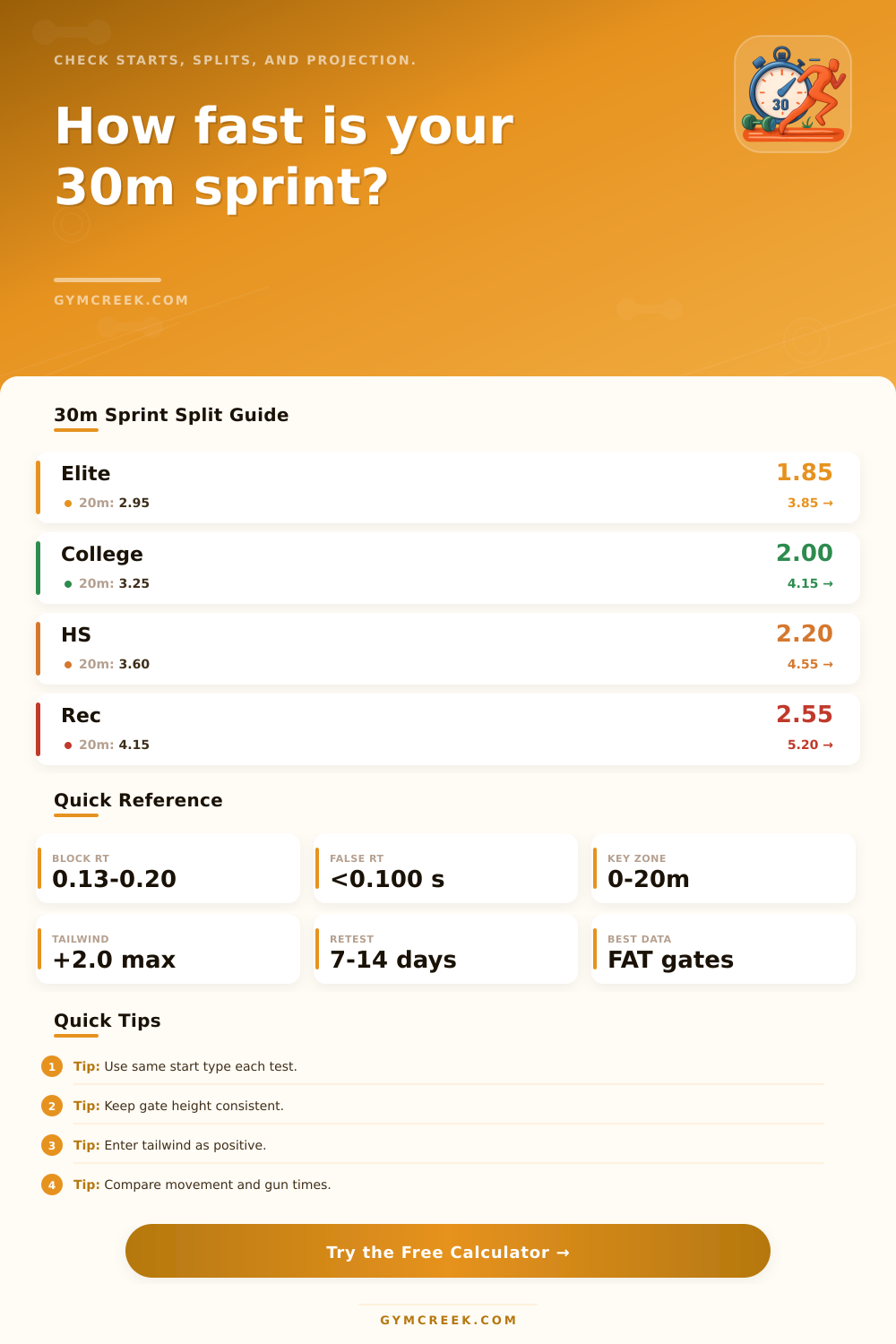
| Profile | 10m | 20m | 30m |
|---|---|---|---|
| Elite blocks | 1.80-1.95 | 2.90-3.10 | 3.75-3.95 |
| College sprinter | 1.95-2.10 | 3.15-3.35 | 4.05-4.30 |
| Field athlete | 2.05-2.25 | 3.30-3.65 | 4.30-4.75 |
| Recreational | 2.35-2.75 | 3.85-4.45 | 4.95-5.80 |
| Start type | Reaction use | Main read | Caution |
|---|---|---|---|
| Blocks | Reaction | Race start | FAT best |
| Three-point | First step | Field sport | Stance varies |
| Standing | First step | General speed | Rocking risk |
| Fly-in | Usually none | Speed quality | Not a start |
| Condition | Input | Model effect | Note |
|---|---|---|---|
| Tailwind | +1.0 m/s | About 0.015 s | Faster |
| Headwind | -1.0 m/s | About 0.018 s | Slower |
| Wet track | Surface | 0.03-0.08 s | Grip loss |
| Grass | Surface | 0.08-0.16 s | Uneven |
| Formula part | Variables | Use | Caution |
|---|---|---|---|
| Movement split | Split - delay | Clean start | Mode matters |
| Segment speed | 10m / split | Phase speed | Gate height |
| Accel index | Speed gain | Drive phase | Simple model |
| Projection | Surface, wind | Compare tests | Approximate |
💡Tips
The 30-meter sprint is a measurement of speed that is used in a variety of athletic setting. High school football combine use the 30-meter sprint to separate the fast athlete from the very fast athletes. College track coach use the 30-meter sprint to determine if an athlete possess the raw power necessary to compete against other track athlete in the 100-meter sprint.
Additionally, many weekend track athletes use the 30-meter sprint to determine their speed due to the sprint’s short length and high-intensity required run to complete the race. The 30-meter sprint can be used to calculate the athlete’s start. For instance, if an athlete began the sprint with starting blocks, the athlete has three strides to sprint from the start to the next phase of the sprint.
What the 30 Meter Sprint Tells You
An even greater start advantage is offered to athletes that begin with a three-point start, as the three-point start removes the advantage of the starting blocks but introduces a rocking motion that can even increase the athlete’s speed as registered on the stopwatch timer. A standing start removes even more advantage of the start than the three-point start. These different start types can be entered into the calculator along with the athlete’s reaction time to calculate the athlete’s speed for the 30-meter sprint.
Beyond the athlete and the start of the sprint, there are other factors that can influence the speed of an athlete during a 30-meter sprint. For instance, the track that the sprinters utilize can have different impact upon the athletes’ speeds. A synthetic track typically offers more grip on the track than a worn or wet track.
Additionally, grass tracks can create friction for the runners, as well as an uneven footing for the runners. As a result, grass tracks can slow the athletes during the first 10 meters of the sprint. Finally, tailwinds can help the sprinters to run faster during the sprint, but only up to a legal limit.
The calculator accounts for these environmental variables to allow the athlete to compare sprint conditions. The 30-meter sprint can be divided into three different 10-meter segment. Each 10-meter segment indicate different information about an athlete’s sprinting.
For example, the first 10 meters indicate how quickly an athlete can generate force with the ground. The middle 10 meters indicate the athlete’s sprinting rhythm. Finally, the last 10 meters indicate whether an athlete is still sprinting at an increasing rate or if the athlete can maintain their sprinting speed.
If the middle 10 meters are slower than the first 10 meters, the athlete should focus on training the drive phase of their sprint. If the final 10 meters have no increase in speed, the athlete should focus on sprinting transition mechanic. The calculator automatically performs both of these calculations.
In addition to the factors described above, the timing of the 30-meter sprint can impact the number displayed for that sprint. For instance, if a track uses automatic timing device to time sprinters, the results will be accurate. However, if the track uses human timing of sprinters, the sprint times will be slightly slower due to the human timer having to start the sprint timer after the starting signal is given to the sprinters.
Additionally, video analysis of sprinters can be used as a timing method for sprinting event and will fall somewhere between the time captured by manual timing versus automatic timing. However, if an athlete changes the timing method being used for sprinting tests, that new timing method must be selected in the calculator for the result to be valid and comparable to each other. Finally, the type of test that is performed can also have an impact upon the time that is recorded.
For instance, the 30-meter sprint is a test that measures the start of an athlete, but the “fly-in” test measure the time that it takes for an athlete to reach their top speed. Additionally, the distance that an athlete sprints before beginning the sprint impact the time that is recorded for that sprint test. For instance, if an athlete performs a 20-meter run-in before sprinting the remaining 10 meters, their time will be faster than a start from the blocks.
These variable are represented in separate column in the calculator such that the times for the “fly-in” tests are not confused with starting sprint times. An athlete’s age can have an impact upon the 30-meter sprint times, as well as the athlete’s background and training. For instance, a 17-year-old athlete may sprint at the same time as a 35-year-old athlete, but the training needs for those two athlete may be completely different.
For instance, younger athletes may need to increase their ability to generate force, but older athletes may need to increase their focus on recovery after sprinting effort. These variables are accounted for in the calculator to ensure that the results match the described athlete. Many athletes make mistake when timing sprint tests, however.
For instance, if an athlete changes their type of shoe, the track surface, the warm-up before the sprint, or the timing method, they will have changed the results of their 30-meter sprint. To compare sprint times, all variable except for training should be accounted for. Additionally, athletes should only sprint test every seven to fourteen day to allow their bodies to adapt to the training.
If sprint tests are performed too close together, the effects of weather and motivation can impact the result of the 30-meter sprint. Based off the result from the 30-meter sprint, coaches and athletes can make decisions regarding training. For instance, if the first 10-meter segment displays the weakest speed for sprinters, the athlete should focus on strength training with sledpushing or sprinting down hills to improve that first 10 meters.
If the middle 10 meters are the weakest segment, the athlete should focus upon improving their posture and the drive of their arm during sprinting. Finally, if the last 10 meters are the weakest part of the sprint, sprinting work while already sprinting at their top speed should be implemented into the athlete’s training. The calculator provides these suggestion to the coaches and athletes, but the coaches and athletes must make the actual decision for training.
Thus, the 30-meter sprint is a specific tool for measuring speed, but it will reveal any change that is made to an athlete’s training program.