3 Rep Max Calculator
Estimate a reliable 3RM from a recent set, compare common strength formulas, adjust for RPE or reps in reserve, and translate the result into training max, bodyweight ratio, and useful loading ranges.
📌Presets
Each preset loads a realistic lift, bodyweight, rep set, RPE, equipment style, and training goal so the estimated 3RM changes for more than just the bar weight.
⚙Calculator
3RM strength estimate
Enter a recent hard set to estimate your 3 rep max.
📊Strength Metrics
📑Reference Tables
| Formula | Equation | Best range | Use in output |
|---|---|---|---|
| Epley | Weight x (1 + reps / 30) | 1 to 10 reps | Primary anchor |
| Brzycki | Weight x 36 / (37 - reps) | 2 to 8 reps | Conservative check |
| Lombardi | Weight x reps ^ 0.10 | 3 to 12 reps | High-rep balance |
| 3RM from 1RM | 1RM / 1.10 | Top triples | Final conversion |
| Target | Percent 1RM | Percent 3RM | Training note |
|---|---|---|---|
| 1RM | 100% | 109% to 112% | Peak single |
| 3RM | 90% to 93% | 100% | Heavy triple |
| 5RM | 84% to 87% | 92% to 95% | Backoff strength |
| 8RM | 78% to 81% | 85% to 89% | Volume work |
| RPE | RIR cue | Adjustment | Meaning |
|---|---|---|---|
| 10 | No reps left | 0% | True max set |
| 9 | 1 rep left | +3% to +4% | Near max set |
| 8 | 2 reps left | +6% to +8% | Strong reserve |
| 7 | 3 reps left | +9% to +12% | Practice set |
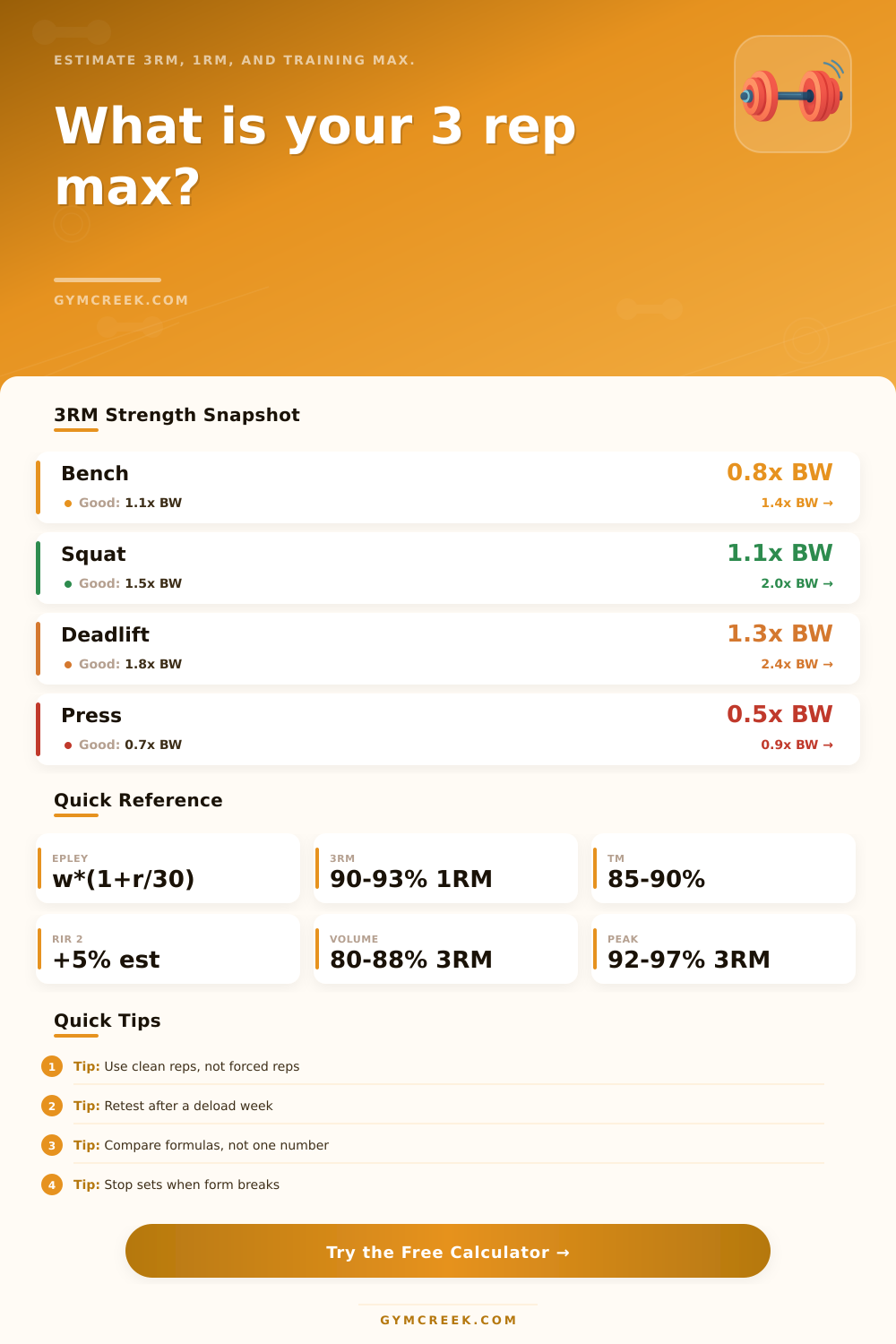
| Lift | Novice | Good | Strong |
|---|---|---|---|
| Bench press | 0.8 x BW | 1.1 x BW | 1.4 x BW |
| Back squat | 1.1 x BW | 1.5 x BW | 2.0 x BW |
| Deadlift | 1.3 x BW | 1.8 x BW | 2.4 x BW |
| Overhead press | 0.5 x BW | 0.7 x BW | 0.9 x BW |
💡Tips
The three-rep max is a measurement of strength, but it is also a tool that can help to plan future training session for that individual athlete. The single number that is represented as the three-rep max for an individual athlete dont tell the whole story of the strength of that athlete; the athlete must use the three-rep max to make decisions regarding the athletes weights and training milestone. The three-rep max is a useful statistic in that the three-rep max allow for an athlete to translate that one measurement into a plan for training.
The raw measurement of an athlete’s strength with percentages for training program does not necessarily align. An athlete may feel that they were able to perform more repetitions then they performed during their test; they may have performed three repetitions with difficulty, or they may have performed three repetitions but felt that they could have perform more. These factor can impact the outcome of the three-rep max; fatigue and performance of the exercise can impact the outcome of the three-rep max test.
How to Use Your Three-Rep Max
For instance, if an athlete was fatigued from performing other exercise prior to the three-rep max test, their result will be lower than if they had performed the test after rest. Additionally, the way that an athlete performs an exercise can change the outcome; performing an exercise with momentum instead of using strict form can impact the result of the three-rep max.
The type of lift that is performed can change the outcome of the three-rep max. A bench press test at a certain weight does not necessarily translate to the same as a squat of the same weight. Therefore, the three-rep max for bench pressing can not be compared to the three-rep max for squatting; each exercise have its own strength curve.
However, the three-rep max calculator handles the mathematics associated with each of these different types of lift. The experience level of an athlete can also impact the three-rep max. New lifters often experience significant increase in the strength that they are able to exhibit every week. As a result, small increases in strength are often significant for beginner.
In contrast, more experienced lifter experience smaller increases in strength; they require a more precise measurement of strength via the three-rep max calculations. Therefore, an individual with more experience lifting weights may have a different interpretation of the three-rep max than someone with less experience lifting weights. An athlete’s readiness to perform can also impact the outcome of a three-rep max test.
For instance, if an athlete is not ready to perform their exercise; due to sleep, stress, or the temperature of the gym, their outcome will be lower than if they were ready and rested. An athlete with low readiness will exhibit a lower three-rep max than their true strength, and an athlete with high readiness will exhibit a higher three-rep max than their typical strength. Thus, no single three-rep max test should be regarded as a truth for an athlete; rather, the three-rep max should be just one data point for an athlete regarding their developing strength.
Therefore, an athlete should consider their various three-rep max tests over time to recognize their developing trend in strength. The quality of an athlete’s form while performing the three-rep max test is also important. For instance, a paused repetition is not the same as a touch-and-go repetition; the paused repetition will exhibit more purely strength than the touch-and-go repetition.
Additionally, the use of certain lifting equipment can change the outcome of a three-rep max test; lifting belt and supportive sleeves will increase the strength of an athlete’s three-rep max test result. These factor must be accounted for in order to ensure that the three-rep max test result is accurate for training. Based off the outcome of a three-rep max test, an athlete can determine a variety of training goal.
Some athletes may use the three-rep max as a means of establishing a conservative training program that allows for athletes to exhibit more volume in their training program; others may use their three-rep max result to prepare for a specific date for competition. Thus, an athlete must decide upon their goal for weight training prior to using the three-rep max to establish their training weight. As with any training program, an athlete may make mistake in the application of the three-rep max test.
For instance, some athletes may establish a three-rep max as their limit for strength, and they will never lift weights above that maximum; this is a mistake that can lead to undertraining for that athlete. Other athletes may use their three-rep max as an invitation to lift as much weight as possible; this can lead to injury for that athlete. A three-rep max is an estimate based upon a variety of assumption.
Thus, an athlete should retest their three-rep max after a recovery period to ensure that their estimate is moving in the appropriate direction for that athlete. An athlete’s age and sex are two additional factor that can impact an athlete’s three-rep max. For instance, older athletes may require longer warm-up and more conservative increases in the weights that are lifted during training; a younger athlete may be able to handle different training schedule. Each of these factor is accounted for in the three-rep max calculator to provide the athlete with realistic notes regarding their three-rep max.
A three-rep max test should be treated as a moving reference point.
An athlete should test their strength, adjust their weights according to that test, and observe how their recovery impact their next strength test. By treating a three-rep max as a moving reference point, an athlete can adjust their training program to develop their strength over time. Thus, the three-rep max calculator make it easier for an athlete to focus on their training goals rather than on the mathematics that relate to their strength.