3 Mile Run Score Calculator
Estimate 3-mile pace, age-adjusted score, split targets, speed, and VO2 max from one timed run.
📌Presets
Presets load realistic 3-mile finishes across sex, age group, surface, elevation, and unit settings.
⚙Calculator
3-mile run snapshot
Enter your finish time to calculate pace, score, and oxygen-use estimate.
📊Run Metrics Grid
📑Reference Tables
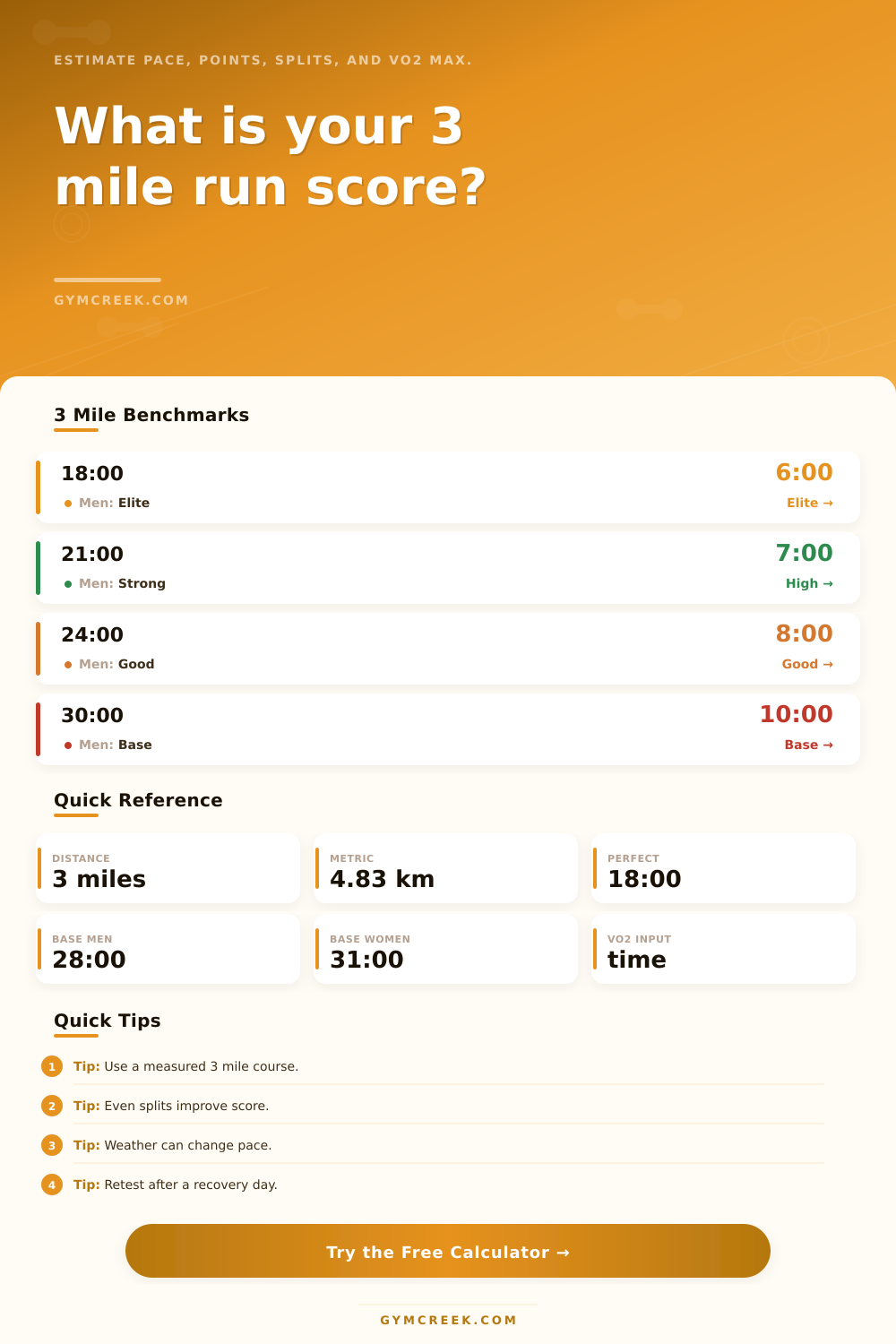
| Finish | Mile Pace | Score Range | Category |
|---|---|---|---|
| 18:00 | 6:00 | 100 | Maximum |
| 21:00 | 7:00 | 85-90 | High |
| 24:00 | 8:00 | 70-80 | Solid |
| 27:00 | 9:00 | 55-65 | Borderline |
| 30:00 | 10:00 | 40-55 | Retest risk |
| Age Band | Men Pass | Women Pass | Max Goal |
|---|---|---|---|
| 17-20 | 27:40 | 30:50 | 18:00 |
| 21-25 | 28:00 | 31:00 | 18:00 |
| 26-30 | 28:20 | 31:20 | 18:00 |
| 31-35 | 28:40 | 31:40 | 18:00 |
| 36-40 | 29:20 | 32:20 | 18:30 |
| 41-45 | 30:00 | 33:00 | 19:00 |
| Pace | 3 Mile | 5K Equivalent | VO2 Band |
|---|---|---|---|
| 6:00/mi | 18:00 | 18:38 | 55+ |
| 7:00/mi | 21:00 | 21:45 | 47-53 |
| 8:00/mi | 24:00 | 24:51 | 40-46 |
| 9:00/mi | 27:00 | 27:58 | 35-39 |
| 10:00/mi | 30:00 | 31:04 | 31-34 |
| Formula | Inputs | Output | Use |
|---|---|---|---|
| Linear score | Time, sex, age | Points | 3-mile test |
| Daniels VO2 | Speed, time | VO2 est. | Aerobic fitness |
| Pace split | Finish, distance | Splits | Race control |
| Course adjust | Heat, grade | Adj. time | Context check |
💡Tips
In the world of endurance sports, the three mile run occupy a special position. It is long enough to require a lot of aerobic capacity, but not long enough to rely only on fitness; instead, it requires pacing and strategy. As such, it serve as a linchpin for military fitness tests and serious amateur benchmarks. For many, it forms a major component of amateur standards or even military fitness testing. It distinguishes those trained bodies capable of working hard despite fatigue from those who is merely jogging.
Once you enter in your time and conditions, the calculator above do the rest. It converts raw seconds into pace measures and useful points to help you make sense of them in terms of your training goals. The vast majority of runners looks at the clock at the end. But most don’t pay attention to their surroundings. A runner who runs three miles on a controlled, flat track in 70 degree temperatures has a very different experience then one who runs in 90 degrees on a hilly road.
How to Use the 3-Mile Run Calculator
The heat cause your core temperature to increase more quickly and sends blood away from your muscles to try and cool your skin. The elevation also create extra resistance and requires more oxygen. When you factor those things out, you have a normalized score, which means it’s measuring how fit you realy are. When you run multiple times, whether different days or places, this levels the playing field and allows you to compare your performances.
Most folks give away points gained during training through poor pacing. Adrenaline makes it feel great to go out hard at the beginning, but by mile two, that initial rush of energy has turned to lactate and now you’re crawling along. Use the tool’s split targets to see what your goal time would look like if you were evenly paced throughout.
Want to finish in eighteen minutes? You better have a solid six minute per mile pace from the gun. Going off by thirty seconds on the first mile will cost you more than thirty seconds at the finish line. Sprinting the last half mile to catch up means you risk breaking form or worse yet, cramping up.
In the reference section you’ll find scoring tables that show how you compare with wider benchmarks. Generally speaking, if you’re running about twenty one minutes, you’re solidly in the right place as a runner. If you’re nudging into late twenties, it’s time to do some base conditioning work. The categories aren’t random labels, but markers of changes in focus for your training.
If your score land in the borderline zone, it means you have an aerobic engine but it isn’t efficient. Knowing that will help you determine if you should of start doing tempo runs, or just tack on volume miles. Another indicator of your cardiovascular health is a VO2 max estimate. VO2 max refers to the maximum amount of oxygen your body can utilize when exercising at maximum effort.
The gold standard is to get this tested in a lab, but field estimates from time trials help us monitor changes over time. If your VO2 estimate increases, that’s typically a sign that either your muscles is becoming more efficient at using oxygen and/or your heart is getting stronger (higher stroke volume). Your workout plan shouldn’t have to be perfect, just moving in the right direction if it’s going to work.
Scoring also takes into account age since the human body change as we get older, lowering peak output and increasing recovery times. To reflect this normal change, the calculator reduces your passing window accordingly. A 22 year old runner isn’t expected to be equal to their 35 year old counterpart. The calculation recognizes that our bodies are capable of doing certain things naturaly throughout our lives. So there’s no penalizing someone based off an unrealistic measure of what they can do athletically at any given time. It rewards staying fit for life instead of shutting out athletes who may be past their prime but still have amazing capabilities.
The best time for retesting is when you have recovered properly. If you retake right away after a hard effort, many will see their scores decline as they’re still recovering and fatigued. Give it a couple of days so that your muscle glycogen stores can refill and your nervous system has a chance to reset. That way, your new score is an honest indication of improvement instead of simply no longer being as tired as you were on your previous attempt.
At its core, the three mile test will tell you where you are at right now, in terms of fitness. It measures mental toughness, endurance and speed all at once. Then use it to guide how you train for the next block. Focus on what showed up as your weak spot in your splits. You’re looking to not only be faster, but to understand why you finished when you did. That insight transforms an otherwise ordinary run into real progress towards your own athletic journey.