1500m Pace Calculator
Estimate 1500m race pace, 400m and 300m split targets, mile pace, speed, VO2 demand, energy cost, and strategy adjustments from one goal time.
📌Race Presets
Pick a realistic race scenario, then adjust the goal time, athlete details, track setup, and pacing strategy for your own 1500m plan.
⚙1500m Inputs
1500m pace snapshot
Enter a goal time, athlete profile, cadence, track setup, and strategy to build a realistic 1500m pace plan.
📊Race Metrics
📑Reference Tables
| Goal | 400m | 800m | 1200m |
|---|---|---|---|
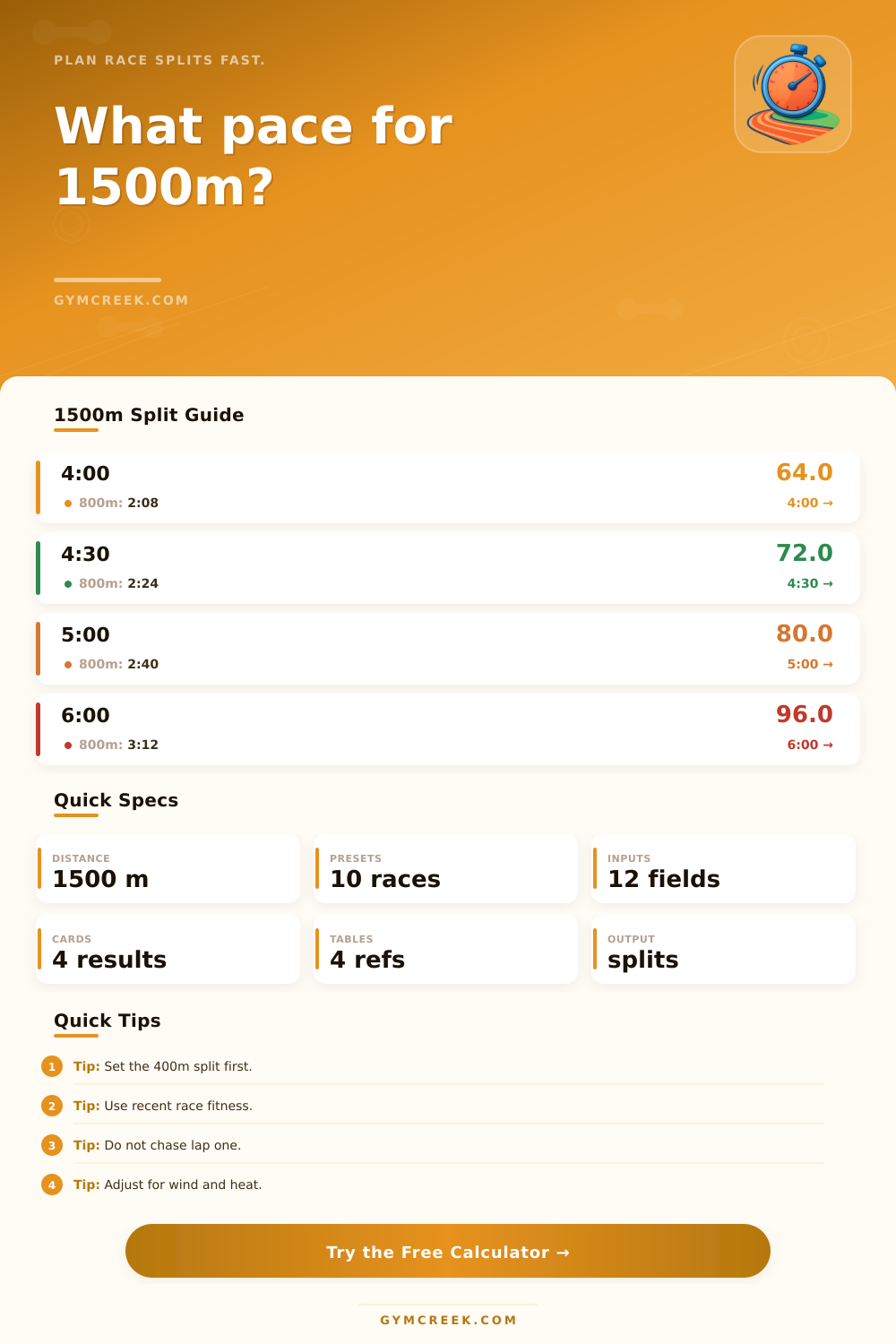
| 4:00 | 64.0 | 2:08.0 | 3:12.0 |
| 4:30 | 72.0 | 2:24.0 | 3:36.0 |
| 5:00 | 80.0 | 2:40.0 | 4:00.0 |
| 6:00 | 96.0 | 3:12.0 | 4:48.0 |
| Strategy | Lap 1 | Mid race | Last 300 |
|---|---|---|---|
| Even pace | Target | Steady | Target |
| Fast start | 1-2 sec fast | Hold rhythm | Survive |
| Negative | 1-2 sec slow | Build | Kick |
| Tactical | Relaxed | Position | Fast close |
| Setup | Factor | Effect | Use |
|---|---|---|---|
| 400m track | 1.00 | Baseline | Race plan |
| Indoor 200m | 1.02 | More turns | Indoor race |
| Road loop | 1.03 | Variable | Time trial |
| Grass loop | 1.06 | Slower | Fitness test |
| Metric | Formula | Inputs | Readout |
|---|---|---|---|
| Pace | Time / dist | Goal, meters | km and mile |
| Speed | Dist / time | Meters, sec | m/s, km/h |
| VO2 | ACSM run | m/min | ml/kg/min |
| Energy | MET x kg x hr | VO2, weight | kcal |
💡Tips
Between a distance race and a pure sprint lies the 1500 meters. It is just long enough that most runners starts feeling it in their legs by the 400-meter mark, and then the feeling comes back when there are roughly 300 meters remaining. Why? Because the pace you set out running begin to take its toll.
Having a goal time isn’t enough. You have to know what that time demands from your stride. You should also know how it impacts your breathing. And, finally, you should consider whether or not you’re willing to maintain form during final lap when things get ugly. How? Use the calculator in the box above to convert one target time into several meaningful checkpoints.
How to Use the 1500 Meters Calculator
Total seconds divided evenly over 400-meter laps. Equivalent mile pace and average speed. Oxygen cost for this effort. Those figures is useful for determining if the pace you intend to run is reasonable, before you head to track. That’s why it asks for body height and weight. Heavier runners pay a higher energetic cost to running the same speed. Taller runners with abnormally short strides frequently encounter cadence limitations they didn’t anticipate. Those details are included in calories estimate. But it also feeds them into stride length check. So you can judge if your target time match your actual movement.
Sex and age feed into caution score. This is essentially a warning that both of these factors changes one’s ability to recover. Both also change typical race experience. There is some real and tiny difference in the math based off track type and lane selection. If running indoors, there are turns that cost you time on 200-meter track. Those are just additional factor added to an otherwise unchanged official distance.
There’s also the matter of running lane two or three (non-staggered) which takes a few extra meter. That’s something most folks don’t consider until they hear it from the clock. The calculator accounts for both so the splits you see are closer to what you’ll actualy run.
This is where runners overestimate: pacing strategy. On paper, an even split plan appears clean, but few championship races play out this way. A negative split means staying patient early and giving everything in the last 300 meters. See how each option moves the checkpoints around and make your decision as to what fits the race you’re in.
Those are the inputs: wind, surface and effort level. They alter the actual demand. The clock doesn’t change; the physical cost changes. A 2 percent headwind equals added work that won’t appear on the scoreboard. Running on a grass loop will add hidden effort. Those factors stacked increase caution score. It’s good feedback prior to committing to a time. The caution score rises when those factors stack, which is useful feedback before you commit to a time that only works under perfect conditions.
Quick context from the reference tables on page. No need to memorize formulas. A table converts common goal times to 400 and 800-meter splits. Another table shows how various strategies affects the early, middle and closing segments. Glance through it for reference purposes. Then test your own numbers in the calculator again.
This stuff doesn’t replace racing experience or even training. It just takes away the arithmetic so you can concentrate on those decisions that realy matter on race day.