12-3-30 Workout Calories Burned Calculator
Estimate treadmill calories, ACSM walking METs, vertical gain, distance, and weekly burn from body weight, speed, incline, duration, handrail use, and training frequency.
Your treadmill calorie estimate
The calculator uses the ACSM walking equation and then applies handrail, grade, and fitness-context adjustments.
| Preset style | Speed | Incline | Training interpretation |
|---|---|---|---|
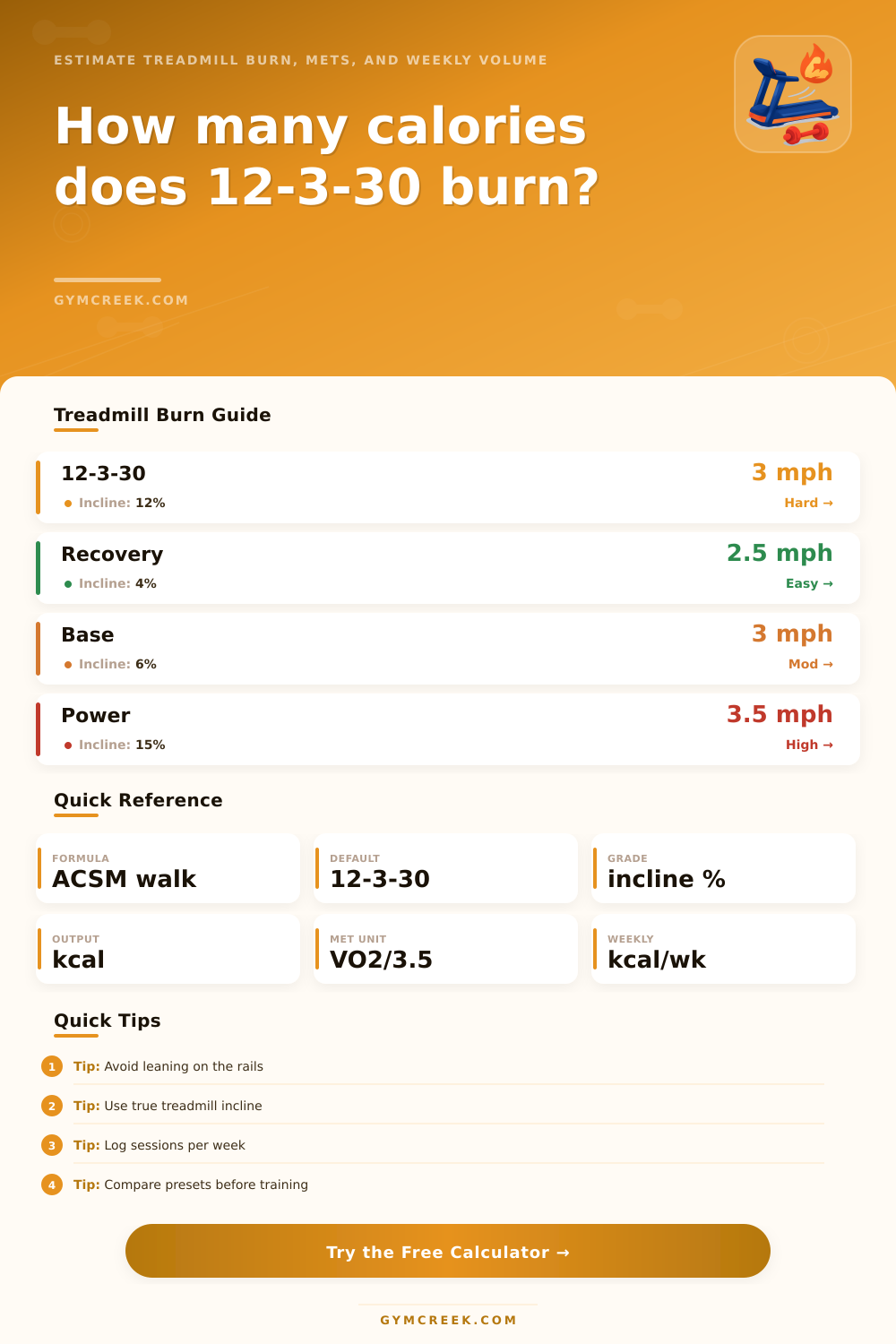
| Classic 12-3-30 | 3.0 mph | 12% | Hard incline walk for many recreational users; pacing and rail use matter. |
| Beginner ramp | 2.4 to 2.8 mph | 4% to 8% | Lower grade exposure while building calf and aerobic tolerance. |
| Steady base walk | 3.0 mph | 6% | Moderate aerobic option when 12% is too much for frequent sessions. |
| Power incline walk | 3.3 to 3.6 mph | 12% to 15% | High muscular and cardio demand; best used sparingly for most users. |
| Metric | Formula | Output | Why it matters |
|---|---|---|---|
| Walking VO2 | 0.1 x speed + 1.8 x speed x grade + 3.5 | ml/kg/min | ACSM treadmill walking equation using meters per minute and decimal grade. |
| MET estimate | VO2 / 3.5 | METs | Converts oxygen cost to a standard exercise-intensity unit. |
| Calories | MET x 3.5 x kg / 200 x minutes | kcal | Standard MET calorie estimate scaled to body weight and duration. |
| Vertical gain | Distance x grade | feet or meters | Shows the climb created by the treadmill incline setting. |
| Adjustment | Multiplier | Use case | Reading |
|---|---|---|---|
| No handrails | 1.00 | Natural arm swing | Best match for treadmill walking equations. |
| Light touch | 0.94 | Brief balance contact | Small reduction for partial unloading. |
| Regular support | 0.86 | Hands on rails often | Moderate reduction because the belt does less work against body mass. |
| Heavy leaning | 0.75 | Body weight carried by arms | Large reduction; actual burn may be much lower than display calories. |
| Sessions per week | Total minutes | Typical use | Volume note |
|---|---|---|---|
| 1 to 2 | 30 to 60 | Occasional incline work | Useful for testing tolerance without crowding other training. |
| 3 to 4 | 90 to 120 | Common 12-3-30 frequency | Check calves, shins, and recovery before adding more incline. |
| 5 to 6 | 150 to 180 | High weekly consistency | Often needs lower intensity days or less grade to stay sustainable. |
| 7+ | 210+ minutes | Daily incline routine | Monitor soreness and rotate easier walks when fatigue builds. |
The 12-3-30 workout use a treadmill to create a specific type of physical demand of the leg and lungs of the person performing the exercise. To complete the 12-3-30 workout, a person must exercise on a treadmill that is set to a speed of three miles per hour, an incline of twelve percent, for a period of thirty minutes. Such a treadmill setting will create a demand upon the legs and the lungs of the person perform the exercise.
The 12-3-30 workout is popular due to the simplicity of the exercise and the fact that no special knowledge of exercise or programming are required to perform the exercise. The number of calories that is burned during the 12-3-30 can be calculated with a simple equation that correlate the amount of oxygen that the body uses to perform the exercise to the calories that is burned. The equation takes into account the incline of the treadmill and the speed at which the person walk on the treadmill.
How the 12-3-30 Treadmill Workout Burns Calories
The actual workload that is placed upon the legs of the individual, however, the individual can alter by the individual’s use of the handrail of the treadmill. Should an individual place most of their weight upon the handrails, the individual will reduce the workload upon the legs, leading to both the reduction of the number of calories that the individual burns, and the reduction of the difficulty of the 12-3-30 workout. A calorie calculator can be utilized to calculate the number of calories that will be burned during a 12-3-30 workout.
The calculator will ask for the individuals weight, the speed of the treadmill, the incline of the treadmill, the length of the exercise in minute, and whether or not the individual utilize the handrails of the treadmill. The result of the calculator can be multiplied by the number of times that the individual plan to perform the 12-3-30 workout each week. This number will represent the total number of calories that the individual performing the 12-3-30 workout will burn each week.
The incline of the treadmill will cause the individual to gain height while performing the exercise, leading to the activation of the calf and shin muscle. Thus, even at three miles per hour, the calves and shins may begin to feel fatigued after performing the 12-3-30 workout for extended period of time. Many individuals may make mistake when performing the 12-3-30 workout.
For instance, many individuals may not understand that placing the weight of their bodies onto the handrails will reduce the calories that is burned during the 12-3-30 workout. A light touch of the individuals hands upon the handrails may only reduce the workload performed by the legs by a small percentage of the total workload. However, a heavy touch upon the handrails will reduce the calories burned by the individual by twenty-five percent.
In addition, treadmills may not always accurate reflect the incline of the treadmill. The incline that is displayed upon the treadmill may not be the same than the incline that is provided to the legs of the individual. Thus, an individual may have to adjust the incline that is reflected upon the treadmill to reflect the incline that the body feels.
An individual should also consider the number of times that they will perform the 12-3-30 workout each week. Performance of the 12-3-30 three or four times each week is likely to be tolerated by the body without excessive soreness. Performance of the 12-3-30 five or six times each week, however, will likely require an individual to perform an easier workout at least once or twice each week.
Performance of the 12-3-30 seven days per week will likely lead to fatigue in the lower leg of the individual. Thus, to prevent excessive fatigue, an experienced individual with strong legs may reduce the intensity of the 12-3-30 workout at least two days each week. The value of the numbers associated with the 12-3-30 workout is that they allow an individual to make trade-offs between the intensity of the workout and the need for the body to rest and recover.
For instance, an individual may burn the same number of calories during a short 12-3-30 workout that includes a steep incline as that individual would burn during a long 12-3-30 workout that includes a flat incline. However, the body will likely fatigue at a different rate with these two type of workouts. For instance, an individual that is returning to exercise after taking a break from exercise may have to perform the 12-3-30 workout with an incline that is less than twelve percent for several week to avoid fatigue of the calf muscles.
Additionally, the total number of calories that are calculated for each week will allow an individual to understand whether or not they are performing the 12-3-30 workout within the limits of their physical fitness level. Overall, the calorie calculator that estimates the number of calories that can be burned during the 12-3-30 workout can be adjusted if the individual change the use of the handrails or if the incline of the treadmill is not accurate to the incline that is provided to the legs of the individual. Thus, by using the calculator and by monitoring the total number of calories that the individual calculates for each week, an individual can ensure that the 12-3-30 workout becomes a repeatable part of the individuals training program.