100m Sprint Calculator
Project 100m performance from reaction time, 30m and 60m splits, acceleration quality, max velocity, wind, altitude, and track surface.
📌Presets
Presets load realistic sprint-test profiles. Splits are treated as race-clock splits from the gun, so reaction time is separated from movement time.
⚙Calculator
100m sprint projection
Enter reaction, 30m, 60m, max velocity, and race conditions to calculate.
📊Sprint Metrics
📑Reference Tables
| Profile | RT | 30m | 60m |
|---|---|---|---|
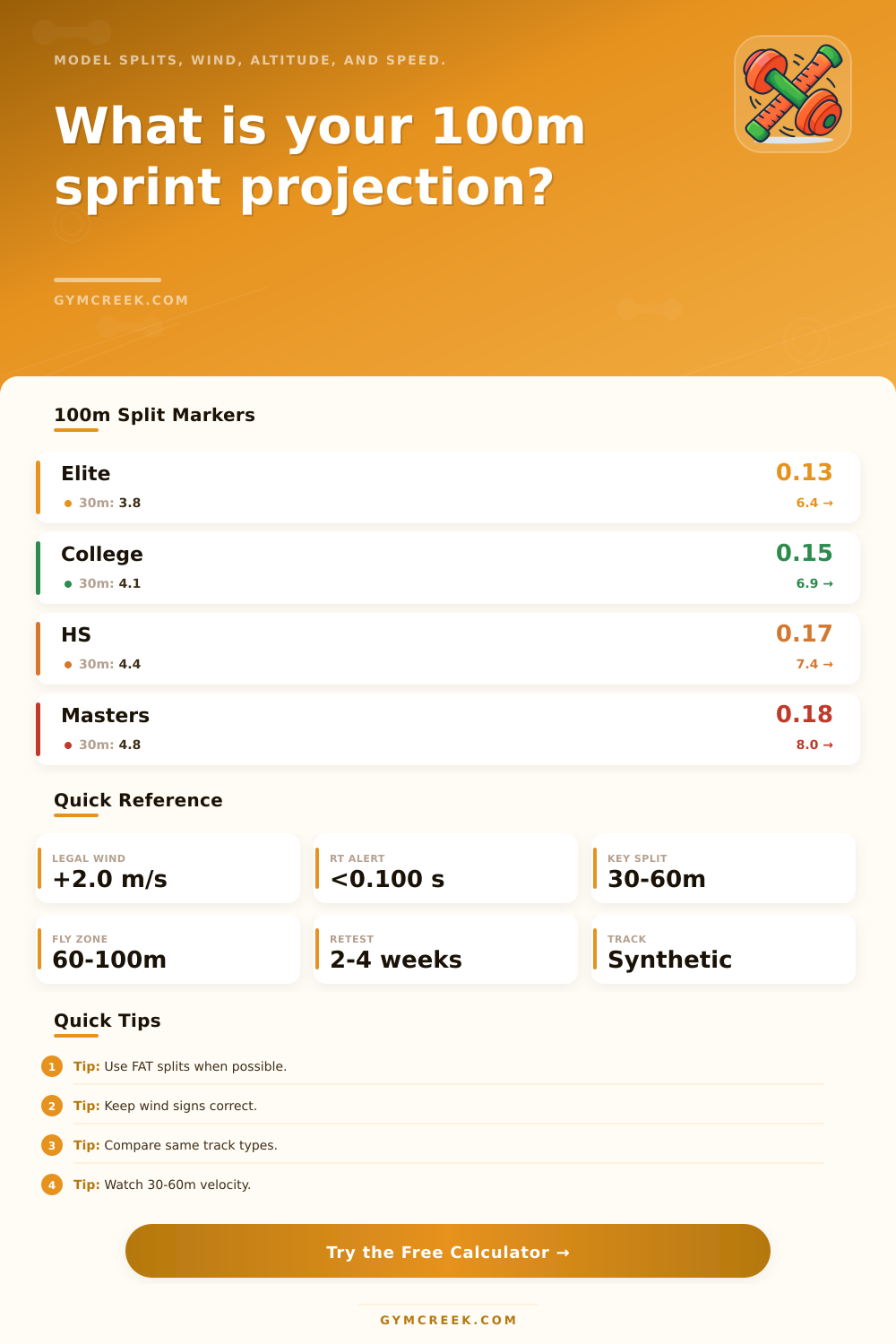
| World class | 0.12-0.15 | 3.75-3.95 | 6.30-6.60 |
| College | 0.14-0.17 | 4.00-4.30 | 6.75-7.15 |
| High school | 0.16-0.20 | 4.30-4.75 | 7.20-7.90 |
| Masters | 0.17-0.23 | 4.60-5.20 | 7.70-8.70 |
| Condition | Input | Model effect | Note |
|---|---|---|---|
| Tailwind | +1.0 m/s | About 0.05 s | Faster race |
| Headwind | -1.0 m/s | About 0.05 s | Slower race |
| Altitude | 1000 m | About 0.02 s | Less drag |
| Wet track | Surface | 0.08-0.16 s | Grip loss |
| Phase | Distance | Main clue | What it shows |
|---|---|---|---|
| Reaction | 0m | RT | Start signal |
| Drive | 0-30m | 30m split | Acceleration |
| Rise | 30-60m | Velocity | Max speed entry |
| Close | 60-100m | Decel ratio | Speed endurance |
| Formula part | Variables | Use | Caution |
|---|---|---|---|
| Movement time | Split - RT | Clean phases | Needs FAT |
| Segment speed | Distance/time | 30-60m | No stride data |
| Close estimate | 40m / speed | 100m projection | Model only |
| Corrections | Wind, altitude | Compare races | Approximate |
💡Tips
The 100m race is a very simple track and field event. Despite the simplicity of the event, small difference in preparation and conditions can change the time of the race for the competitors. For instance, if one sprinter leave the blocks a tenth of a second late compared to the other sprinters, that sprinter will lose place in the competition.
Additionally, if one sprinters runs into a headwind as compared to the others, that sprinter will lose places as well. Because such small differences can impact the outcome of the 100m race, coach and sprinters break down the race into measurable pieces. By breaking the 100m race into these pieces, coaches and sprinters can determine which part of the race need to be trained, and which part of the race does not need to be trained.
Parts of the 100m Race
The first piece of the 100m race is the reaction time for the sprinter. Sprinters and coach often misunderstand reaction time for the 100m race. Reaction time isnt a sprinters ability to think.
Additionally, reaction time is not the speed of a sprinters thoughts. Reaction time is the time between the starter’s gun and the first movement that the sprinters make away from the blocks. Electronic timing systems record reaction time in thousandths of a second.
Reaction times below 0.100 is considered false starts. A reaction time of 0.140 is faster than a reaction time of 0.190. This small difference in reaction times result in a difference of almost a full body length in the race between sprinters by the time they reach the 30 meter mark.
The calculator separates reaction time from the race segment to allow for the remaining segment of the race to be measured separately from the reaction time. The next segment of the 100m sprint is between the 0 and 30 meter marks of the track, and it is the segment of the race where force is most important for the sprinters. During the segment between 0 and 30 meters, the sprinters are rising from the drive phase, and they are pushing against the track.
Small improvements in the placement of the sprinters blocks at the start can result in improvements of up to 0.1 seconds in their reaction times to the starting gun.