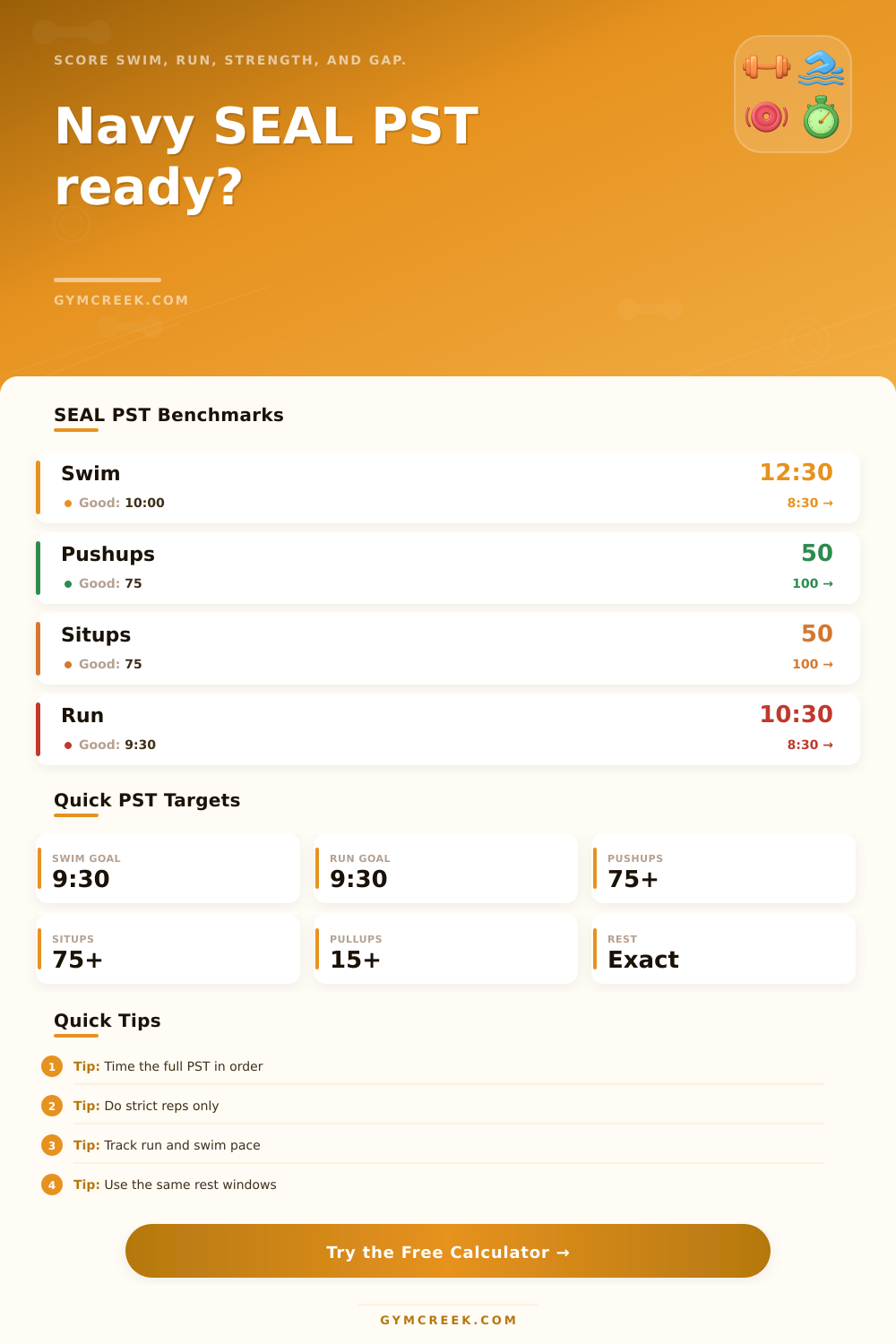
The Navy SEAL Physical Screening Test require the individual to use many of the energy system within there bodies. Furthermore, the test require the individuals to swim, run, push, pull, and perform these activity while fatigued. Because there are so many different movement and rules for the Navy SEAL Physical Screening Test, the test can be difficult for an individual to interpret on they own.
However, the calculator included on this page take the raw number from an individual’s Navy SEAL screening test and transforms those raw number into a clear picture of the individuals fitness level. The input for the calculator are important because they relate to the requirement of the Navy SEAL screening test. For example, the test require time measurement for swimming and running because these measure show an individual’s endurance; however, measurements of the number of push-ups, sit-ups, and pull-ups is required because those measurements measure an individual’s strength.
How the Navy SEAL Screening Test Calculator Works
Furthermore, an individual must enter an individual’s rest compliance data into the calculator; an individual’s rest compliance data will allow the calculator to determine whether or not that individual followed the protocol required of them during the Navy SEAL Physical Screening Test. For instance, if an individual rested for longer than the protocol allow for a certain event, there score will be penalized. Finally, an individual must enter an individual’s age into the calculator; age is one of the factor that allows the calculator to determine an individual’s body recovery capacity.
The calculator uses the output to determine how far an individual is from there target score, and what category that individual fell into according to there score. These category label are not to be used to boast one’s fitness level to others, but are provided to provide an individual with insight as to which area they should train within the Navy SEAL Physical Screening Test. Furthermore, the calculator also provide a strength balance metric for the individual.
This strength balance metric determine whether an individual’s push, pull, and core score are the same from event to event. If an individual’s score are vastly different from event to event, then they have an imbalance within their physical strength, which can lead to stalled progress with improving there score on the Navy SEAL Physical Screening Test. As with any test, preparation for the Navy SEAL screening test may not be linear in its approach for each individual.
For example, an individual may struggle with their swimming event while excelling in their ability to perform push-ups. Additionally, an individual may have a fast running time but score poor on the screening test due to a lack of adherence to the rest window between events. The calculator allow for these mismatch to be recognized so as to avoid having to perform the calculation by hand each time that individual performs the Navy SEAL screening test.
While the reference table provided on this page may be of great aid for each individual to understand their fitness level compared to other, the reference tables do not provide a means of determining how an individual felt during the test day or how they recovered from training block. The largest gap field allow for an individual to see what adjustment would provide the greatest benefit to their score on the Navy SEAL Physical Screening Test. Thus, this field allow an individual to focus primarily on the area that they need the most improvement in rather than those in which they already have strength.
Furthermore, while many individual may perform the Navy SEAL Physical Screening Test only once each year, it is recommended that each individual treat the Navy SEAL Physical Screening Test as an event that should be performed on a regular basis to monitor their fitness. For instance, if an individual performs the Navy SEAL Physical Screening Test every four to six week, the individual will be able to recognize if their swim time is improving or if their rest compliance is negatively impacting there score on the screening test. Moreover, the Navy SEAL Physical Screening Test is meant to reward individual for improving there consistency with the screening test and adhering to the rule required of them during the screening test.
Thus, an individual who can complete each requirement while maintaining a minimum number of repetition will score higher than an individual who score well in two event but fails to meet the minimum for the third. In addition to the factor that are accounted for in the calculator, an individual’s sleep, nutritional, and injury history may impact their performance on the Navy SEAL Physical Screening Test but cannot be measured by the Navy SEAL Physical Screening Test calculator. Thus, the calculator will provide an individual with a snapshot of their fitness level.
However, that individual should use the calculator to review the data provided by the Navy SEAL Physical Screening Test. Furthermore, after an individual complete a training block, they can re-enter their time and repetition into the calculator. Thus, the calculator will provide an individual with feedback regarding whether or not there training has help them to reduce the gap in the area that they need the most improvement.
By continuing to test themselves in the same way that they plan to perform during the Navy SEAL Physical Screening Test, the individual will begin to notice there improvement over time.