Waist Hip Height Ratio Calculator
Estimate waist-to-height ratio, waist-to-hip ratio, risk band, target waist range, and measurement sensitivity from waist, hip, height, sex, age band, and tape method.
📌Measurement Presets
Each preset fills waist, hip, height, sex, age band, unit, measurement site, posture, and tape tightness.
⚙Calculator
Waist ratio snapshot
Enter waist, hip, height, sex, age band, and measurement method to calculate.
📊Metrics Grid
📑Evidence-Style Reference Tables
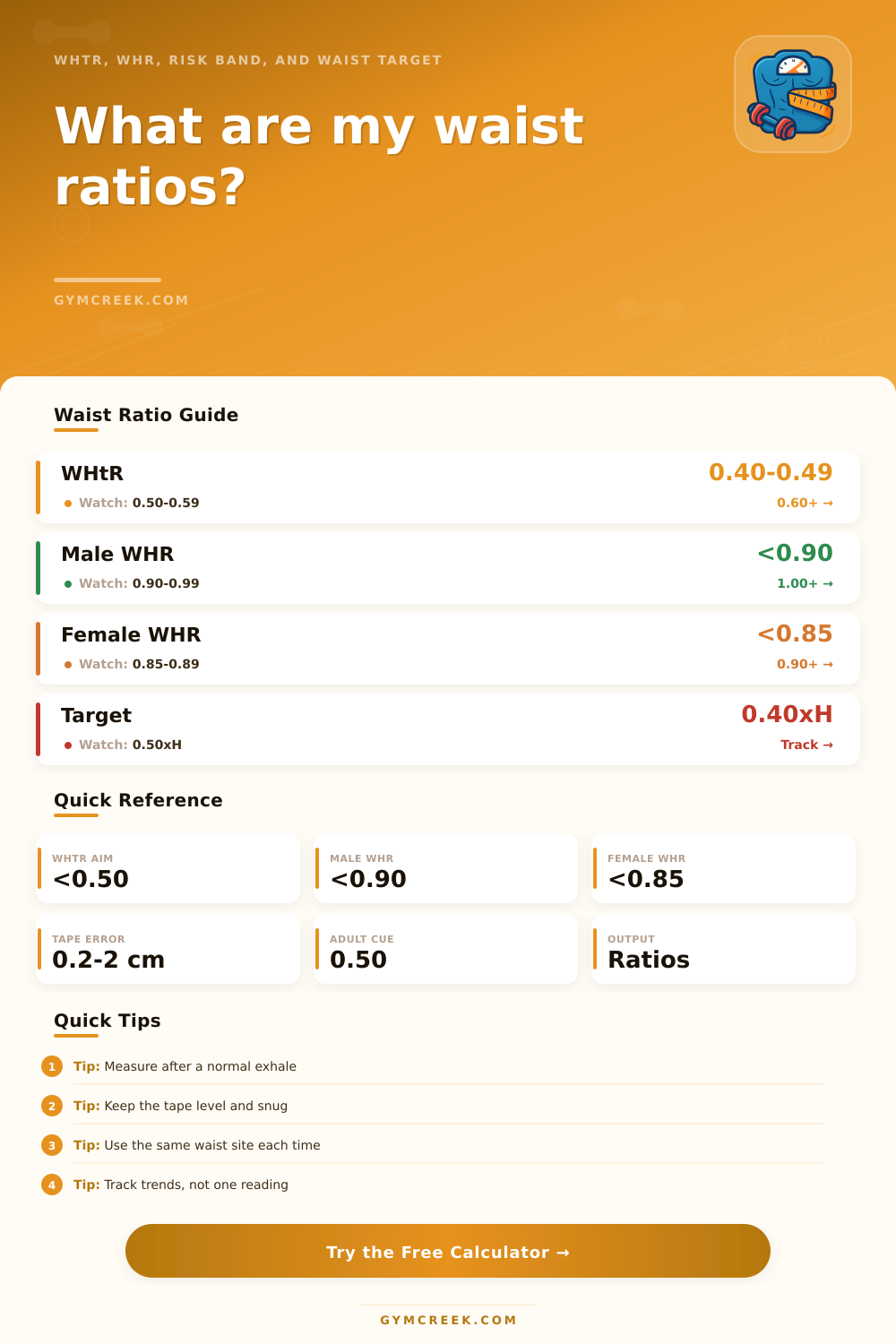
| WHtR band | Typical interpretation | Adult cue | Calculator action |
|---|---|---|---|
| Below 0.40 | Very low waist relative to height | Check context | Review measurement if unexpected |
| 0.40 to 0.49 | Lower cardiometabolic risk signal | Common target zone | Maintain consistent tracking |
| 0.50 to 0.59 | Increased risk signal | Often used as an action point | Compare trend and other measures |
| 0.60 or higher | High risk signal | Stronger follow-up cue | Discuss with a qualified professional |
| Sex | Lower risk | Increased | High |
|---|---|---|---|
| Male | Below 0.90 | 0.90 to 0.99 | 1.00 or higher |
| Female | Below 0.85 | 0.85 to 0.89 | 0.90 or higher |
| WHR formula | Waist divided by hip | Same unit required | Round to 2 decimals |
| Use case | Body-fat distribution cue | Complements WHtR | Not a diagnosis |
| Method choice | What it changes | Typical effect | Best practice |
|---|---|---|---|
| Midpoint waist | Standard landmark | Good repeatability | Use same spot each time |
| Navel waist | Often easy to find | May read higher or lower | Record the site used |
| Iliac crest | Hip-bone landmark | Protocol dependent | Keep tape level |
| Hip widest point | WHR denominator | Affects WHR strongly | Measure over widest buttock point |
| Source | Possible shift | Why it matters | Tracking cue |
|---|---|---|---|
| Normal exhale | Baseline | Stable abdominal position | Use the same breath point |
| Tape tightness | About 0.5 to 1.5 cm | Changes both ratios | Snug, no compression |
| Landmark switch | About 1 to 3 cm | Can change the risk band | Do not mix sites in a trend |
| Repeat average | Narrows random error | Improves trend quality | Use 2 or 3 close readings |
💡Tips
A waist hip height ratio calculator can tell you how your body fat are distributed on your body. Many individual focus on the number on the scale to determine there body fat percentage. However, the scale will tell you the total number of pound that you weigh, not where your body fat is located.
A waist hip height ratio calculator can help you to determine where your body fat percentage is located using tape measurement. Using this calculator will show you a more accurately picture of your body composition than the scale alone. The measurements that you use for your waist, hips, and height need to be accurate to provide you with the correct ratio.
How to Use a Waist Hip Height Ratio Calculator
Your waist should be measured at the midpoint between your lowest rib and your hip bone. Measuring at the navel will produce a different number for your waist size. Your hips should be measured at the widest point over your buttocks.
Measuring at the top of the pelvis will produce a different number than measuring at your widest point. Finally, you should measure your height while standing and without shoes on your feet. These factors will affect the ratio that is calculate, so be sure to note these variable when using the calculator for future measurements.
There are two different ratio that the calculator will calculate for you using the calculator. The first ratio is your waist-to-height ratio, which compare your waist size to your height. The waist-to-height ratio will help you determine if you have any fat accumulation around your middle.
The second ratio is the waist-to-hip ratio, which compares the fat that is located in the middle of your body to the fat that is located at the base of your lower body. Your waist-to-hip ratio can tell you if your body is an “apple” shape or “pear” shape. The calculator will place these ratios into risk band for you to see the target waist size for your height.
Your age and sex can play a role in your waist-to-height and waist-to-hip ratios. For example, a teenager may have a different ratio than an adult due to growth spurt. An adult may also have different ratio than a teenager due to the metabolic risk that come with age.
However, the calculation for these ratios will not change with your age and sex. The calculator will provide you with these variables as a way for you to easily understand your measurements without having to remember the different chart for each age and sex. Furthermore, the calculator will provide an estimate of the sensitivity of the calculations.
The sensitivity of the waist-to-height and waist-to-hip ratios will allow you to understand if a small change to a ratio is a result of your body changing or your body posture when taking the measurements. Many individuals may take the measurements once with the waist hip height ratio calculator and then neglect to take these measurements again. However, by taking the measurements regularly and under the same condition, you can compare the results of the calculations.
By taking your measurements at the same site, using the same posture, and with the same breath on your body, the result of these calculations will be more accurate. For example, if you take your waist measurement while standing and with your breath held, you may get a different reading then if you measured while lying down or breathing evenly. You should note where you measured and your posture so that you use the same variable for future measurements.
Additionally, taking repeated measurements is always better than single measurement because they can show you a trend in your body fat percentage. The reference table will provide you with the waist-to-height and waist-to-hip ratio zone for your body fat percentage. These zones will allow you to discuss your waist-to-height and waist-to-hip ratios with a clinician.
By knowing your ratio zones, you can easily discuss the results of your body fat percentage with your clinician or personal trainer. It is necessary for you to be consistent with the variables in your waist-to-height and waist-to-hip ratio calculation. If you change the site of your measurement, your ratio will change, even if your body fat did not change.
Another factor that is important to be consistent with is your breathing. If you take a deep breath when taking your waist measurements, your waist size will change compared to if you breathe even. Therefore, take your waist measurements with a normal exhale so that your breathing does not change the accuracy of these calculations.
The primary value of using a waist hip height ratio calculator is its ability to make visible the patterns of your body fat percentage. For instance, even if your weight on the scale remain the same, your waist-to-height ratio may be increasing. This could mean that your body fat is changing in some way.
However, if your waist-to-height ratio is decreasing, this can indicate that the changes that you have made to your diet or physical activity are having the desire effect on your body fat percentage. By understanding these possible direction of change in your body fat percentage, you can make informed decision regarding your health and the management of your body fat percentage. You should of checked with a doctor first.