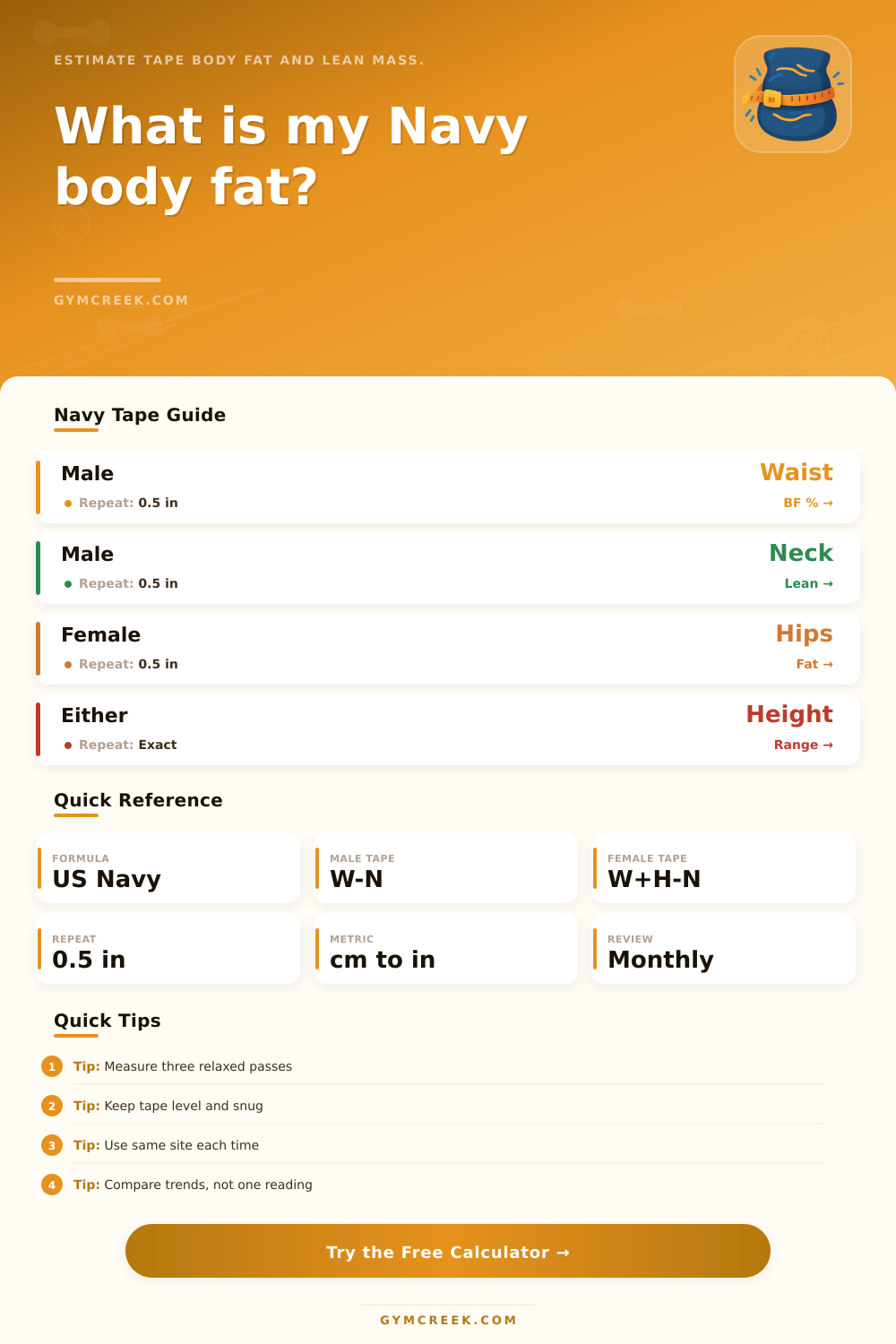
The Navy body fat calculator is a tool that use specific measurement of an individual’s body to calculate the amount of body fat that the individual has. The military created the Navy body fat calculator as a means of measuring the body fat of individuals without having to use expensive equipment or go through laboratory analyses to determine the body fat percentage of those individuals. To use the Navy body fat calculator, an individual’s height, waist, neck, and (for women) hip measurement must be taken, and the individual must enter those measurements into a specific formula that produce an estimate of the body fat of that individual’s body.
Furthermore, because the Navy body fat calculator utilize only a tape measure to take the measurements of an individual’s body, the Navy body fat calculator allows individuals to track their body fat percentage over time and with each passing months. The inputs for the Navy body fat calculator are an individual’s height, waist circumference, neck circumference, and (for women) hip circumference. The height of an individual is required because the body is often treated as a cylinder in the Navy body fat calculator.
How to Use the Navy Body Fat Calculator
The Navy body fat calculator utilizes the circumference of an individual’s waist as a means of measuring the fat that accumulate at the waist of an individual. The Navy body fat calculator calculates the circumference of an individual’s neck as a means of excluding the muscular structure of the body from being counted towards the body fat percentage calculation of the individual. For women, the circumference of the hips is also calculated as an input in the Navy body fat calculator because the fat distribution of women is not the same than the fat distribution of men.
Furthermore, it is also possible to take multiple measurement at each site to ensure that the body measurements are accurate and repeatable; if the measurements at a certain site differ significantly from one another, it indicates that the tape measure was not properly placed or tight at the time of each measurement. The outputs of the Navy body fat calculator are an individual’s body fat percentage, lean mass, fat mass, and category label. The body fat percentage calculated by the Navy body fat calculator is a single percentage number that represents the percentage of total body weight that is comprise of body fat.
The lean mass and fat mass outputs calculate the weight of each of these component of the body; knowing these two values allows an individual to understand if they are losing weight that is only made up of body fat, or if they are losing both fat and lean muscle mass. The category label associated with the body fat percentage allow an individual to understand if their body fat percentage is within certain standards of their body composition; finally, the Navy body fat calculator also provides an analysis of the sensitivity of the body fat percentage calculations if the tape measurements change by a small amount (such as by half an inch). The Navy body fat calculator does have some limitations to its calculations.
The Navy body fat calculator does not account for an individual’s body fat percentages in the visceral area of the body in comparison to the body fat percentage in the subcutaneous fat area of the body. Additionally, the Navy body fat calculator does not calculate an individual’s body fat percentage in relation to their bone density or the amount of water in their body; each of these factor may impact the body fat percentage of an individual, but the Navy body fat calculator does not account for these factors. Thus, athletes may use the Navy body fat calculator to monitor their body fat percentages in comparison to the results of more complex and costly DEXA or Bod Pod scan.
Overall, though, the Navy body fat calculator is a useful tool to monitor body fat percentage in comparison to those costly scan. Finally, it is important to follow specific technique when using the Navy body fat calculator. Each measurement must be taken with the tape measure level to the individual’s skin, and the tape measure should be snug to the skin; it should not be too tight to the skin.
The individual should breathe normally during the measurement process; holding their breath may impact the measurement of their fat percentage. The three measurement site should be the same every time that individual uses the Navy body fat calculator; if the individual takes the body fat percentage measurements differently each time, the Navy body fat calculator will calculate the fat percentage of the individual inaccurately. Thus, the Navy body fat calculator can only calculate the body fat percentage of the individual if the individual ensures that the placement of the tape measure is consistent to the individual each time the Navy body fat calculator is used.
Therefore, the Navy body fat calculator can be used as a way to monitor an individual’s body fat percentage over time. By entering the individual’s measurements into the Navy body fat calculator, the individual can review the resulting body fat percentage, lean mass, fat mass, category label, and the sensitivity range of that percentage calculation. By reviewing these calculations, an individual can determine if they are satisfied with the body composition measurements of their body relative to their nutrition or training plan.
Furthermore, if the individual continues to use the Navy body fat calculator over several month, the body fat percentage calculations will begin to reflect the body composition changes of the individual as reflected by how their clothes fit on the individual or the performance of the individual in any particular task; this reflection of the body changes by an individual is the primary value of utilizing the Navy body fat calculator.