Army Body Fat Calculator
Estimate Army circumference-method body fat from sex, age, height, neck, waist, hip when applicable, tape tolerance, body weight, and a comparison reading.
📌Military Tape Presets
Presets load realistic tape-test cases across age groups and sexes. Replace them with your measured profile before using the result.
⚙Calculator Inputs
Army tape snapshot
Enter body profile and circumference measurements to calculate.
📊Metrics Grid
📑Reference Tables
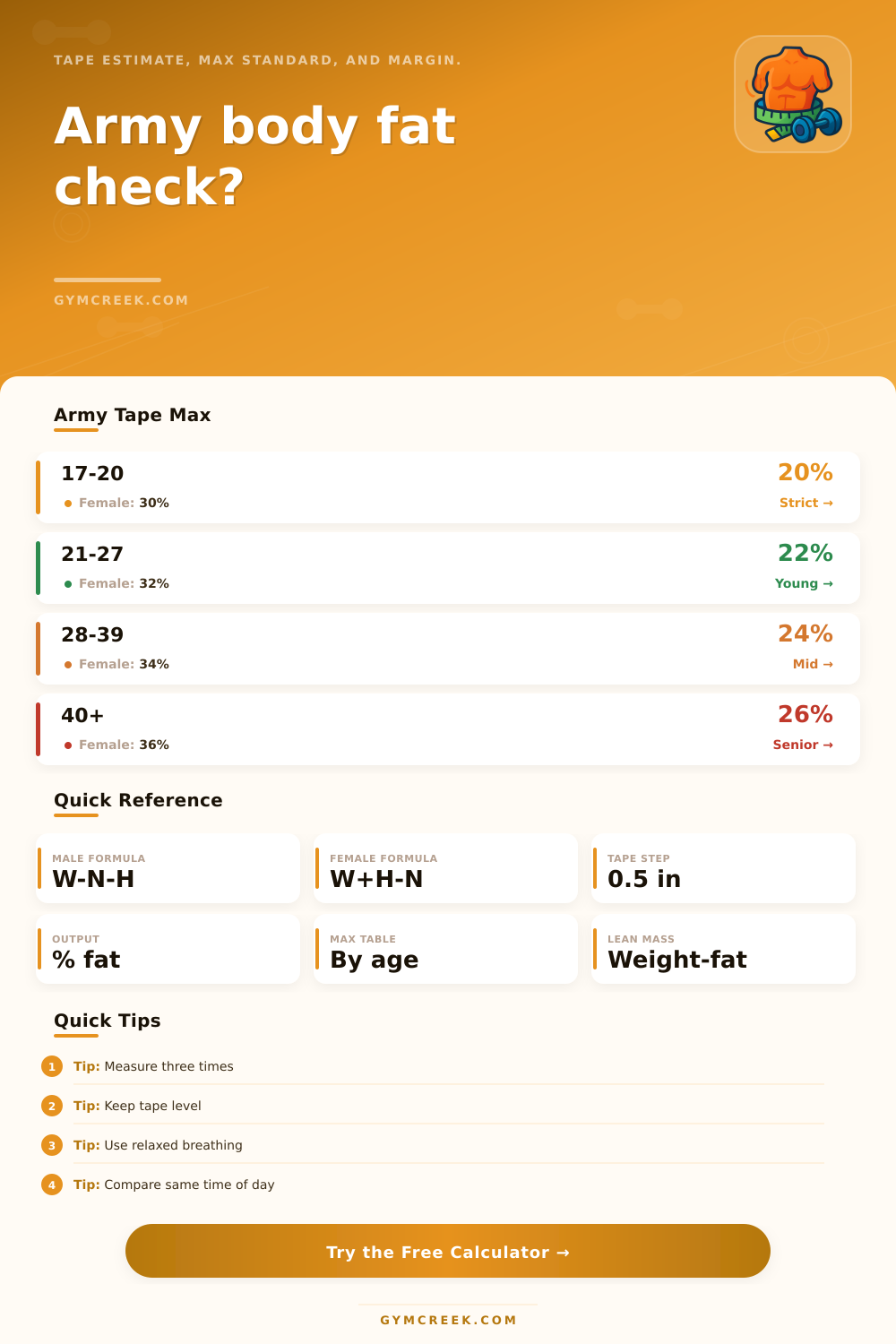
| Age group | Male max | Female max | Calculator use |
|---|---|---|---|
| 17 to 20 | 20% | 30% | Strictest Army age band |
| 21 to 27 | 22% | 32% | Young adult standard |
| 28 to 39 | 24% | 34% | Mid-career standard |
| 40 and older | 26% | 36% | Senior age band |
| Sex | Formula | Required measures | Unit rule |
|---|---|---|---|
| Male | 86.010 x log10(waist - neck) - 70.041 x log10(height) + 36.76 | Height, neck, waist | All in inches |
| Female | 163.205 x log10(waist + hip - neck) - 97.684 x log10(height) - 78.387 | Height, neck, waist, hip | All in inches |
| Metric | Convert cm to inches first | Same measures | cm / 2.54 |
| Final read | Raw percent and nearest whole percent | Body fat result | Percent body fat |
| Input | Common direction | Effect if larger | Calculator sensitivity |
|---|---|---|---|
| Neck | Measured below larynx | Usually lowers estimate | Best case raises neck |
| Waist | Level tape, relaxed | Raises estimate | Worst case raises waist |
| Hip | Female formula only | Raises estimate | Worst case raises hip |
| Tolerance | Entered by user | Widens result range | Best-to-worst band |
| Zone | Trigger | Meaning | Next check |
|---|---|---|---|
| Within Standard | At least 2 points below max | Clear margin on this estimate | Maintain same measurement method |
| Near Limit | 0 to 2 points below max | Passes but little room for tape error | Recheck with careful technique |
| Review Zone | Up to 2 points over max | Close enough for repeat measurement focus | Confirm measurements |
| Over Max | More than 2 points over max | Above the selected max context | Use official guidance |
💡Tips
The Army body fat percentage standards exists to ensure that the soldiers of the Army are ready for combat, and to ensure that they always remains deployable. This standard was also established as a means of preventing the physical decline of soldier, as physical decline can lead to various medical or performance problem. In order to determine if a soldier has a body fat percentage that meets the Army’s standard, the Army utilizes the tape method to calculate the percentage of body fat of each soldier.
The tape method is a helpful technique for measuring body fat of soldiers because it dont require any special and expensive equipments. To utilize the tape method, a soldier’s neck and waist circumference is measured (and for women, the circumference of their hips as well). These measurements are used in an equation to calculate the percentage of body fat of that particular soldier.
How the Army Measures Body Fat
If the soldier’s body fat percentage is within the standard percentage range, they pass the test; otherwise, they must perform more work to meet the percentage standard. While the math required for the tape method is relatively simple, soldiers must take care to ensure that their measurements are consistent in order to recieve the correct body fat percentage estimate. The equation utilizes the measurement of a soldier’s waist circumference as the main factor that determines their body fat percentage, but also utilizes the soldier’s neck circumference as a counterweight to that measurement.
A larger neck circumference will result in a lower body fat percentage estimate, while a larger waist circumference will raise that percentage. A soldier’s height is also incorporated into the calculation of their body fat percentage. For women, the hip circumference is also incorporated into that equation.
While the tape method calculator can help to perform the required calculations for body fat percentage, and prevent errors in those calculations, the soldier is still responsible for understanding how each body measurement impact the body fat percentage estimate. The age and sex of a soldier are two variables that impact the maximum body fat percentage that a soldier can have. For instance, the maximum body fat percentage allowed for a soldier of either sex for the age of 20 is six percentage points lower than the maximum body fat percentage that can be allowed for soldiers of that same age for those of either sex aged 40.
The Army allows for these difference in body fat percentage requirements as it is more difficult for soldiers of either sex to maintain lean body composition as they age. However, the Army still wishes to maintain a specific line for the body fat percentage of each soldier of either sex. Thus, the Army can use the age of the individual soldier to determine the correct maximum body fat percentage for that soldier with the calculator that the Army utilizes.
Another important factor of the Army’s tape method requirement for soldiers is the margin of that body fat percentage relative to the maximum body fat percentage allowed for that soldier. If a soldier has a body fat percentage that is significantly lower than the maximum body fat percentage for that individual, then it is likely that their body fat percentage will remain steady even with slight alterations to the tape measurements. However, if that soldier’s body fat percentage is close to their maximum allowed body fat percentage, then even the smallest error in measuring their body fat will result in that soldier failing the required test.
The calculator for body fat percentage can indicate the sensitivity of that body fat percentage calculation, which can help soldiers to understand how precise their body fat percentage measurements must be. Some errors are likely to occur when using the tape to measure body fat. For instance, a soldier may measure their circumference with the tape too tight against their skin, or too loose/sagging when measuring.
Additionally, a soldier may not take care to measure their waist at the same level each time, or may hold their breath when measuring their waist circumference. Each of these errors will impact the measurement of the soldier’s body fat percentage. While the calculator cannot fix these errors, it can be programmed to show the body fat percentage that would result from these error.
Beyond the calculation of a soldier’s body fat percentage, the calculator also provides an estimate of the soldier’s lean mass. The lean mass is calculated by subtracting the body fat percentage from the total body weight of that soldier. While this calculation is provided as a helpful estimate for soldiers to understand the impact of their body fat percentage, it shouldnt be used as a replacement for a professional body composition scan.
The lean mass value can help to determine if an individual’s weight change are due to the gain or loss of fat mass, or muscle mass. For instance, if an individual’s total body weight and lean mass both decline, their body fat percentage may decline as well. Additionally, if total body weight declines but lean mass remains the same, body fat percentage should decline.
Additionally, the calculator allows soldiers to utilize the comparison field to compare their current body fat percentage to another number. This other number could be any previous body fat percentage that was determined during an official tape measurement, or could be a target body fat percentage that the soldier wishes to compare their percentage to. The difference between these two percentages can help soldiers to determine if they are achieving their body fat percentage goals over time.
Small alterations to body fat percentage are required of soldiers over time due to the built-in noise within the tape method. Finally, the reference tables located on the calculator provide soldiers with important information regarding the Army’s body fat percentage requirements. One table provides information regarding the maximum body fat percentages for different age groups, while the second table provides the mathematical equation that is used to calculate a soldier’s body fat percentage.
The third table explains each of the compliance zone for body fat percentage requirements for soldiers. These three tables are functional tables that can help each soldier understand the requirements of the Army regarding body fat percentage standards. While the tape method for measuring body fat percentage has some inherent weakness, the overall method is still one that is useful to the Army.
For instance, while the tape method may provide inaccurate measurements of the body fat percentage of soldiers with unusually distributed body fat mass, the method is inexpensive and repeatable, and these two factor ensure that the Army can utilize this body composition measurement tool for each soldier. Thus, the best use of this calculator is to determine one’s body fat percentage quickly. Additionally, the calculator can help to show body fat percentage change with time.
Therefore, this tool should be used to calculate body fat percentage with current measurements, with the sensitivity range noted, and with the soldier making a determination of whether or not they should re-measure their body fat percentage, or whether they should continue to perform their training. Additionally, any changes to a soldier’s body composition will impact their body fat percentage, and the calculator can help to show how those percentages may change.