Fat Intake Calculator
Estimate daily fat grams, fat calories percent, per-meal fat, saturated fat ceiling, and essential fat adequacy from calories, diet style, body weight, goal, omega-3 target, meals, training level, and macro allocation.
📌Fat Intake Presets
Presets load realistic calorie, body weight, diet style, goal, saturated fat, omega-3, meal frequency, training, and macro-allocation combinations.
⚙Calculator Inputs
Fat intake snapshot
Enter your calorie target and nutrition preferences to estimate daily fat, saturated fat, per-meal fat, and essential fat adequacy.
📊Metrics Grid
📑Reference Tables
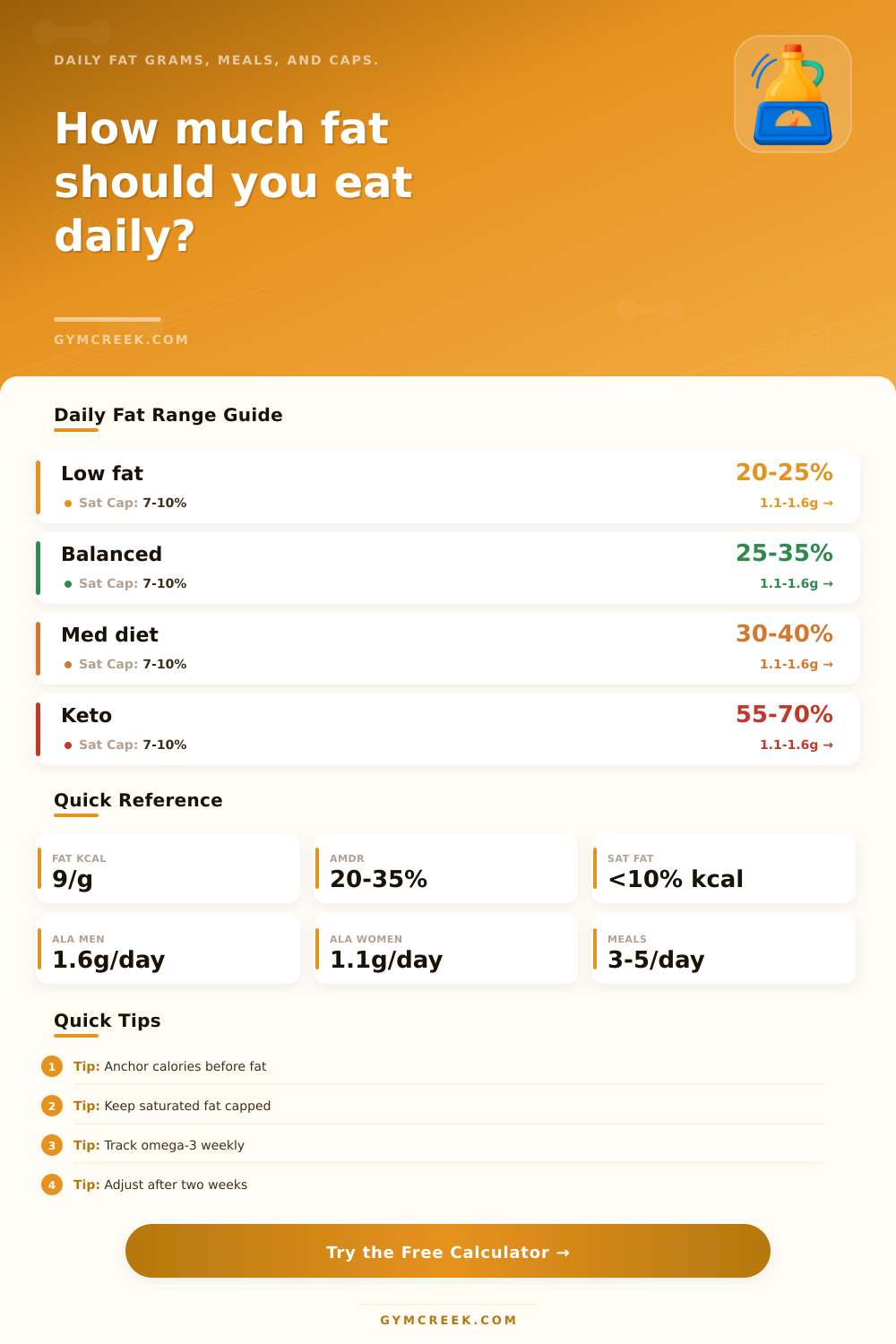
| Diet style | Typical fat range | Best fit | Watch point |
|---|---|---|---|
| Lower fat | 20-25% calories | Higher-carb cuts and endurance blocks | Do not drop below essential fat needs |
| Balanced | 25-35% calories | Most strength, recomposition, and maintenance plans | Keep protein and fiber consistent |
| Mediterranean | 30-40% calories | Olive oil, nuts, fish, and mixed training | Saturated fat can still climb |
| Higher fat | 35-45% calories | Appetite control and lower-carb preference | Carb room may fall for hard training |
| Keto-style | 55-70% calories | Very low-carb nutrition preferences | Performance carbs are limited |
| Input | Adjustment | Why it matters | Calculator cue |
|---|---|---|---|
| Fat loss | Small fat reduction | Leaves room for protein and vegetables | Uses a lower percentage |
| Recomposition | Neutral target | Balances hormones, energy, and training fuel | Keeps style target steady |
| Performance | Protects carb room | Hard sessions often need glycogen | Flags low carb room |
| Lean gain | Slightly higher fat | Calories are easier to reach | Adds a small fat bias |
| Endurance | High-carb warning | Long sessions can suffer if fat is too high | Checks carb calories |
| Fat type | Common target | Food pattern | Planning note |
|---|---|---|---|
| Total fat | 20-35% calories for many adults | Mixed unsaturated and saturated sources | Very high or low can crowd other macros |
| Saturated fat | Less than 10% calories | Butter, high-fat dairy, fatty meats, coconut | Calculator converts the cap to grams |
| Omega-3 | 1.1-1.6 g/day ALA baseline | Fatty fish, flax, chia, walnuts | Your target may differ with clinical advice |
| Unsaturated fat | Most remaining fat | Olive oil, avocado, nuts, seeds, fish | Shown as room after saturated fat cap |
| Formula | Variables | Output | Use |
|---|---|---|---|
| Fat calories | Calories x fat % | kcal/day | Primary fat target |
| Fat grams | Fat kcal / 9 | g/day | Food tracking number |
| Per-meal fat | Fat grams / meals | g/meal | Meal planning |
| Saturated cap | Calories x cap / 9 | g/day | Upper ceiling |
| Omega adequacy | Target vs baseline | Status | Essential fat check |
💡Tips
Fat intake is one of the primary components of the bodys management of energy, as well as hormones and recovery. While many people view fat intake as a single number that they should either eat or avoid, fat intake is actualy a complex variables. Fat intake must be determined based off your daily calorie intake, your level of activity, and your training goals.
Each of these factor will impact not just how much fat your body should consume daily, but also whether that fat intake will displace other macros that the body requires. Because fat intake is difficult to balance correct, the calculator includes mathematical calculations of fat intake that take into account your target calorie intake, your body weight, your diet style, and your training details. A persons fat intake requirements may change according to there specific goals.
How Much Fat Should You Eat Each Day
For instance, individuals who are trying to lose weight may require a moderate fat intake to provide enough space for proteins and fiber to be consumed. Individuals who train hard several days each week may require a different fat intake than those who is more passive in their training schedule. Each of these factors is incorporated into the calculator to arrive at the correct amount of fat that should be consumed daily.
This prevents a person from consuming too much fat intake on the training days that they incorporate to their schedule. The saturated fat requirement for an individual is another factor that must be considered in the calculation of the individuals required fat intake. Saturated fat can have detrimental effects upon the health of an individual if consumed in high amounts.
The suggestion from health authorities is that an individual consumes less than ten percent of their total calorie intake in saturated fat. The calculator automatically calculates this saturated fat requirement in grams, rather than as a percentage of total calories. The remainder of the fat budget can be filled with foods like olive oil, nuts, avocado, or fish.
Omega-3 fatty acids are a different type of fat than the saturated fat that is discussed above, and they are an essential fat for the bodys normal function. The baseline recommendation of omega-3 fat is used to ensure that each individual consumes at least some of this essential fat. However, many individuals who include fatty fish or algae oil into their diets may increase their target of omega-3 fat intake.
The calculator allows an individual to enter their target of omega-3 fat intake, after which it calculates the percentage of total fat that will be comprised of omega-3 fat. If the percentage of total fat that is consumed as omega-3 fat is high, then an individual is advised to adjust the food sources from which they obtain there fat. The frequency with which an individual consumes their meals will also impact their fat intake requirements.
For instance, an individual who consumes four meals a day will be able to consume more fat than an individual who consumes three meals per day. Furthermore, calculating how much fat intake should be consumed with each meal will allow an individual to schedule their fat consumption to optimally balance their training and diet. While many athletes prefer consuming large meals that include fats, others may be better with consuming small meals with frequent dose of fat.
An individuals body weight also plays a role in the calculation of the fat that they should consume daily. The body requires a certain amount of fat for essential fat and protein minimums to be met, and the calculator uses body weight to calculate the minimum fat intake that an individual should consume daily. This minimum is utilized to ensure that an individual does not consume less than the fat needed for optimal health and functioning, particulary during weight loss phases.
An individuals training level will also impact their fat intake requirements. Those who perform endurance training or high volumes of weight lifting will require higher amounts of carbohydrates for energy. This can take up the space for fat intake that the calculator calculates, unless the individual chooses to modify the settings of the calculator to allow for higher fat intake to be consumed.
This calculation prevents an individual from setting their fat intake too high when they train hard each day. The reference tables that are provided within the calculator illustrate the different fat intakes that are used by each diet style. For instance, the Mediterranean diet style requires that an individual consumes thirty to forty percent of their fat intake to be from each meal.
Furthermore, the Mediterranean diet is best suited for individuals with mixed training schedules. A lower fat diet is best suited for those who perform high volumes of endurance training. Finally, a keto-style diet requires high amounts of fat to be consumed by the individual, and takes up most of the macronutrient budget for that individual.
Each of these diet styles can be compared side-by-side within the calculator to provide an individual with insight as to which diet is the best for their lifestyle. After calculating the fat intake for an individual, that number must be followed and maintained. Fat intake should be maintained at the calculated target for periods of ten to fourteen days.
During these periods, an individual can track their hunger, energy, and training levels. Fat intake may be easily adjusted during this ten-to-fourteen day period. The calculator will help to provide the baseline fat intake for an individual, but they must also pay attention to how there body feels while consuming that amount of fat.