Carb Calculator Keto
Track a keto carb budget from total carbs, fiber, sugar alcohols, servings, daily limit, ketosis strictness, training allowance, meals remaining, and weekly compliance.
📌Food And Day Presets
Presets load realistic food labels and day budgets. Replace them with the actual label, serving count, and carbs already eaten today.
⚙Carb Budget Inputs
Keto carb budget snapshot
Enter the food label and day budget to calculate net carbs, remaining budget, and weekly compliance.
📊Metrics Grid
📑Reference Tables
| Strictness | Common net-carb cap | Training allowance counted | Use case |
|---|---|---|---|
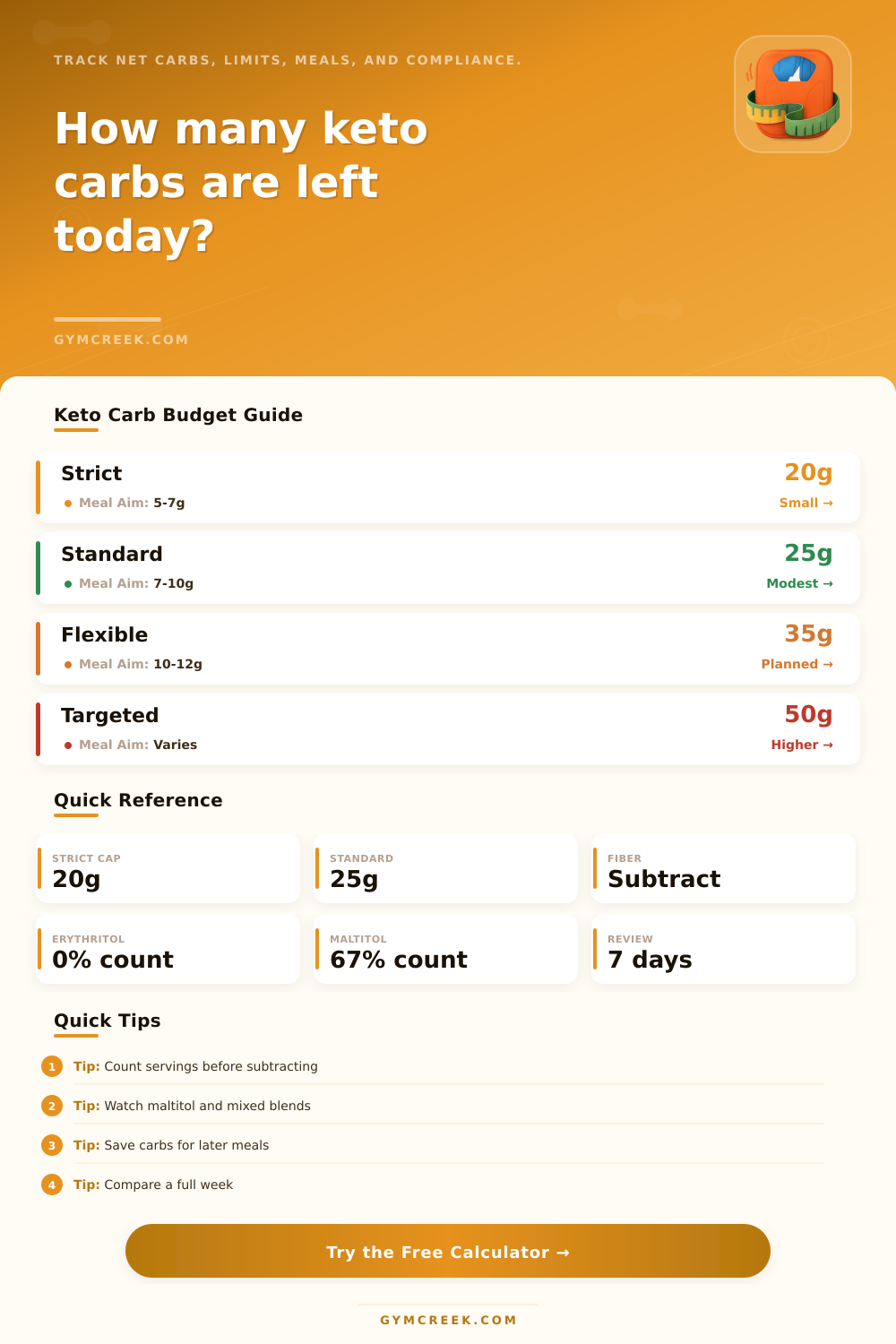
| Strict ketosis | 15 to 20 g/day | 50% of entered allowance | Small margin, simple foods |
| Standard keto | 20 to 30 g/day | 75% of entered allowance | Most daily tracking |
| Flexible keto | 30 to 40 g/day | 100% of entered allowance | Higher vegetable and dairy intake |
| Targeted keto | 35 to 60 g/day | 100% near training | Carbs placed around hard workouts |
| Type | Counted as net carbs | Example | Flag |
|---|---|---|---|
| Erythritol | 0% | 10 g counts as 0 g | Usually lowest impact |
| Allulose | 0% | 10 g counts as 0 g | Often excluded when listed |
| Xylitol or sorbitol | 50% | 10 g counts as 5 g | Partial digestion |
| Maltitol | 67% | 10 g counts as 6.7 g | Higher caution |
| Mixed or unknown | 50% | 10 g counts as 5 g | Conservative middle |
| Flag | Trigger | Why it matters | Budget response |
|---|---|---|---|
| Fiber heavy | Fiber over 40% of total carbs | Net carbs may be low but label tolerance varies | Track digestion and serving size |
| High total carbs | Food total carbs over 25 g | Large labels leave less room for error | Check serving weight carefully |
| Polyol caution | Maltitol or mixed sweeteners | Some grams can still count | Use counted fraction |
| Budget pressure | Over 80% of daily cap | Later meals need tighter choices | Reserve remaining grams |
| Compliance | Days within cap | Interpretation | Next check |
|---|---|---|---|
| Strong | 6 to 7 days | Budget is consistent | Review energy and training |
| Moderate | 4 to 5 days | Some meals need planning | Find recurring high-carb foods |
| Low | 0 to 3 days | Current cap is rarely met | Adjust limit or food choices |
| Training week | Depends on allowance | Carbs may be planned around workouts | Compare rest and training days |
💡Tips
Managing carbohydrate intake on a ketogenic diet dont involve a specific numbers. Instead, it is about understanding the effect of carbohydrate intake on the body on a particular day. You must determine the level of strictness you will have for your carbohydrate limit.
For some peoples, very strict limit are required. For others, more carbohydrate will be needed due to the requirement of vegetable, dairy product or the need to consuming carbohydrates for training purposes. You must understand the difference between total carbohydrates and net carbohydrates in your diet.
Managing Carbs on a Keto Diet
The difference between these two figure is often a point of confusion for individuals restricting there carbohydrate intake. Fiber dont impact the body in the same way that other carbohydrate do, hence the need to subtract fiber from the total carbohydrate count to calculate the net carbohydrate count. The same is true for sugar alcohol; some have a more bigger impact on the body than others.
For instance, erythritol will have a different impact on the body then maltitol. It is essential to account for the impact that food will have on your body, as the carbohydrate count on the food can be low yet it can contain a more higher amount of carbohydrates due to the sugar alcohol that are in that food. Your level of physical activity will impact your carbohydrate intake.
The more active your body is, the more carbohydrates your body can take in. The body can take in more carbohydrates when perform intense training than when remaining sedentary. Thus, the timing of your carbohydrate intake will have a greater impact on your body then calculating the number of carbohydrates you can have in a 24-hour period.
Monitoring your remaining carbohydrate budget and the carbohydrate allowance you have per meal will tell you how much flexibility you have for your meals. This will allow you to determine whether your meal should be simple or complex. Additionally, you will know when you are approaching your carbohydrate limit.
Knowing when you are approaching your carbohydrate limit is more important then knowing the number of carbohydrates you consumed that day. Weekly pattern of your carbohydrate consumption are more important than any one meal that you consume. The weekly patterns will show you if your carbohydrate limit are working for you.
One day of carbohydrate consumption higher then the limits is manageable as long as the other days is low in carbohydrates. However, several day of higher carbohydrates will change how you feel throughout the week. Reviewing your carbohydrate intake for a seven-day period will allow you to understand whether your carbohydrate limit need to be changed.
The reference information include in the tool will allow you to make decision regarding your carbohydrate intake. The reference information will show you how strictness in carbohydrate intake will change your daily carbohydrate limit. Additionally, the reference information will show you why some sweetener are more problematic than others.
This tool will not replace your awareness of how you feel while on the ketogenic diet. However, it will allow you to control your carbohydrate intake without go beyond your limit and feeling bad about how you are feeling throughout your day. Many people make error in calculating there carbohydrate intake because they dont calculate the math for the serving size.
Additionally, many people make error in assuming that all sugar alcohol are the same. One serving of a food product may be okay to consume, but three servings may exceed your carbohydrate limit. Small error in calculating carbohydrates can become a problem over time.
For instance, treating maltitol as if it is the same as erythritol is one of the most common error with carbohydrate counting. The value of tracking your carbohydrate intake is not in the accuracy of the single calculation. The value of tracking is in become more aware of the food that you consume.
By becoming aware of the carbohydrates that you consume, you will be able to recognize whether or not your food choice match the way that you feel you should of feel.