Intermittent Fasting Macro Calculator
Estimate fasting-window calories, macros, meal grams, training-window carbs, and a fasting adherence score from your protocol, body stats, goal, activity, meals, and carb cycling.
📌Protocol Presets
Presets load common fasting setups. Adjust the eating window, meal count, and training timing to match your real day.
⚙Calculator Inputs
Fasting macro snapshot
Enter your fasting setup to calculate calories, macros, meal targets, and adherence pressure.
📊Metrics Grid
📑Reference Tables
| Protocol | Fast | Window | Adherence cue |
|---|---|---|---|
| 12:12 | 12 hr | 12 hr | Easiest for athletes and new fasters |
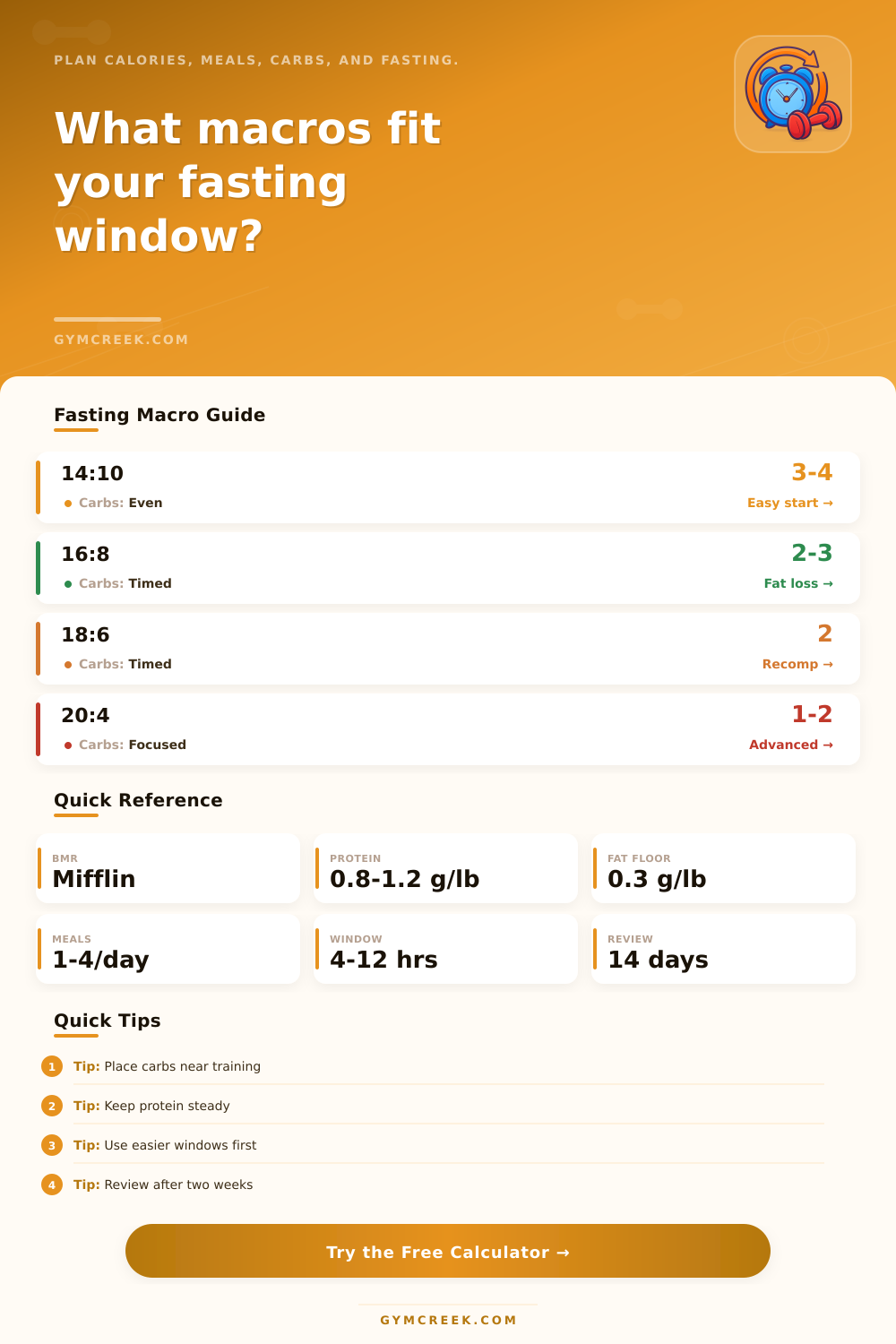
| 14:10 | 14 hr | 10 hr | Good first fat-loss structure |
| 16:8 | 16 hr | 8 hr | Common balance of structure and flexibility |
| 18:6 | 18 hr | 6 hr | Needs deliberate protein spacing |
| 20:4 | 20 hr | 4 hr | Advanced; harder around training |
| Style | Imperial | Metric | Use case |
|---|---|---|---|
| Moderate | 0.8 g/lb | 1.8 g/kg | Maintenance or easier fasting |
| Recomp | 1.0 g/lb | 2.2 g/kg | Most strength-focused fasters |
| High cut | 1.15 g/lb | 2.5 g/kg | Deficit with hunger control |
| Athlete | 0.9 g/lb | 2.0 g/kg | More calories from carbs |
| Plant buffer | 1.1 g/lb | 2.4 g/kg | Higher total protein target |
| Training timing | Carb share | Best meal | Note |
|---|---|---|---|
| Fasted morning | 25% | First meal | Break fast with protein and carbs |
| Before window | 30% | Meal 1 | Prioritize post-training intake |
| Early window | 35% | Meals 1-2 | Useful for lunch training |
| Mid window | 40% | Center meal | Easiest carb placement |
| Late window | 35% | Last meals | Avoid under-eating earlier |
| Step | Formula | Variables | Output |
|---|---|---|---|
| BMR | Mifflin-St Jeor | Sex, age, height, weight | Resting calories |
| TDEE | BMR x activity | Activity multiplier | Maintenance calories |
| Goal | TDEE x bias | Cut, recomp, gain | Daily calorie target |
| Macros | P4, C4, F9 | Protein, carbs, fats | Gram targets |
| Score | 100 - penalties | Fast, meals, training | Adherence estimate |
💡Tips
Intermittent fasting protocols requires individuals to consume the majority of their nutritional intake within a specific period of time. The effectiveness of intermittent fasting, however, relies upon the individual’s nutritional intake matching there fasting protocol. For example, many individual may choose a fasting protocol based off the protocol’s appearance in various fitness literature, yet find themselfs lacking in energy or noticing a lack of progress with their goals due to the mismatch between their nutritional intake and their fasting schedule.
As such, the success of intermittent fasting is determined not by the fast itself, but in how the calories, protein, and training fuel that is consume during the eating period. The target number of calorie for fasting protocol can be calculated based upon an individual’s body weight, their height, their age, and the level of activity that they perform each day. Once the individual has established their target calories, they can select one of several goals, fat loss, muscle recomposition, maintenance, or performance.
Match Your Food to Your Fasting Plan
Which will allow the calculator to make slight adjustment to the target calories. In addition to setting the calorie target, the individual can also specify their protein style, the calories that will be dedicated to protein intake for muscle retention, as opposed to carbohydrates or fats. For example, individuals that perform high levels of training will require more protein than those with lower training loads.
The calculator performs these various calculation after the individual inputs their data into the calculator. In addition to the calorie and protein calculations, the number of meals that an individual will consume during the eating period, as well as the timing of those meals in relation to the individual’s training session, is another variable to consider. For example, those that select fewer meals during the eating period will have to consume more protein during one meal than other.
High levels of protein consume during a meal may lead to slow recovery after that meal. One solution to this problem is to include a large portion of carbohydrates in meals near the individual’s training sessions, as those carbohydrates will be used as fuel for training instead of being stored as fat. A reference table is included in the calculator to display how different training sessions will impact the recommendation of the nutrients distribution to match training sessions.
The length of the fasting period also creates tradeoff in the protocol that the individual must consider. For example, protocols that suggest fasting for periods of 14 or 16 hours will require an individual to consume three or four meal throughout the day. However, protocols that suggest fasting for 18 or 20 hours will require an individual to consume their daily calories within fewer meals.
As such, those that follow such protocols must consume much larger portions of protein during each meal to meet their bodys protein needs for the day. While this protocol may be suitable for some individuals, it may lead to digestive or adherence issue for others. The adherence score that the calculator generates is an estimate of the number of these difficulty that may exist within the fasting protocol that the individual selects.
Though optional, the body fat percentage of an individual is another variable that may be entered into the calculator. This percent of body fat can help to provide a more accurately estimation of lean body mass. An accurate lean body mass can allow the protocol to provide a more realistic target of protein that should be consume by the individual’s body.
For example, individuals with higher body fat percentages can consume less protein per pound of body weight than lean athlete. In addition to these variables, individuals should also consider whether or not the protocol is sustainable for at least a two-week period. Factors like protein per meal and carbohydrate timing can impact the adherence score that is provided by the calculator.
For example, adjusting the number of meals that are consume daily, by changing the length of the eating period, or by adjusting the training schedule to an earlier time within the eating period can improve the adherence score. Each of these changes will not impact the number of calories that are consume daily, yet may have an impact upon the adherence to the protocol. It is also important to review the results generate by the intermittent fasting protocol after the individual has followed the protocol for a full two-week period.
If the individual’s weight, energy levels, and performance in training are beginning to reach the goals that are set, then the protocol is likely appropriate for the individual. In cases, however, where some goals are not being met, the individual can adjust the variables that impact those specific goals.