Low Carb Diet Macro Calculator
Estimate calories, carb tiers, training carb allocation, meal carbs, fiber, protein, fat, and a low-carb adherence score from your body stats and goals.
📌Low Carb Presets
Presets load practical low-carb starts. Change carb tier, meal count, training allocation, fiber, protein, and fat flexibility to match your routine.
⚙Calculator Inputs
Low-carb macro snapshot
Enter your body stats and low-carb preferences to calculate daily macros.
📊Metrics Grid
📑Reference Tables
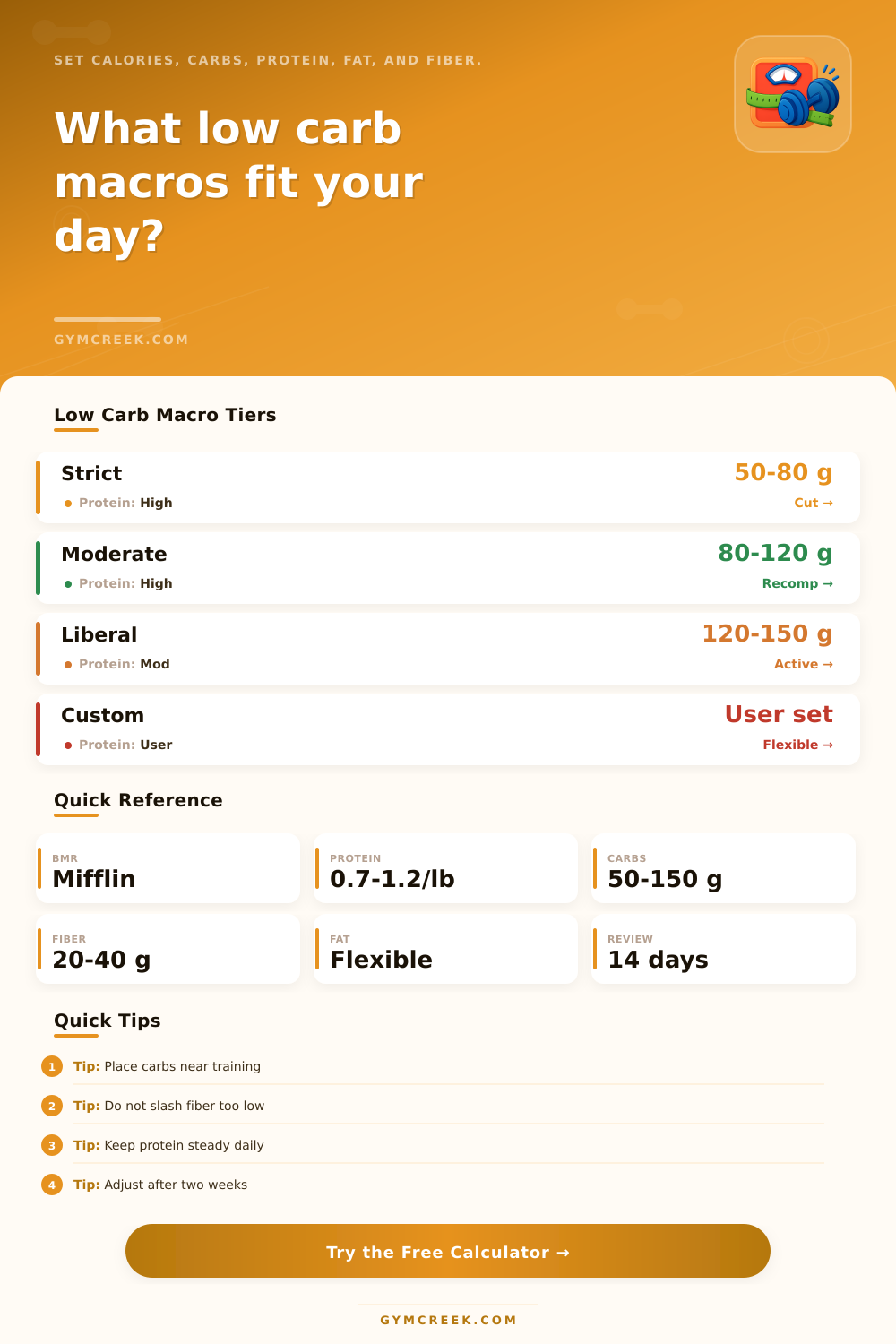
| Tier | Total carbs | Use case | Notes |
|---|---|---|---|
| Strict low carb | 50-80 g/day | Short fat-loss phase | Not the same as medical keto. |
| Moderate low carb | 80-120 g/day | Most balanced plans | Leaves room for fiber and training. |
| Liberal low carb | 120-150 g/day | Active users | Better for higher training volume. |
| Custom | User set | Fine tuning | Use trends and recovery to adjust. |
| Allocation | Meaning | Best fit | Meal effect |
|---|---|---|---|
| 0-10% | Even carb day | Rest days | Most carbs stay with meals. |
| 15-25% | Moderate workout focus | Lifting and classes | Small carb reserve around training. |
| 30-35% | Higher workout focus | Hard sessions | Meals get fewer carbs. |
| 40-45% | Maximum focus | Long training | Best for active low-carb users. |
| Setting | Typical range | Purpose | Calculator use |
|---|---|---|---|
| Protein | 0.7-1.2 g/lb | Muscle retention | User-selected protein factor. |
| Leaner fats | Lower remainder | Larger calorie gap | Adds a small fat buffer. |
| Balanced fats | Middle remainder | Everyday planning | Uses remaining calories after P/C. |
| Higher fats | Higher remainder | Satiety preference | Protects a higher fat floor. |
| Formula | Variables | Output | Use |
|---|---|---|---|
| Mifflin-St Jeor | Weight, height, age, sex | BMR | Calorie baseline. |
| TDEE | BMR x activity | Daily burn | Sets maintenance calories. |
| Goal calories | TDEE x goal bias | Target kcal | Creates cut, maintain, or gain target. |
| Macro calories | P/C x 4, F x 9 | Macro split | Checks the daily calorie budget. |
| Adherence score | Carbs, fiber, protein, allocation | 0-100 | Rates plan fit to low-carb rules. |
💡Tips
Many who attempt a low carbohydrate diet begin by guessing at portions. Many who guess at portions experience energy dip or increased hunger. Those who experience energy dips and increased hunger isnt lacking willpower in adhering to a low carbohydrate diet, instead they do not understand the relationship between calories, protein requirement, and carbohydrate timing in relationship to there training schedule.
Should an individual understand these relationships to there body, a low carbohydrate diet can be followed more easy. The amount of protein that an individual need to consume is dependent upon there body weight and training schedule. An individual who lifts weight three or four times per week needs to consume approximately one gram of protein per pound of body weight.
Simple Guide to Protein, Carbs, Fiber and Fat for a Low-Carb Diet
This amount of protein will help to ensuring that the low calorie requirement of the low carbohydrate diet does not break down muscle. Should an individual consume too little protein, muscle is broken down and performance with their lift may stall. An individual can utilize a calculator to determine the amount of protein an individual needs based off there body stat.
Carbohydrate needs fall into a wider range then many individual anticipate. Fifty to eighty grams of carbohydrates is a range that may work for individuals who are attempting to lose fat and who have moderate levels of activity. Eighty to one hundred twenty grams of carbohydrates may be a better range for individuals with high levels of training.
Higher levels of carbohydrates allow an individual to consume more fiber and to avoid limiting the number of carbohydrates consume with each meal. These range is utilized in the tool to ensure the carbohydrate suggestions are easily usable within an individual’s diet. The allocation of carbohydrates for training day differs from the allocation for rest days.
An individual who allocates a percentage of their carbohydrate intake to those days that includes training may improve there performance. An individual who consumes the same amount of carbohydrates on rest days should spread the carbohydrates more even amongst meals. Adhering to these suggestion will lead to improved energy and adherence to the diet.
Fiber is a type of carbohydrate. An individual who desires to feel full and to have strong digestion should consume between twenty-five and thirty-five gram of fiber per day. Consuming too little fiber may leave an individual feeling unsatisfied after meal.
The fiber field within the tool can be used to test different amounts of fiber. Testing different amounts of fiber will reveal how many carbohydrates an individual can consume before they begin to track the food that they consume. Fat is the remaining macronutrient for an individual to consume to meet there calorie target.
Some individuals prefer to consume less fat to include more vegetable in there diet. Other individuals may prefer to include more fat in there diet to feel satisfied after meal. The flexibility within the plan allow for adjustments to the amount of fat within the diet.
Changes to the amount of fat an individual consume will not impact there calorie target. The amount of fat an individual should consume may be determined according to how hungry they feel two hour after meals and how there performance with training may suffer if they consume too little fat in there diet. The tool calculates the adherence score according to the number of carbohydrates consumed, the amount of protein consumed, the fiber content of an individual’s diet and the number of day that include training.
A high adherence score indicate that an individual has a high amount of protein to help there muscle, is getting enough fiber to aid in there digestion and that there carbohydrate allocation agree with there training schedule. While a high adherence score does not ensure perfect result from the diet, a high adherence score indicates that an individual is following a diet that is constructed according to figure that are realistic to be met every day. An individual should of run the calculator to determine the figure that should be followed for two weeks.
After consuming the diet for two week, assess energy, hunger and training performance. Performance may improve with small alteration to the protein levels or carbohydrate levels consume with training. Once all the macronutrients agree with an individual’s training schedule, they will no longer second-guess the food that they consume.