Keto Macro Calculator
Estimate keto calories, net carbs, protein, fat grams, ketogenic ratio, and GKI context from body stats, body fat, activity, goal, protein target, carb cap, adaptation level, fiber, and sugar alcohol handling.
📌Keto Presets
Presets load realistic keto profiles. Replace them with your own body stats, carb cap, activity, protein target, and tracking method.
⚙Calculator Inputs
Keto macro snapshot
Enter body stats and keto settings to estimate macros.
📊Keto Metrics
📑Reference Tables
| Phase | Net carbs | Protein | Fat target |
|---|---|---|---|
| Strict start | 15-20 g | 0.7-0.9 g/lb LBM | Calories remainder |
| Fat loss | 20-30 g | 0.8-1.1 g/lb LBM | Moderate deficit |
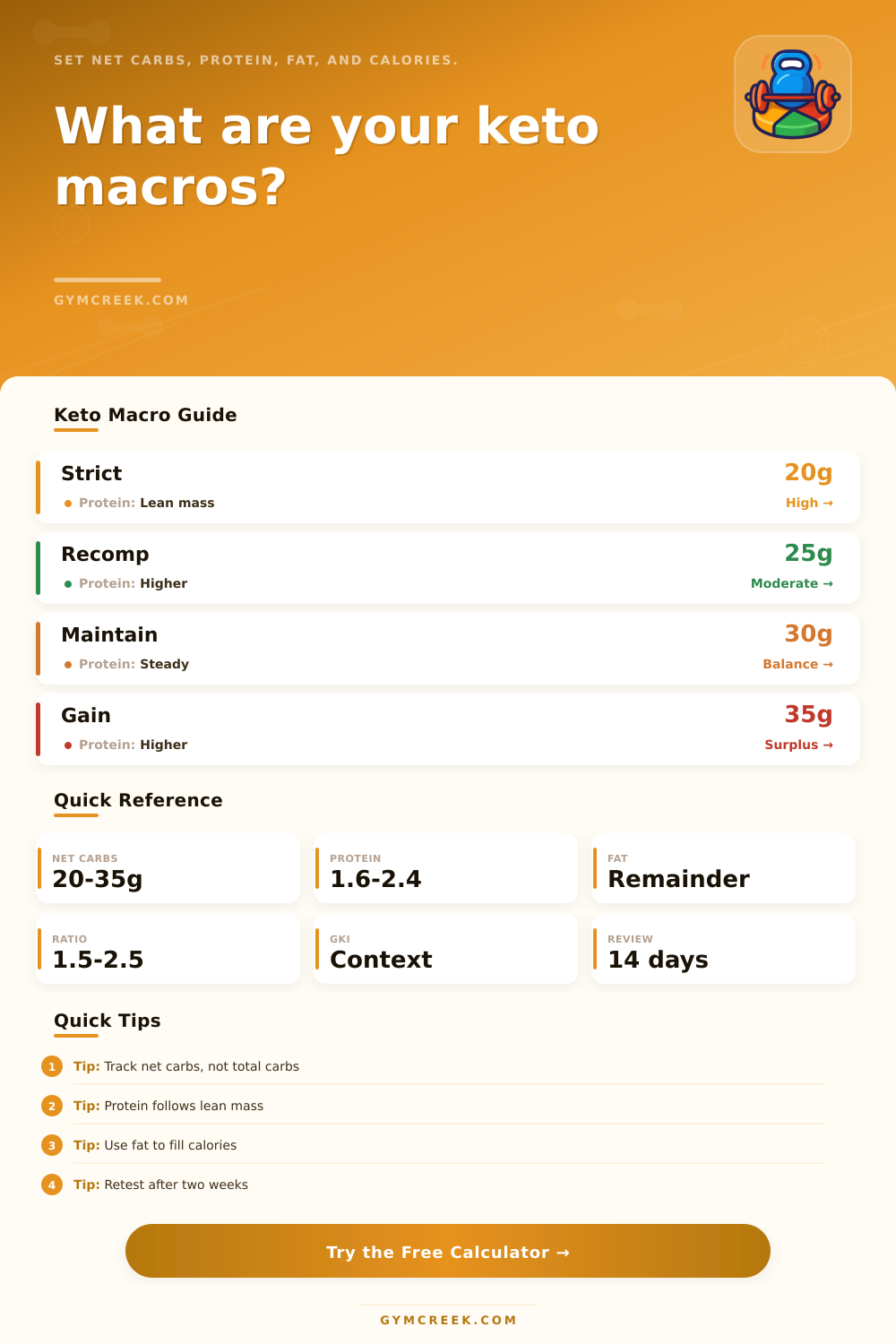
| Recomp | 20-35 g | 0.9-1.2 g/lb LBM | Performance support |
| Maintenance | 25-50 g | 0.7-1.0 g/lb LBM | Stable energy |
| Lean gain | 30-60 g | 0.8-1.1 g/lb LBM | Small surplus |
| Method | Fiber | Sugar alcohols | Use when |
|---|---|---|---|
| Strict | Subtract fiber | Count half | Stalls or uncertainty |
| Standard | Subtract fiber | Subtract erythritol | Most tracking apps |
| Sensitive | Subtract 75% | Count 75% | Digestive sensitivity |
| Total carbs | Do not subtract | Count all | Therapeutic tracking |
| Metric | Common range | What it means | Planning cue |
|---|---|---|---|
| Ketogenic ratio | 1.5-2.5 | Fat kcal vs protein plus carb kcal | Higher is stricter |
| GKI under 3 | Deep | Low glucose relative to ketones | Often therapeutic context |
| GKI 3-6 | Moderate | Common nutritional ketosis zone | Useful keto feedback |
| GKI 6-9 | Light | Some ketosis signal | Check carbs and timing |
| GKI over 9 | Low | Limited ketosis context | Review intake and trend |
| Formula | Variables | Output | Use |
|---|---|---|---|
| Mifflin-St Jeor | Weight, height, age, sex | BMR | Calorie base |
| Lean mass | Weight x (1 - BF%) | LBM | Protein base |
| TDEE | BMR x activity | Maintenance | Goal calories |
| Net carbs | Total - fiber - alcohol credit | Effective carbs | Keto cap check |
| GKI | Glucose mmol/L / ketones | Index | Context only |
💡Tips
Calculating the macronutrient you need on a ketogenic diet requires an understanding of how to calculate the protein, fat, and carbohydrate needs of your body. Most peoples will try to guess there macronutrient needs. Guessing at any value, however, will produce inaccurate results.
Using a calculator to determine your macronutrient needs will allow you to create specific numbers for each macronutrient that will reflect your biological needs. Protein needs comes from your lean body mass, or the weight of your muscles and organs in the body. Your body fat percentage can play a role in your protein needs.
How to Use a Keto Calculator to Find Your Protein, Fat, and Carbs
People with high body fat percentages have different needs than people with low body fat percentages and the same body weight. Your lean body mass determine your protein needs, so it is essential to account for this in the calculator. If your body fat percentage is not account for, your protein needs can either be too high or too low for your needs.
Enter your body fat percentage into the calculator to determine your protein needs based off your lean body mass. Your activity level will play a role in your caloric needs. The activity level that you select in the calculator will determine how many calories you need each day.
People with desk job and little physical activity will require different calories than people who perform physical activity every day. Accounting for activity level will ensure that you meet your needs. If you dont account for activity level, you may either not consume enough food to feel energetic each day or you may consume too much food such that you are unable to lose body fat.
Net carbohydrates are not the same than total carbohydrates. Your ketogenic diet will require that you understand the difference between these two values. The ketogenic diet calculator allow you to select how carbohydrates, fiber, and sugar alcohols are subtracted from your diet.
Depending on the method that you choose, your net carbohydrate intake will change, even if your total carbohydrate intake remain the same. Fat is the macronutrient that fill the remaining calories once you have calculated your protein and carbohydrate needs. If you are in a calorie deficit, there will be fewer calories for fat than if you are maintaining your body weight.
The ketogenic diet calculator will show you the remaining calories for fat to fill your diet. The fat target will change according to your protein and carbohydrate target. Adaptation to ketosis will change over time.
The adaptation level will determine how your body respond to the ketogenic diet. A person who is just beginning the ketogenic diet will have different adaptation than a person who has followed a ketogenic diet for many month. The adaptation calculator provides context for your adaptation to ketosis.
While it will not change the total calories that you must consume each day, it can help you understand what the numbers mean in terms of your adaptation level. The Glucose Ketone Index and the ketogenic ratio are two additional measurement that can be seen on the ketogenic diet calculator. These two values only become meaningful after tracking your data for a few week.
While they are not required for tracking ketosis, you can observe them using the calculator to determine whether they is useful in your tracking parameters. Using a ketogenic diet calculator will provide stability in your diet. Your body weight and your energy levels will fluctuate each day.
Your macronutrient target will remain stable once you calculate it. Using a stable macronutrient target allow you to track your success in following the ketogenic diet over long periods of time.