Jump Rope Weight Loss Calculator
Estimate jump rope calories, interval burn, weekly fat loss, and the timeline to a goal from body weight, cadence, workout duration, weekly sessions, food deficit, and expected compensation.
📌Jump Rope Weight-Loss Presets
Presets load realistic combinations of body size, cadence, interval density, weekly frequency, diet deficit, goal loss, and adherence for quick comparisons.
⚙Calculator
Jump rope weight-loss snapshot
Enter your rope cadence, interval format, weekly frequency, and diet deficit to project a practical fat-loss timeline.
📊Metrics Grid
📑Reference Tables
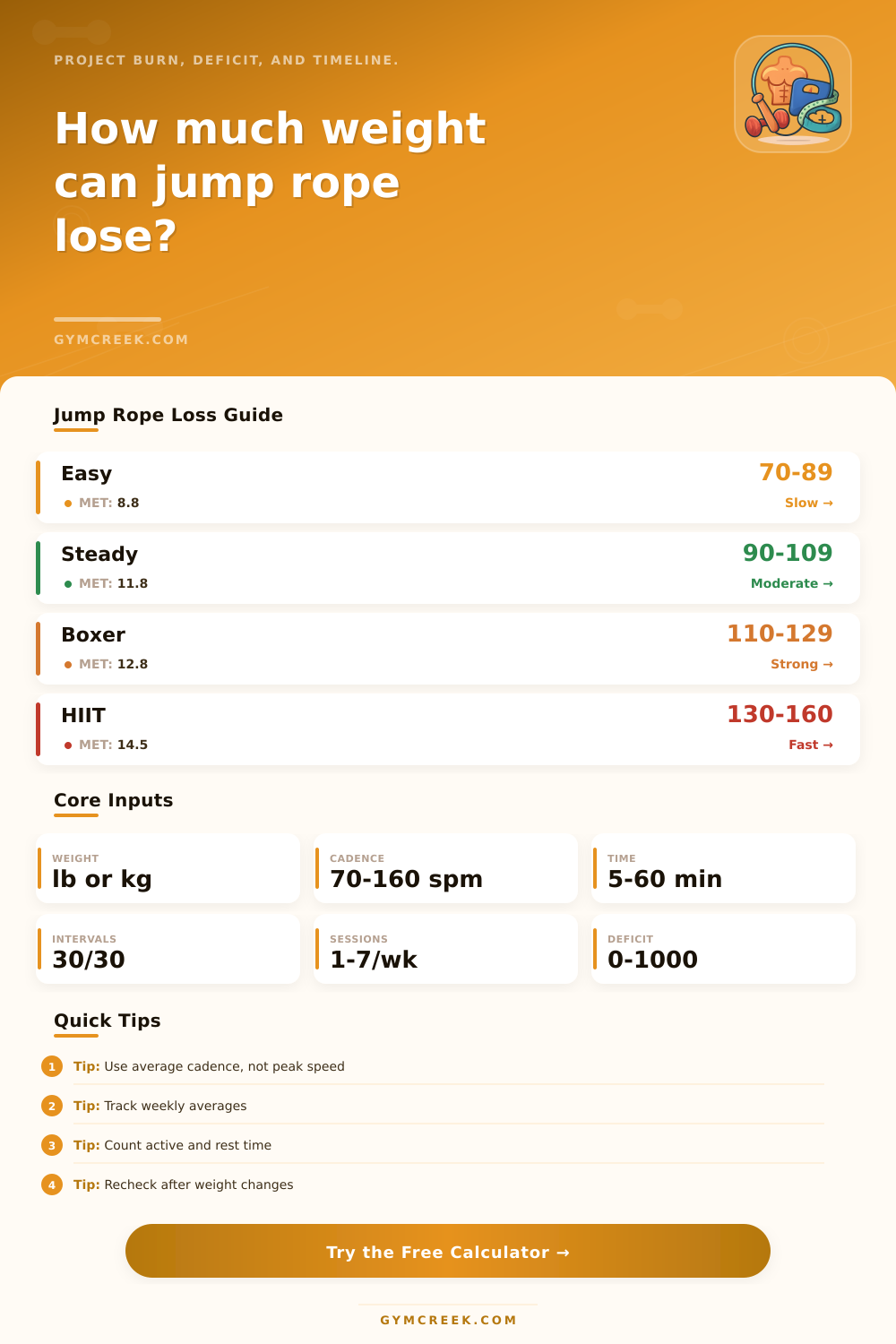
| Cadence | Typical style | Base MET | Use case |
|---|---|---|---|
| 70-89 spm | Easy basic bounce | 8.8 | Beginner practice or warm-up days |
| 90-109 spm | Classic fitness skipping | 11.8 | Steady calorie work with manageable breathing |
| 110-129 spm | Boxer step or fast singles | 12.8 | Rhythm, conditioning, and higher weekly burn |
| 130-160 spm | HIIT or double-under work | 14.3 | Short hard sessions with more recovery need |
| Format | Active share | Best fit | Model note |
|---|---|---|---|
| Continuous | 100% | Steady base skipping | Set rest seconds to zero |
| 60/15 | 80% | Fitness rhythm sets | Good balance of work and skill |
| 45/15 | 75% | Beginner ladders | Keeps form from falling apart |
| 30/30 | 50% | HIIT or double-under sets | Lower active time but high intensity |
| 20/40 | 33% | Sprint rounds | Use when cadence is very high |
| Weekly pace | Deficit range | Common feel | Adjustment cue |
|---|---|---|---|
| 0.25-0.5% body weight | Mild | Easy to sustain | Good for beginners or busy weeks |
| 0.5-1.0% body weight | Moderate | Most planned cuts | Often the practical target zone |
| 1.0-1.5% body weight | Aggressive | Harder recovery | Watch energy, sleep, and training quality |
| Over 1.5% body weight | Very high | Difficult to maintain | Consider easing diet or session load |
| Step | Formula | Output | Why it matters |
|---|---|---|---|
| MET burn | MET x 3.5 x kg / 200 x min | kcal | Standard exercise energy estimate |
| Active time | Duration x work / cycle | minutes | Separates jumping from planned rest |
| Weekly deficit | Exercise net + diet deficit | kcal/week | Combines training and food plan |
| Fat loss | Deficit / 3500 lb or 7700 kg | lb or kg | Converts energy deficit to scale trend |
| Timeline | Goal loss / weekly loss | weeks | Projects a rough goal date |
💡Tips
Jump rope are a form of exercise that can assist with weight loss, and jump rope can be used as part of a weight loss plan. There is several different factors that can impact the results that an individual may see from incorporating jump rope into there fitness routine. The factors that impact the results of jump rope include the body weight of the individual, the cadence at which they jump, the time that they spend jumping in intervals, how often they jump each week, and the calories that they consume through there diet.
The body weight of an individual is one of the primary factors that impact the results of jump rope. An individuals body weight impacts the amount of energy that their body must expend in order to move. An individual that weighs more will burn more calories jumping compared to an individual that weigh less.
What Affects Weight Loss With Jump Rope
The cadence at which an individual jumps jump rope impacts the number of calories that are burn per minute. You can measure jumping cadence in the number of jumps that are performed during a specific amount of time. The time in which an individual jumps in intervals will impact the number of calories that are burned during the jump rope routine.
The number of times that an individual jumps each week will impact the overall adaptation of the body to jumping on jump rope. The dietary intake of the individual is also a factor in the results that are gained from jump rope. You must consider the dietary intake of an individual in conjunction with the calories that are burned from jump rope.
If an individual consumes too many calories, they will burn more calories jumping than they would otherwise expect, and they will gain weight at a faster rate. Adherence and compensation percentages is also factors in the results of jump rope. For example, if an individual misses some jump rope sessions, they will gain the benefits of jump rope less than if they consistent jump on jump rope.
Jumping at different intensities with different jumping styles can also impact the number of calories that are burned during jump rope. For example, an individual can jump at a steady rate at a moderate cadence. This allows an individual jump for longer periods of time without straining their joint.
An alternative is to jump at a faster rate, or jump in a boxer rhythm. This type of jumping will increase the heart rate of an individual, and will cause them to burn more calories jumping rope. Jumping at a faster rate, however, may cause an individual to lose their jumping form, and jump in longer rests between jumps.
Finally, jumping double unders or jumping on jump ropes with added weight will increase the intensity of an individuals jump rope routine. However, increasing the intensity of jump rope may prevent an individual from being able jump as often as they would like. One of the common mistake that individuals can make with jump rope is to think that the more jumps that an individual makes at a cadence, the more fat that will be burned.
However, jumping at high cadence for long periods of time may cause an individual to jump in long rests between jumps. Thus, fewer calories can be burned at high cadence with long rests compared to a slower cadence. Another mistake is to use jump rope at high intensity with a very large calorie deficit in the diet.
High intensity jump rope with a large dietary deficit may make it difficult for an individual to recover after jumping. Thus, an individual that cant jump on jump rope will not be able to attain the benefits from jump rope. The calculator is an estimation of the number of calories that will be burned with jump rope based off the factors discussed, but cannot account for each individuals variable.
For example, the weight of the water in an individuals body may change the weight that is reflected on the scales, making it seem as if an individual is not losing weight, even though they are burning calories with jump rope. Individual factors, such as sleep and stress, can also change the number of calories that is consumed by an individual. These factors will impact the calorie deficit that is calculated with jump rope.
An individual should use the calculator to determine their estimated calories, but should of recalibrate the estimate if their body weight or jump rope cadence change. Finally, using jump rope in the long term is more beneficial for an individual then using jump rope at a very high rate in the short term.