Jump Rope to Miles Calculator
Convert jump rope work into running miles using cadence, counted jumps, user height, stride proxy, rope style, jump pattern, foot contacts, calories, MET intensity, and equivalent running pace.
⚡Jump Rope Presets
Presets fill a realistic athlete profile, rope style, cadence, session length, and stride proxy. You can edit any field before calculating.
📏Session Inputs
Your session converted to running distance
Complete the form and calculate to see your distance equivalent.
📊Fitness Metrics Grid
📘Reference Tables
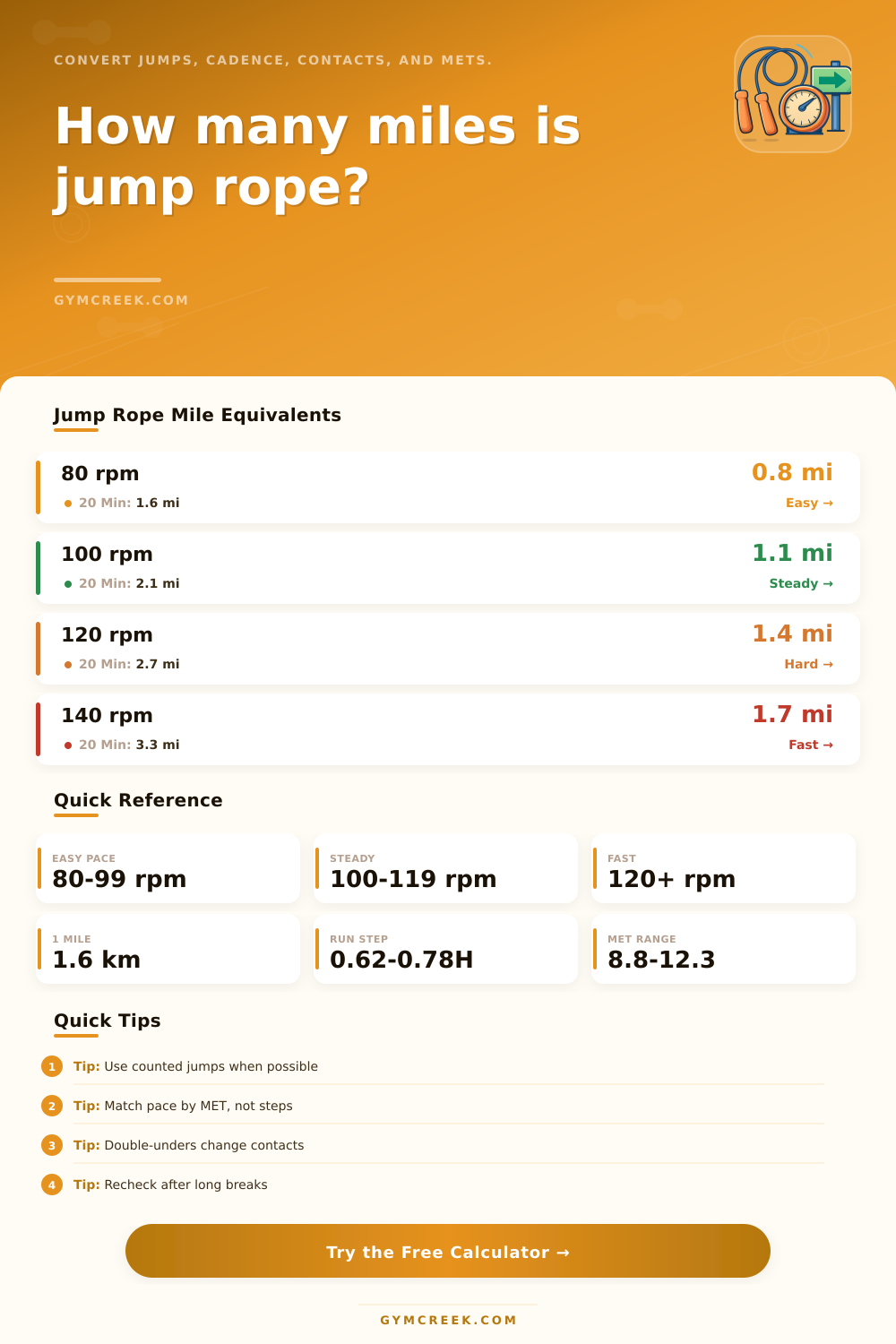
| Cadence | Session Feel | Base MET |
|---|---|---|
| Under 80 rpm | Skill or recovery | 7.5 |
| 80 to 99 rpm | Easy aerobic | 8.8 |
| 100 to 119 rpm | Steady conditioning | 10.5 |
| 120 to 139 rpm | Hard sustained | 11.8 |
| 140+ rpm | Fast intervals | 12.3 |
| Pattern | Cycle Rule | Contacts |
|---|---|---|
| Two-foot singles | 1 jump per turn | 2.0 per jump |
| Boxer step | 1 jump per turn | 1.4 per jump |
| Alternate-foot run | 1 jump per turn | 1.0 per jump |
| High-knee run | 1 jump per turn | 1.0 per jump |
| Double-unders | 1 jump per 2 turns | 1.0 per turn |
| Pace | Speed | MET |
|---|---|---|
| 12:00 min/mi | 5.0 mph | 8.3 |
| 10:00 min/mi | 6.0 mph | 9.8 |
| 9:00 min/mi | 6.7 mph | 10.5 |
| 8:00 min/mi | 7.5 mph | 11.8 |
| 7:00 min/mi | 8.6 mph | 12.8 |
| Proxy | Formula | Use Case |
|---|---|---|
| Compact | 0.62 x height | Shorter stride or fatigue |
| Average | 0.70 x height | Default running estimate |
| Long | 0.78 x height | Taller stride or faster run |
| Custom | Your measured step | Track or watch data |
💡Calculator Tips
Converting jump rope to running distances is a complex operation because jump rope distance dont depend solely on the number of times that you jump. Several factor have to be considered before distance can be converted from jump rope to running distance, including the distance that your feet covers when jumping, the length of your running stride, and the amount of effort that your body exert during jump rope intervals. A jump rope to running distance conversion tool take into account these factors to calculate a distance that you can note in your training records.
Cadence is one of the factors that has the most influence on the calculation of jump rope distance. The more higher the cadence during jump rope intervals, the more effort that you will expend, and the more energy that your body will burn during those interval. The same number of jumps will burn more energy if you jump at a high cadence than if you jump at a slow cadence.
How to Convert Jump Rope Jumps to Running Miles
The type of jump rope that you use also affect the amount of effort that you must expend. For example, a jump rope with added weight will require more energy than a lighter jump rope. The pattern of jumps that you complete will also have an impact on your jump rope distance.
A jump rope conversion tool take into account these factors to provide you with an accurate measurement of the distance you jumped. The distance that a jump rope to running distance conversion tool calculates is derived from the blend of two different distance estimation method. The first method count the number of times that your feet contact the ground during jump rope intervals and compares that number to the number of steps that are required to run one mile.
The second method calculates the amount of energy that your body burned during jump rope intervals and determine how many miles that you would run to burn the same amount of calories. The combination of these two method provides a more accurate measurement of jump rope distance than either method alone. For example, counting the number of times that your feet hits the ground will provide an overestimation of distance when jumping at high speeds.
Calculating the energy burned will underestimate the distance covered during low-cadence jump rope skill work. A small change in the way that you jump will change the distance that a jump rope distance conversion tool calculates. For example, jumping on a PVC jump rope will burn more calorie than jumping on a beaded jump rope.
Completing double unders will increase the number of times that your feet hit the ground and increase the overall intensity of your jump rope interval. A long jump rope interval at a slow cadence may yield the same distance covered as a short interval at a high cadence. A jump rope to running distance conversion tool will allow you to view both of these distances on the same scale to balance the number of miles jumped in a given week.
The distance that a jump rope to running distance conversion tool calculates also take into account your height and stride length. Each person has a different stride length when running. A person that is tall will have a longer stride length than a shorter individual.
This distance will impact the number of miles jumped during jump rope intervals. A jump rope distance conversion tool will account for your stride length so that the distance calculated for jump rope intervals is accurate to your body. Your body weight and age can impact the calibration of the distance calculation of calories burned during jump rope intervals.
Two individual may burn a different number of calories during jump rope intervals even if they jump the same number of jumps and for the same length of time. Because training jump rope intervals may have pauses in between jump rounds, the distance calculated by the jump rope to running distance conversion tool may not reflect the actual distance jumped. While the conversion tool calculates variables such as calories and distance jumped, it does not account for the pauses between rounds.
Therefore, if the distance calculated by the jump rope to running distance conversion tool does not match the distance jumped, it is recommended that you review the factors you entered into the tool to determine the cause of any discrepancy. One of the main uses of a jump rope to running distance conversion tool is to allow you to compare jump rope and running distances over a long period of time. Using this tool will allow you to log the number of miles jumped during jump rope sessions so that they can be compared to the number of miles run during running training sessions.
By logging the miles jumped during jump rope intervals, you can easily compare different jump rope techniques and intensities. This tool will allow you to plan your jump rope training just as thorough as your training with running.