Fall Force Calculator Climbing
Estimate climbing fall factor, peak climber force, rope stretch, stopping distance, impact severity, and anchor load caution from mass, fall distance, rope out, elongation, belayer give, device friction, and anchor configuration.
📌Real Climbing Scenarios
Presets are realistic planning examples, not gear ratings. Replace every value with your actual rope, belay, route, and anchor context.
⚙Calculator Inputs
Climbing fall force snapshot
Enter fall details to estimate fall factor, peak force, rope stretch, and anchor load caution.
📊Metrics Grid
📑Reference Tables
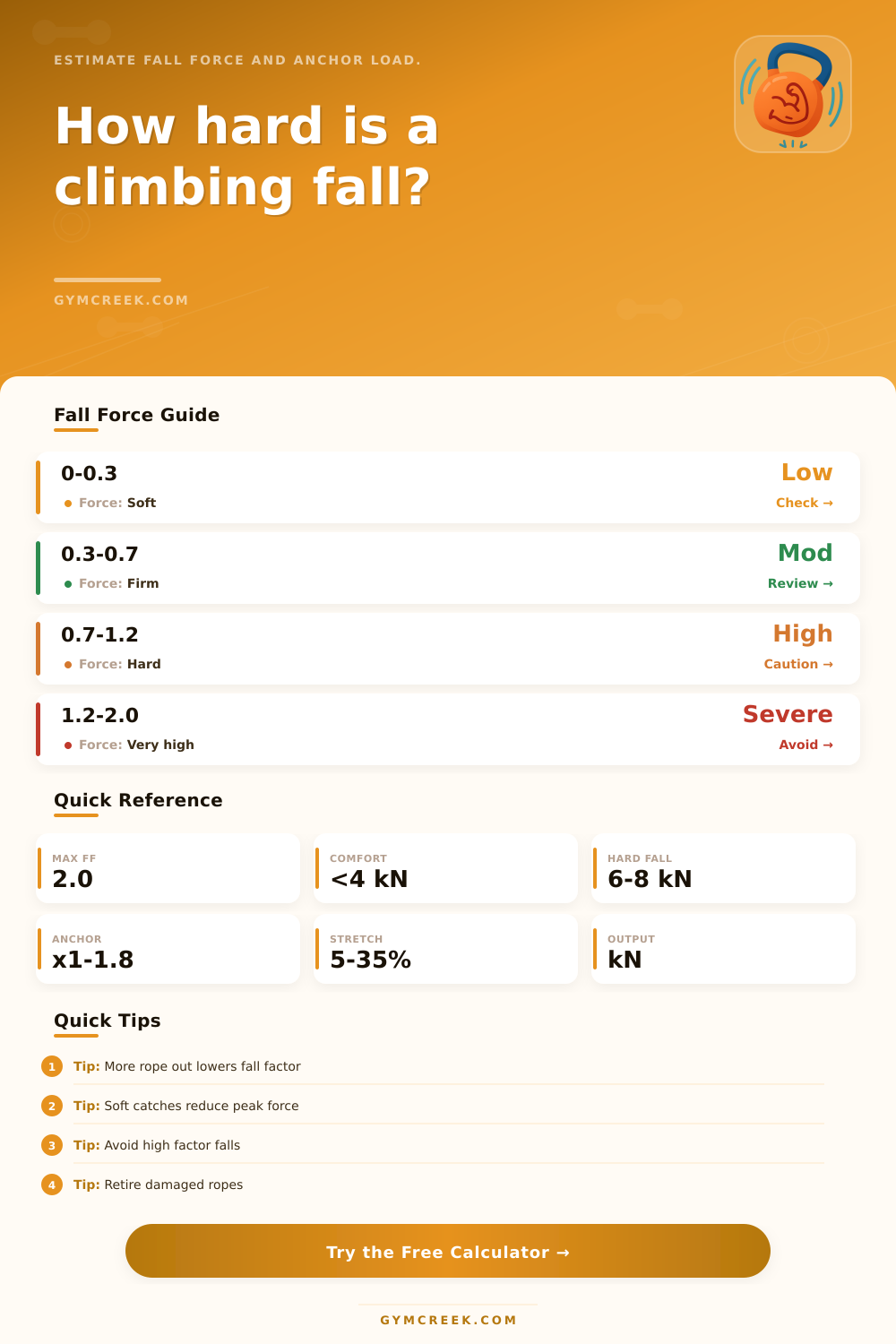
| Fall factor | Typical situation | Severity cue | Planning response |
|---|---|---|---|
| 0.0-0.3 | Top-rope or short lead fall with lots of rope | Usually low impact | Still inspect rope path and swing risk |
| 0.3-0.7 | Common lead fall with moderate rope out | Noticeable catch | Use attentive belay and clean clipping stance |
| 0.7-1.2 | Long fall with limited rope or poor belayer movement | Hard impact possible | Reduce slack and protect before hard moves |
| 1.2-2.0 | Near-anchor multipitch or factor-two style fall | Severe load range | Avoid with immediate protection and stance planning |
| Rope / system | Typical stretch | Force effect | Notes |
|---|---|---|---|
| Dynamic single rope | 26-35% | Lower peak force | Common lead climbing basis |
| Half or twin rope system | 28-38% | Often softer | Depends on clipping and rope pair |
| Static rope | 2-6% | Very high force | Not for lead fall arrest |
| Wet or stiff rope | Reduced | Higher caution | Retire or inspect if damaged |
| Input | Energy loss | Catch character | Model effect |
|---|---|---|---|
| Dynamic tube catch or slip | High | Soft catch with movement | More stopping distance, lower force |
| Standard tube device | Moderate | Typical attentive belay | Balanced rope slip and control |
| Assisted-braking firm catch | Low | Less slip | Can raise peak force if static |
| Redirected high-friction belay | Very low | Force transfers to anchor | Raises anchor load caution |
| Configuration | Load multiplier | Risk cue | What to check |
|---|---|---|---|
| Lead bolt or protection piece | 1.35x | High but expected loads | Clip path, ledges, rope drag |
| Top-rope anchor | 1.65x | Pulley-style load | Master point, edge protection, direction |
| Trad gear anchor | 1.25x | Placement quality matters | Rock, equalization, extension |
| Ice screw or marginal medium | 1.45x | Medium can dominate safety | Ice quality, screw spacing, backups |
| Redirected top belay | 1.80x | Anchor may see high combined load | Direction, belayer stance, redundancy |
| Output | Formula | Variables | Meaning |
|---|---|---|---|
| Fall factor | Fall distance / rope out | fall, rope | How severe the fall geometry is |
| Rope stretch | rope out x elongation % x rope condition | rope, stretch | Primary stopping distance estimate |
| Peak force | (energy / stop distance + body weight) / 1000 | mass, fall, stop | Estimated climber peak force in kN |
| Anchor load | peak force x anchor multiplier x friction transfer | force, anchor | Caution estimate for protection or anchor |
💡Safety Tips
The sensation of a climbing falls changes based off several specific variable. The variables that affect the sensation of a climbing fall include the amount of rope that is out, the distance of the drop that occur before the rope catches the climber, and the movements that the belayer makes during the fall. While many people thinks about the ability of the climbing gear to hold the weight of the falling climber, a climber should be more concerned with the force that will be placed upon the body of the climber should they fall, as well as the force that will be placed upon an anchor setup.
The geometry of the fall is more important than the distance of the fall; a short distance of fall with a long amount of rope has a different effect upon the body than if the fall were of the same distance but with a short amount of rope. One of the measurement of the geometry of the fall is referred to as the fall factor. The fall factor is a measurement of the distance of the fall compared to the amount of rope between the climber and the anchor (or the belayer).
What Affects the Force of a Climbing Fall
If the factor is low, it means that the amount of rope has a great deal of length where it can stretch to absorb the energy of the climbers fall. However, if the factor is high, it means that the rope has less length to stretch. Thus, the force of the fall will be greater with a high fall factor than with a low fall factor.
For instance, a small slip on a high ledge will feel like a much harder fall than if the climber had fallen a similar distance but on a pitch lower on the climbing route. You can use a calculator to determine the fall factor of a given situation by entering variables like the mass of the climber, the distance of the fall, the length of the rope, and the amount that the rope elongate during a fall. Another line of defense for the body of the climber is the use of dynamic rope.
Dynamic rope include a percentage of the rope that should stretch when the climber is on the rope, and the rope turns some of the energy of the fall into heat and movement so that the force of the fall is not transmitted to the body of the climber. The percentage of stretch that is listed on the rope package is not the only factor that determines the stretch of the rope; the age of the rope, the stiffness of the rope, the wetness of the rope, and how the rope has wore with use all impact how much the rope will stretch when the climber begins to fall. If the rope has lost its ability to stretch, it will transfer more force to the body of the climber, as well as more force to the anchor point setup.
Because of this, climbers pay attention to the condition of their ropes. The movements of the belayer also have an impact upon the sensation of the fall. For instance, if the belayer performs a small jump upwards of the ground, the distance that the force of the fall is disperse is increased.
Additionally, if the belayer utilizes a type of device that allows for some slip of the rope (such as a belay device), the distance of the fall is also increased. However, an assisted braking device that locks quickly may reduce the slip of the rope, but may also increase the load on the falling climber. Similarly, if the belayer is standing on a solid stance will create a different sensation than if the belayer is being pull off of a solid stance.
These different stances are important to understand because the stopping distance for the rope is the main factor that affects the force of the fall. Another factor that impacts the falls is the type of climbing anchor that is create. A single bolt or a single cam will experience a different load than if the setup were a top rope.
A top rope may create a pulley effect with the use of a master point. Additionally, any anchors that are used in multipitch climbs that are close to the belayer will experience higher forces than if those anchors were placed further from the belayer. Additionally, the use of devices like ice screws or other marginal placements may result in the medium of the rock or ice failing before the rope fails.
A calculator can create multipliers to adjust for each of these types of anchor so that they can be compared to one another. It is common for people to use the calculator to determine the force of the fall, but there are other factor into the calculation of the fall force. These other factors include the amount of drag that the rope may experience, the chance of a swing during the fall, the proximity of a ledge, and the quality of the climbing protection.
These variables can be addressed by using the fall factor calculator to create several version of the same situation. Each scenario can be reviewed by adjusting only one variable so that an individual can understand which variables has the greatest impact upon the force of the fall while climbing. Overall, climbers should seek to keep fall factors low.
One way that factors can be kept low is to clip into protection early on in the climb from good standing position. Each calculation creates a plan for the climb, rather than guaranteeing that the outcome will be as calculated. Thus, if the factors indicate that the force of the fall will be high, additional protection or adjustment of the belay can be made.
An adjustment to the climbing or protection is a sensible response to these high number.