Hiking Backpack Weight Calculator
Estimate starting pack weight, bodyweight percentage, consumable burn-down, target load range, and load stress from body size, base weight, food, water, fuel, season kit, and trip style.
📌Backpack Presets
Presets load realistic pack profiles for day hiking, overnight trips, dry carries, shared gear, winter kit, and long-distance resupply planning.
⚙Calculator
Backpack weight result
Use the calculator to estimate your starting and average carry.
📊Pack Metrics Grid
📑Reference Tables
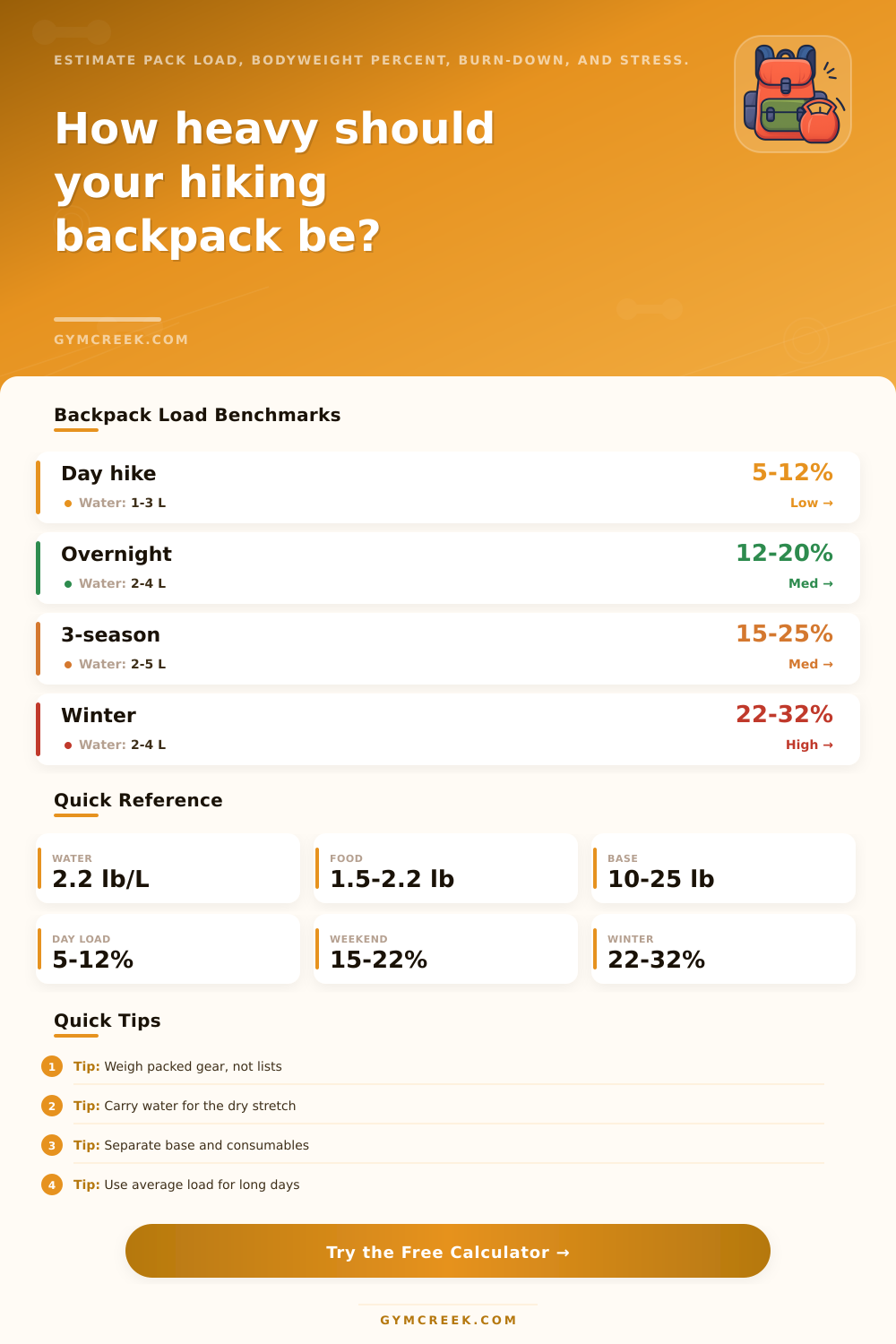
| Trip Style | Target % | Typical Load | Planning Note |
|---|---|---|---|
| Day hike | 5-12% | 8-20 lb | Water and layers |
| Overnight | 12-20% | 18-32 lb | One food block |
| Multi-day | 16-25% | 25-45 lb | Food dominates |
| Winter trip | 22-32% | 35-60 lb | Bulky safety kit |
| Item | Calculator Rule | Metric | Notes |
|---|---|---|---|
| Water | 2.205 lb/L | 1 kg/L | Heaviest carry |
| Food | days x per day | kg or lb | Burns down daily |
| Fuel | burn % entered | kg or lb | Partial carry-out |
| Season kit | preset add-on | kg or lb | Not burned down |
| Season | Add-on | Stress | Examples |
|---|---|---|---|
| Summer | 0-1.5 lb | Low | Sun, rain shell |
| 3-season | 2.5 lb | Moderate | Layers, gloves |
| Wet cold | 5 lb | Higher | Insulation, rain |
| Winter | 9 lb | High | Snow, warmth |
| Formula | Inputs | Output | Limit |
|---|---|---|---|
| Total pack | base + food + water + gear | start load | Scale accuracy |
| Pack percent | pack / body | % bodyweight | Fitness varies |
| Burn-down | food + water + fuel | end load | Refill timing |
| Stress score | load + terrain + season | rating | Estimate only |
💡Tips
Determining the weight of a hiking pack is a necessary task due to the fact that the weight of the hiking pack impact how a person feel on the hike. A person does not feel the weight of there hiking pack while standing in one place, but they do begin to feel the weight of that hiking pack when climbing hills or mountain on the hike. The weight of the hiking pack impact each persons pace on the hike, as well as their joint; notably the knees.
Thus, each individual should consider the weight of their hiking pack in relation to their body weight. The body weight of the individual that is carrying that hiking pack is affect by the weight of a hiking pack. A hiking pack that weighs 30 pounds will feel more heavy to an individual that weighs 130 pounds than it will to an individual that weighs 180 pounds.
Check How Heavy Your Hiking Pack Is for Your Body
Enter your weight, your height, and your gear weight into the calculator to determine the percentage of your body weight represent by your hiking pack. This percentage represents a more accurate measurement of the physical stress that the hiking pack will place upon the individual than the weight of the hiking pack alone. Additionally, the hiking pack calculator will also provide information regarding how much of the weight of your hiking pack consist of consumables, such as food and water.
Because food and water are consumables, the weight of these items will change throughout the hike. While it is necessary to carry enough food and enough water to allow an individual to travel from water source to water source during the hike, any additional liter of water or meals will increase the weight of that hiking pack. Both these variable can be adjusted within the hiking pack calculator to provide an understanding of how the total weight of that hiking pack can change.
Furthermore, the calculator also allow individuals to view how the weight of the hiking pack will decrease as the individual consume the food and water within the hiking pack during the hike. This information allows individuals to make decisions regarding how much food and water to bring on the hike, and how long they may desire to complete that hike. The weight of the hiking pack may also be impact by the terrain that will be featured within the hike.
Summer hikes may require different gear than winter hike, for instance; winter hikes will require more gear to provide the individual with insulation from the cold weather. Thus, terrain may impact the total weight of the hiking pack. However, the weight of the hiking pack do not change with the terrain that will be hiked.
Instead, each terrain can be used to calculate a stress score for the hike. This stress score will combine the percentage of body weight with the various environmental factor that may impact the hike. Although not a perfect measurement of how the individual’s legs may feel during the hike, this score will help individuals to compare the two different hiking plans that they may has.
Finally, the experience level of the individual with hiking pack will also impact how much weight they are able to support. An individual with more experience will be able to handle more weight than an individual with little hiking experience. An experience level can be set within the hiking pack calculator to reflect the stress score of an individual with a specific amount of experience with hiking with heavy pack.
Thus, a new hiker and an experienced hiker can have the same weight of gear, but the new hiker may experience more physical stress than the experienced hiker. It is also useful to separate the weight of the hiking pack into base weight versus consumables. Base weight is any gear that will be present within the hiking pack for the entire hike, while consumables (like food and water) will decrease in weight as they are consume during the hike.
By separating these two variables, individuals can more easy determine if they are adding unnecessary weight to their hiking pack. Additionally, reference table include information regarding typical weights of hiking packs compared to the various types of hike that individuals take. The hiking pack calculator can provide the most value to individuals if it is run with the same number twice.
For instance, each individual could calculate the weight of their hiking pack with a full carry of water, but also calculate the weight of the hiking pack with one liter of water less than the total amount that they will carry. By comparing the stress score and the weight of the hiking pack at the end of the hike with each scenario, individuals can see the difference that small change to the hiking pack can make. Thus, each individual can use the hiking pack calculator to make adjustment to their hiking plans to account for the terrain, season, and physical conditioning of the individual.