Hiking Difficulty Calculator
Estimate a route difficulty score, effort points, Naismith-style time, altitude penalty, and recovery load from trail distance, elevation gain, terrain, weather, pack weight, trail condition, and hiker fitness.
📌Real Trail Presets
Presets use rounded public-style route estimates for planning practice. Always replace them with your current map, seasonal conditions, and group details.
⚙Calculator Inputs
Hiking difficulty snapshot
Enter route details to estimate total difficulty, effort, time, altitude penalty, and recovery load.
📊Metrics Comparison Grid
📑Reference Tables
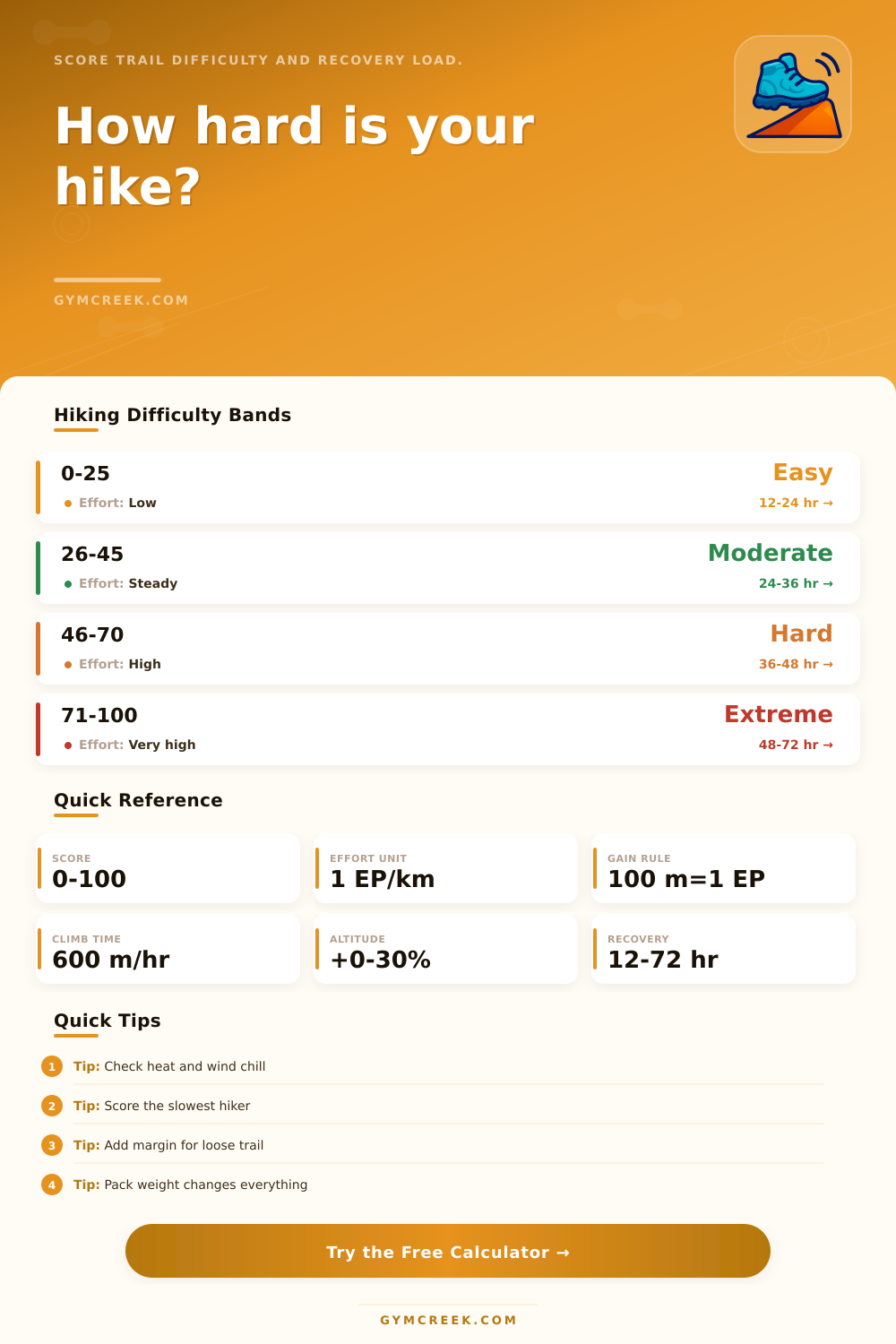
| Score | Band | Typical route feel | Planning response |
|---|---|---|---|
| 0-25 | Easy | Short distance, gentle grade, reliable trail | Normal day-hike prep |
| 26-45 | Moderate | Steady climb or longer mileage | Check pace, water, and daylight |
| 46-70 | Hard | Long day, steep gain, rough footing, or weather stress | Start early and build conservative margins |
| 71-100 | Extreme | Big elevation, altitude, exposed terrain, heavy load, or severe conditions | Use expert judgment and alternate plans |
| Input | Time factor | Score effect | Notes |
|---|---|---|---|
| Class 1 maintained | 0.95x | Low | Even tread with low route-finding demand |
| Class 2 rough trail | 1.08x | Moderate | Rocks, steps, uneven grade, or careful footing |
| Class 3 scramble | 1.22x | High | Hands may be used for balance or progress |
| Ice or hard snow | 1.45x | High | Traction, skill, and exposure can dominate the day |
| Factor | Low impact | High impact | How it is applied |
|---|---|---|---|
| Altitude | Below 1500 m | Above 3500 m | Adds score points and slows time by penalty percent |
| Weather | Cool and dry | Very hot, very cold, wind, rain | Raises time factor and recovery load |
| Pack | 0-4 kg | 18 kg plus | Adds load penalty and effort points |
| Fitness | Conditioned | New or detrained | Modifies time, score, and recovery |
| Formula | Base variables | Adjustment | Output |
|---|---|---|---|
| Difficulty score | Distance, gain, grade | Terrain, pack, altitude, weather, condition, fitness | 0-100 rating |
| Effort points | 1 km + 100 m gain | Multiplier from route stress | Comparable trail load |
| Naismith time | 5 km/hr plus 600 m/hr climb | Terrain, trail, load, altitude, weather, fitness | Moving time estimate |
| Recovery load | Score and effort points | Pack, weather, altitude, fitness | Easy-day guidance |
💡Planning Tips
Planning a hike require consideration of many different factor. While distance and elevation are two factors to consider, they arent the only factors that will affect a hike. The factors to consider include, but are not limited to, the elevation that you will climb, the type of ground that you will hike on, your pack weight, and the weather.
The calculator include the mathematical calculation of each factor that affects the hike. Factors like distance will always be one of the base layer for any hike because the further you hike, the more time you will spend on the hike and the more fatigue that will result for your body. Elevation is another of the initial factor that can compound the hike.
Things to Think About When Planning a Hike
The more that you climb in elevation, the more energy that you will expend for your hike. Additionally, the calculator can all add factors like altitude, pack weight, terrain class, trail conditions, weather stress, and the fitness level of the slowest person in a group to the hike calculation. The fitness level of the slowest person in the group is one of the more important factor since the hike cannot be completed faster than the slowest person in the group.
A trail may be rated as moderate in difficulty, but if you are required to carry water on a hot day, the trail could become more difficult. Similarly, if a recent storm makes the ground rocky, the trail could become more difficult. Since hiking packages require the input of the fitness level of the least-conditioned hiker in the group, planning for the least-conditioned hiker will ensure that you plan for the entire group.
The complexity of navigating the trail will require a certain adjustment to the hike since mental load will have a direct impact on your body. While many individual may not think about recovery time prior to a hike, it is an important part of planning for a hike. The calculator estimate the amount of recovery time that is required before another demanding hike.
A demanding hike at high altitudes with a heavy pack and poor hiking conditions may require three days of recovery to feel normal again. Using this recovery time will allow you to decide whether or not the group should schedule a rest day, or whether the hike should be scaled back based off the plans that are made prior to beginning the hike. Each of the hiking terrain and conditions can interact with the other, leading to more difficult hikes than expected.
For instance, a maintained path in dry weather may be less of a time investment for the hiker than a maintained path in packed snow or ice. The calculator allow for separate adjustments for terrain class and trail conditions to display the impact of each of those factor individually. Additionally, since the weather can have a direct impact on hiking conditions, separate adjustments for weather stress help to account for weather impact on the hike.
Each of the factors in this impact include the impact of weather on hydration levels, energy use, and decision-making for those on the hike. Altitude is another factor for consideration in the hike. Many individual can handle altitude below 5,000 feet.
However, the effects of altitude become more prominent after reaching ten thousand feet. The hike calculator include an adjustment for both time and the overall hike score as a result of high altitudes. Hiking any distance at high altitudes can be difficult due to the increased time required for each recovery between steps on the hike.
Pack weight is another variable to consider. For instance, a light daypack will add little to the effort for individuals on the hike. However, going over nine or ten pounds in pack weight will result in an increasing amount of effort for those on the hike.
Additionally, using the hike calculator allow individuals to adjust the pack weight that they plan to achieve to see how many liter of water or how much weight in outerwear they may need to add to the hike. The reference tables allow individuals to see how the hike score relates to the hikes that are available. Easy hikes will typically be shorter distance with less elevation gain and easier footing.
Intermediate hikes will feature more climbing or more miles to hike. Hard hikes will include more challenge in a single hike, and extreme hikes are similar with the exception that there are more challenges for those individual on the hike. The hike calculator is most useful when used prior to committing to a hiking route.
Inputting the hike variables like your pack weight, the weather, and the fitness level of each individual in your hiking group will allow you to see the impact of each factor on your hike. By using this calculator prior to beginning your hike, you can make adjustments to your hiking plans and ensure that each individual can enjoy the hike whilst minimizing the risk of injury.