Power Index Calculator Swimming
Build a unique swimming power index from event time, course, stroke, age group, technique score, and pace consistency without copying official point tables.
📌Swim Presets
Presets fill realistic event, course, stroke, age, time, technique, and split drift inputs so you can compare different swim profiles quickly.
⚙Calculator Inputs
Index ready
Enter a valid swim profile to calculate the power index.
📊Current Profile Metrics
📘Reference Tables
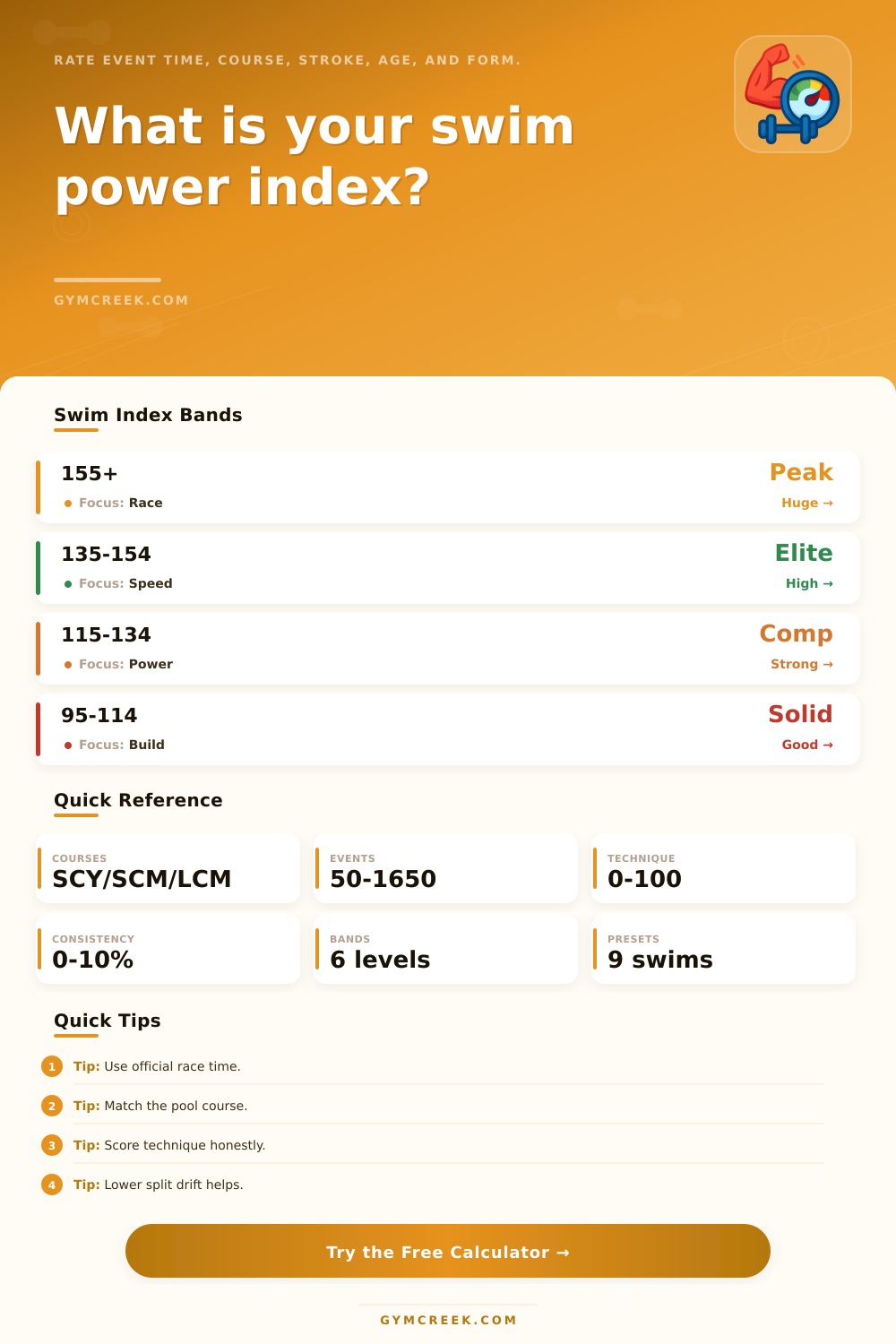
| Index | Band | Readout | Training signal |
|---|---|---|---|
| 155+ | Championship surge | Exceptional time plus excellent form control | Protect recovery and race-specific sharpening |
| 135-154 | Elite lane | High power profile for the selected event | Small technique errors can move the score quickly |
| 115-134 | Competitive power | Strong race or time trial profile | Build repeatability and race-specific turns |
| 95-114 | Strong training | Solid swim performance with room to tune | Technique and pacing usually create the biggest gains |
| 75-94 | Building base | Developing speed or inconsistent pacing | Prioritize clean mechanics and repeat sets |
| Under 75 | Technique first | Time, form, or split drift is limiting the profile | Use controlled repeats before chasing more intensity |
| Item | Baseline role | Adjustment | How it affects index |
|---|---|---|---|
| Freestyle | Fastest reference stroke | 72 sec per 100 m base | Highest baseline speed expectation |
| Backstroke | Long-axis stroke | 80 sec per 100 m base | Compares backstroke to its own pace curve |
| Breaststroke | Kick-dominant stroke | 89 sec per 100 m base | Slower baseline avoids freestyle-style scoring |
| Butterfly | Power stroke | 78 sec per 100 m base | Rewards speed while accounting for fatigue load |
| Individual medley | Mixed-stroke event | 84 sec per 100 m base | Uses a blended reference pace |
| SCY | Short yard course | Yards convert to meters, turn credit applied | Accounts for shorter distance and more walls |
| SCM | Short meter course | Small turn-density credit | Usually a little faster than long course |
| LCM | Long course meters | Neutral pool reference | Fewer turns, more pure swimming per length |
| Input | Good range | Warning range | Use in formula |
|---|---|---|---|
| Technique score | 75-95 | Under 60 | Multiplies speed index by form quality |
| Pace drift | 0-3% | Over 8% | Rewards even splits and controlled repeats |
| Age factor | Prime factor near 1.00 | Large factor for youth or masters | Compares time to age-adjusted reference |
| Event distance | Official race distance | Unmeasured open-water distance | Sets distance curve and pace per 100 |
💡Calculation Notes
A swimming index is a tool that measure the performance of a swimmer by taking into account many different variable. Swimmers often find that the raw time that it takes for them to swim a certain distance or event dont always reflect there performance in the water. These factors that can affect a swimmer’s raw time can include the age of the swimmer, the length of the pools in which they are swimming, the stroke that they use while swimming, and how consistent the swimmer maintains a pace in there performance.
The swimming index for each swimmer provide a better overall picture of that swimmer’s performance to the swimmer and the coach for whom they are competing by accounting for these different variables. Each of the various variables that the swimming index takes into account is a factor that can alter the score that is provided to each swimmer. Variables like course length must be accounted for because pools with more wall (short course pools) will require the swimmer to turn more often then pools with fewer walls (long course pools).
How a Swimming Index Helps Swimmers and Coaches
Additionally, some swimming strokes are inherentely faster than others, so a swimmer that uses a fast swimming stroke will have raw time that are faster than a swimmer that employs another stroke. A swimmer’s age is another variable to account for because a younger swimmer is likely to have different times than an older swimmer. Other variables related to a swimmer’s technique in the water and their consistency while swimming will also impact their swimming index score.
The swimming index is a tool that can help to indicate how coaches and swimmers should train, but the swimming index is not a tool that is use to crown a swimming champion. For instance, if a swimmer has a high score for a sprint performance, they may need to focus on recover for there next race. If a swimmer has a middling score for a long race, they may need to focus on there pacing for there next race.
The swimming index can help swimmers and coaches to make these kind of decisions due to the simplified score that is presented to the swimmer rather than a series of complex mathematical coefficients. Beyond the swimming index score that is provided to each swimmer, there are other data points that account for each swimmer’s performance, but the swimming index does not account for every single factor. For instance, variables like illness, travel, and even growth of the swimmer can impact there performance and there age variable within the swimming index.
Additionally, a swimmer that trains alone in the water will exhibit different performance result than they would while competing in a more competitive swimming environment. By making small adjustment in a swimmer’s technique in the water, their swimming index score can be improved. For example, improving the catch in the swimmer’s butterfly stroke will improve there technique score.
Additionally, reducing the swimmer’s split drift will also increase there swimming index score; a swimmer that reduces there split drift is swimming more consistent. Reference tables are provided with the swimming index to indicate why different swimming profile will result in different scores from the swimming index calculation. These reference tables allow the swimmer to understand the impact that each of the variables have upon the swimming index score.
Additionally, these tables help to indicate in what ways the swimmer can best utilize there training time. Although no swimmer desires to obtain a perfect swimming index score, the use of the swimming index allows each swimmer to understand which variable change and why that variable has changed. A swimmer can use the swimming index after each time trial to measure there improvements in performance in the pool.
For instance, if a swimmer has improved in there raw time but there swimming index score has remained the same, the swimmer’s improvements is due to either age or luck. However, if a swimmer’s time remains the same but there swimming index score increase, the swimmer has improved there technique. Additionally, if each swimming index score is compared to the other within a season, those scores can help to indicate the direction in which the swimmer is progressing.
While the specific score for a swimmer’s swimming index is important, the direction of that score is more important for making decisions regarding the swimmer’s training program.