Swimming to Steps Calculator
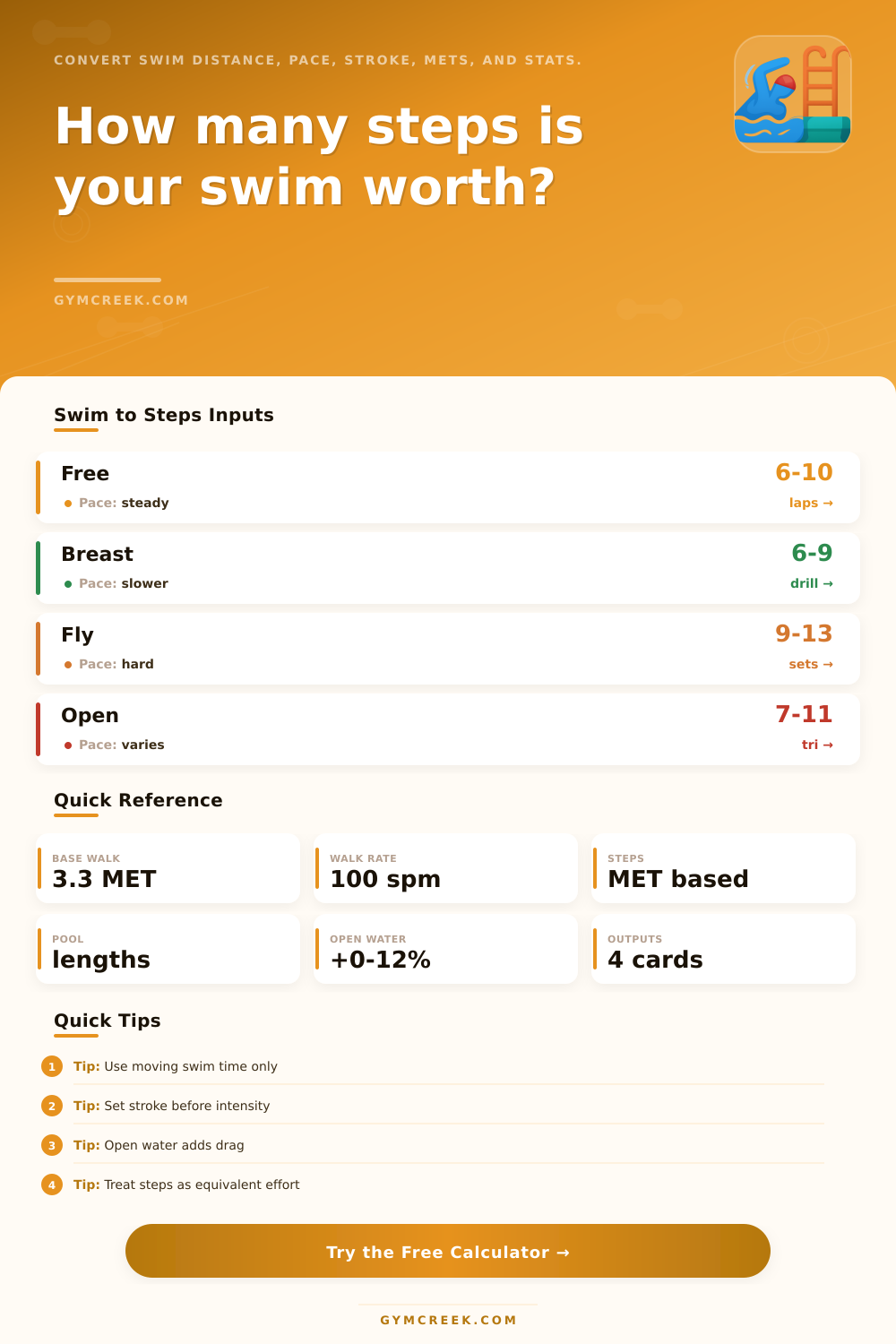
Convert a pool or open-water swim into step-equivalent effort using distance, stroke, pace, intensity, conditions, body stats, calories, MET minutes, and a walking-step reference.
📌Swim Presets
Each preset loads a complete swim profile with stroke, water setting, distance, pace or time, body stats, intensity, rest handling, and walking-step reference.
⚙Calculator
Swim step-equivalent estimate
Enter swim distance, pace or time, stroke, setting, body stats, and intensity to convert swimming work into walking step-equivalent effort.
📊Swim Metrics
📑Reference Tables
| Stroke | Easy | Moderate | Vigorous / Race |
|---|---|---|---|
| Freestyle | 5.8 MET | 8.3 MET | 10.0 to 11.2 MET |
| Backstroke | 4.8 MET | 7.0 MET | 9.0 to 10.0 MET |
| Breaststroke | 5.3 MET | 8.0 MET | 9.8 to 10.8 MET |
| Butterfly | 7.0 MET | 10.0 MET | 12.5 to 13.5 MET |
| Method | Walking baseline | Best use | Formula idea |
|---|---|---|---|
| Standard | 3.3 MET at 100 steps/min | General fitness logs | MET minutes divided by walking MET per step |
| Height based | Step length plus walking kcal | Personal body-size estimate | Swim calories divided by kcal per walking step |
| Brisk walk | 4.3 MET at 120 steps/min | Active walkers | Compares against brisk-walk effort |
| Conservative | 3.0 MET at 90 steps/min | Lower step credit | Uses a slower walking reference |
| Setting | Adjustment | What it reflects | Use carefully when |
|---|---|---|---|
| Pool laps | 0% to -3% | Turns and wall push-offs improve efficiency | Drill sets have many pauses |
| Open water calm | +4% | Sighting, navigation, and fewer wall breaks | GPS distance is noisy |
| Open water choppy | +8% | Waves, chop, and variable line | Current helps or hurts |
| Current / rough | +12% | Current, cold, chop, and heavy drag | Race conditions are extreme |
| Output | Formula | Inputs | Why it matters |
|---|---|---|---|
| Swim time | Pace x distance, or total time minus rest | Distance, pace, rest share | Separates moving swim work from deck time |
| MET minutes | Adjusted MET x moving minutes | Stroke, intensity, setting, pace | Creates an effort volume across strokes |
| Calories | MET x kg x hours | Body weight and swim time | Gives body-size context for the same swim |
| Step equivalent | MET volume compared with walking steps | Walking baseline and calibration | Turns a non-step workout into comparable effort |
💡Tips
Swimming and walking are two different physical activities. However, many people want to compare swimming and walking to determine there total movement. After swimming, many people want to know how much swimming effort are required compared to the number of walking steps they took.
Because swimming does not involve walking footfalls, no one can take steps while swimming. Instead, a swimming to steps calculator can help compare swimming to walking by calculating the energy burned during swimming and the effort required to swim. A swimming to steps calculator can take into account the distance swam, the stroke used while swimming, the intensity of swimming, and the environmental conditions.
Compare Swimming to Walking Steps
The calculator can produce the equivalent walking effort to swimming. This number isnt the number of steps taken while swimming, but it is an estimate to show whether swimming effort was similar to walking at a low rate or high intensity similar to walking at a briskly rate. Swimmers can use a swimming to steps calculator to compare different swimming stroke.
For example, freestyle swimming at a moderate rate burns the middle range of calories required for swimming. However, butterfly stroke requires more effort for the shoulders and core to perform the stroke. Breaststroke may cover the same distance as freestyle but takes more effort due to the glide phase of breaststroke.
Backstroke requires less effort than freestyle, as the body position for backstroke requires less resistance when swimming. If the swimmer changes swimming strokes while swimming, the swimming to steps calculator will change the effort required for swimming. This is also true if the swimmer wants to maintain a certain number of steps for there weekly training.
The intensity required for swimming impacts the effort a swimmer must contribute to swimming. Although both long distance and easy swimming and short distances and fast swimming can burn the same number of calories, the effort required of a swimmer is different between the two activities. A swimming to steps calculator can take into account the pace of swimming to calculate the effort required.
Additionally, open water swimming adds to the effort required to swim because of the need to sight ahead, swim against wave, and the lack of walls in open water. Cold water and currents can add to the effort required of a swimmer to swim the distance, although wearing a wetsuit can reduce the effort required. The weight of the swimmer can add to the effort required of swimming.
The more a person weighs, the more energy they will burn while swimming a distance as compared to a lighter swimmer. Additionally, the taller a person is, the longer their natural stride when walking so the effort required to swim will be translated to walking steps more accurately. A swimmer’s age and activity level while swimming can also be entered into the swimming to steps calculator.
These factors provide context for swimming and how the swim will compare to other activities performed by the swimmer in there daily routine. One of the most common mistakes in swimming is assuming that every swim is the same effort regardless of the rest periods swimmers take between swimming efforts. A swim that includes periods of resting on the pool walls will take less effort than a swim that does not take rest.
A swimming to steps calculator can calculate this so that swimming and walking efforts are comparable. Another common mistake is to assume that all swimming pool lengths are the same. If a swimmer makes frequent turn in a short course swimming pool, they take a break between each set.
However, a long course pool or open water will take more effort to swim the same distance. To calculate the swimming to walking steps comparison, the calculator can use MET values. MET values determine the energy requirements of an activity compared to sitting still.
Swimmers can calculate MET values by the swimming strokes swimmers use. Additionally, swimming to steps calculators use MET minutes that swimmers produce. This number can be compared to a walking baseline set by the user.
The user can choose the number of steps that would produce by walking at a moderate pace, a brisk pace, or by calculating a swimmer’s height. The swimmer can also change the number if the number of swimming steps is too high or too low to compare to the swimmer’s walking steps. Additionally, swimmers can use this swimming to steps calculator to maintain a balance between swimming and walking effort during there training program.
If the swimmer desires to increase there fitness, the calories burned while swimming and walking can help them determine if there training regime is providing enough exercise for there goals. Swimmers who are rehabilitating an injury can use the calculator to ensure that swimming does not take up too much of there total steps compared to walking. However, the swimming to steps calculator does not include all the factor that can influence swimming efforts.
For example, the effect of water temperature, sleep, nutrition, and illness while swimming cannot be accounted for in the calculator. Instead, the number produced is an estimate of swimming efforts and should only be used to determine trends in steps taken over several swimming and walking weeks instead of setting goals to take a specific number of steps compared to swimming efforts. Converting swimming efforts to walking steps allows an individual to understand the relationship between swimming and walking.
For example, a relaxed swim of 1500 meters can take the same effort as an hour of walking at a moderate pace. However, a swim of 800 meters using the butterfly stroke can take more effort than a long distance easy swim or a short distance fast swim. This type of calculation allows individuals to compare swimming and walking.
Additionally, the relationship between swimming and walking becomes even more evident when looking at a swimmer’s efforts over a full week or over a full swimming month. A few swims and a few walks can add up to a high number of total steps taken. While the calculator cannot give the same feeling as swimming, the numbers provided give individual the ability to place swimming on the same scale as walking efforts.