Rowing Efficiency Calculator
Score how efficiently a rowing effort turns stroke rate, meters per stroke, drag factor, watts, heart rate, and RPE into sustainable erg performance.
📌Efficiency Presets
Presets are realistic erg snapshots for calculation only. They are not workout prescriptions.
⚙Calculator Inputs
Rowing efficiency snapshot
Enter split, stroke rate, drag, HR, and RPE to score the piece.
📊Efficiency Metrics Grid
📘Reference Tables
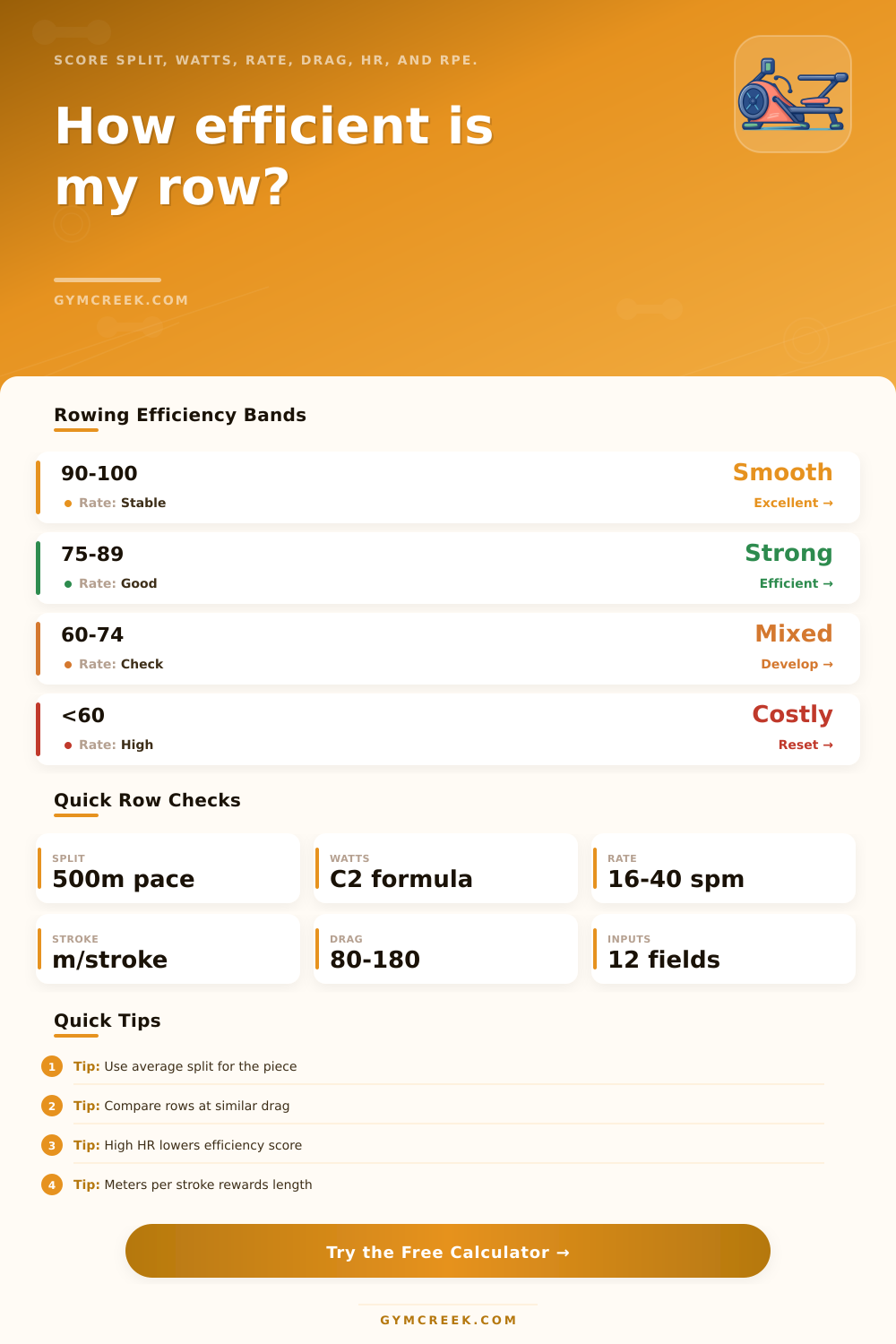
| Score | Meaning | Likely pattern | Next check |
|---|---|---|---|
| 90-100 | Excellent | Power, rate, and effort align | Repeatability |
| 75-89 | Efficient | Good pace with minor cost | Rate stability |
| 60-74 | Developing | One or two inputs are costly | Stroke length |
| Below 60 | Inefficient | High effort for the split | Drag and rhythm |
| 500m split | Approx watts | Typical use | Efficiency cue |
|---|---|---|---|
| 2:30 | 83 W | Recovery | Relaxed rhythm |
| 2:15 | 113 W | Base row | Low HR cost |
| 2:00 | 203 W | Tempo | Stable length |
| 1:45 | 302 W | Hard work | Rate control |
| 1:30 | 480 W | Sprint | Power per stroke |
| Rate | Common row | Efficient sign | Watch for |
|---|---|---|---|
| 16-20 spm | Technique | Long meters per stroke | Overloading drive |
| 20-24 spm | Base | Stable split and HR | Rushing recovery |
| 24-30 spm | Tempo | Power rises smoothly | Short strokes |
| 30+ spm | Hard tests | Length stays controlled | High effort cost |
| Formula | Inputs | Output | Why it matters |
|---|---|---|---|
| Watts | 500m split | Power | Erg output |
| W/kg | Watts, kg | Relative power | Athlete compare |
| Meters/stroke | Speed, spm | Stroke length | Technique signal |
| HRR | Age, HR | Effort pressure | Cost signal |
| BMR | Body data | Energy context | Fitness profile |
💡Calculation Tips
Rowing efficiency is the measurement of how well a persons is converting their physical effort into movement on a rowing machine. Rowing efficiency is important because rowing efficiency will determine whether a person’s effort on the machines results in better performance on the rowing machine. A person may feel that they are putting in effort into the rowing machine as split times is low and heart rates are stable, but if the person requires high effort, then their performance with the rowing machine is inefficiently.
Overall, rowing efficiency cannot be determined from a single number, but instead by the efficiency of each of the rowing machines metrics working together. To calculate the rowing efficiency of a person on a rowing machine, several differently inputs are necessary. The split of the rowing machine will indicate the speed at which the person rows, the stroke rate will indicate the rhythm at which the person rows, the meters per stroke will indicate if the person is rowing with a good rhythm, the drag factor will indicate at what level the rowing machine is set up, the heart rate will indicate the cost of the rowing effort, and the rate of perceived exertion will also indicate the cost of the rowing effort.
What is rowing efficiency?
If each of these factor work together in consistency with one another, rowing efficiency will increase for that person. If any of these factors does not align with the others, rowing efficiency will drop. Aside from split times, many rower should focus on their meters per stroke.
If a person increases their stroke rate but decreases their meters per stroke, they are increasing the speed at which they are rowing, but increasing the chance that their stroke rate is not sustainable. A calculator can help to perform the mathematics for a rower to determine if their changed stroke rate was worth the change in their meters per stroke. Another important rowing machine input is the drag factor.
The drag factor can help a person to understand their resistance on the rowing machine. A high drag factor may make poor meters per stroke look better due to the resistance on the machine, and a light drag factor may make a short stroke look like it is going at a faster rate than it is. A person should compare their rowing performances using similar drag factor settings to ensure that the drag factor is not affecting the rowing efficiency score.
Finally, both the heart rate and the rate of perceived exertion are two different measurements of the cost of rowing machine performances. Each of these factor will help to show how much effort a person use when rowing. For instance, two rows could have the same split rates, but have different efficiency ratings if one row performance has a higher heart rate or RPE than the other.
Row performance with poor sequencing or with rushed recoveries will have lower efficiency ratings due to the effort that the body rowing absorbs, rather than any propulsion create by the rowing machine. If there is a gap between the power output and the effort cost for rowing, then the person should look at their rowing technique. Depending on the type of rowing that is being performed, there will be different efficiency standards required of the rower.
For example, a rower can perform a rowing session that lasts for twenty minutes at a steady tempo, or the rower can perform a sprint test of short duration. The standards for measuring efficiency will be different for each type of rowing test. For instance, a tempo row will have a more even meters per stroke and heart rate readings, while the sprint tests will register high readings for both power and stroke rate.
The reference table on the page can help to compare the efficiency of a persons tempo and sprint rows. There are mistakes that some rowers make when attempting to increase their rowing efficiency. One mistake is increasing the stroke rate without considering the meters per stroke.
Another mistake is varying the drag factor from row to row. Some may think that if the heart rate is high during a row, then the row is not efficient. However, a high heart rate could be from dehydration or sleep issue.
While the calculator will not help with dehydration or sleep issues, it will provide a better understanding of the technical aspects of rowing. Many people may believe that higher watts are always indicative of better rowing efficiency. However, watts only indicate the output that a person can produce during rowing, not the value of that output.
If a person can produce the same watts but with a higher heart rate or with fewer meters per stroke, it indicate that their rowing efficiency is worse. The efficiency score will provide an indication of these factors to help a person understand whether the rowing produces its watts at a reasonable price. Additionally, a persons body weight can impact their watts-per-kilogram figure.
If a person is too heavy for the boat, they may produce a high number of watts. However, a lighter person may have to row at a higher stroke rate to produce the same amount of watts. The calculator can adjust for this with the rower profile to show an efficiency score that indicate the same performance for all rowers of similar categories.
After a person finishes a row, they can use the target selector to select what aspect of rowing they want to adjust. A person can use the selector to indicate that they want to increase the length of the row at the same pace, increase their split time, decrease their heart rate cost, or decrease the stroke rate while maintaining their current pace. If they want to increase the length of the row at the same pace, they would need to maintain the same meters per stroke and drag factor.
To increase the split time, they will need to find ways to increase the meters per stroke and stroke rate. To decrease the heart rate cost, they can adjust their technique and look at their row recovery to ensure that they are recovering efficiently after each stroke. Rowing efficiency can be increased with repetition.
One row at a high efficiency is not as indicative of a persons potential as three rows with similar conditions. The calculator makes it easy to compare the efficiency of an individual’s rowing technique when performing these types of task. The efficiency score will allow a person to identify any inconsistencies in their rowing technique without the assistance of a coach.
The numbers will indicate whether their efforts are being converted to rowing or if they are simply burning up there energy with each stroke.