Rowing Speed Calculator
Convert rowing split pace, distance and time, average watts, stroke rate, erg mode, boat mode, current, and wind into speed over water, speed over ground, 500m split, mph, kph, knots, and efficiency notes.
📌Speed Presets
Each preset loads a speed-focused rowing scenario and recalculates immediately. Boat mode separates water speed from GPS-style ground speed.
⚙Calculator Inputs
Rowing speed snapshot
Enter split, distance and time, or watts to calculate rowing speed.
📊Speed Metrics Grid
📘Reference Tables
| 500m split | KPH | MPH | Knots |
|---|---|---|---|
| 2:40.0 | 11.25 | 6.99 | 6.07 |
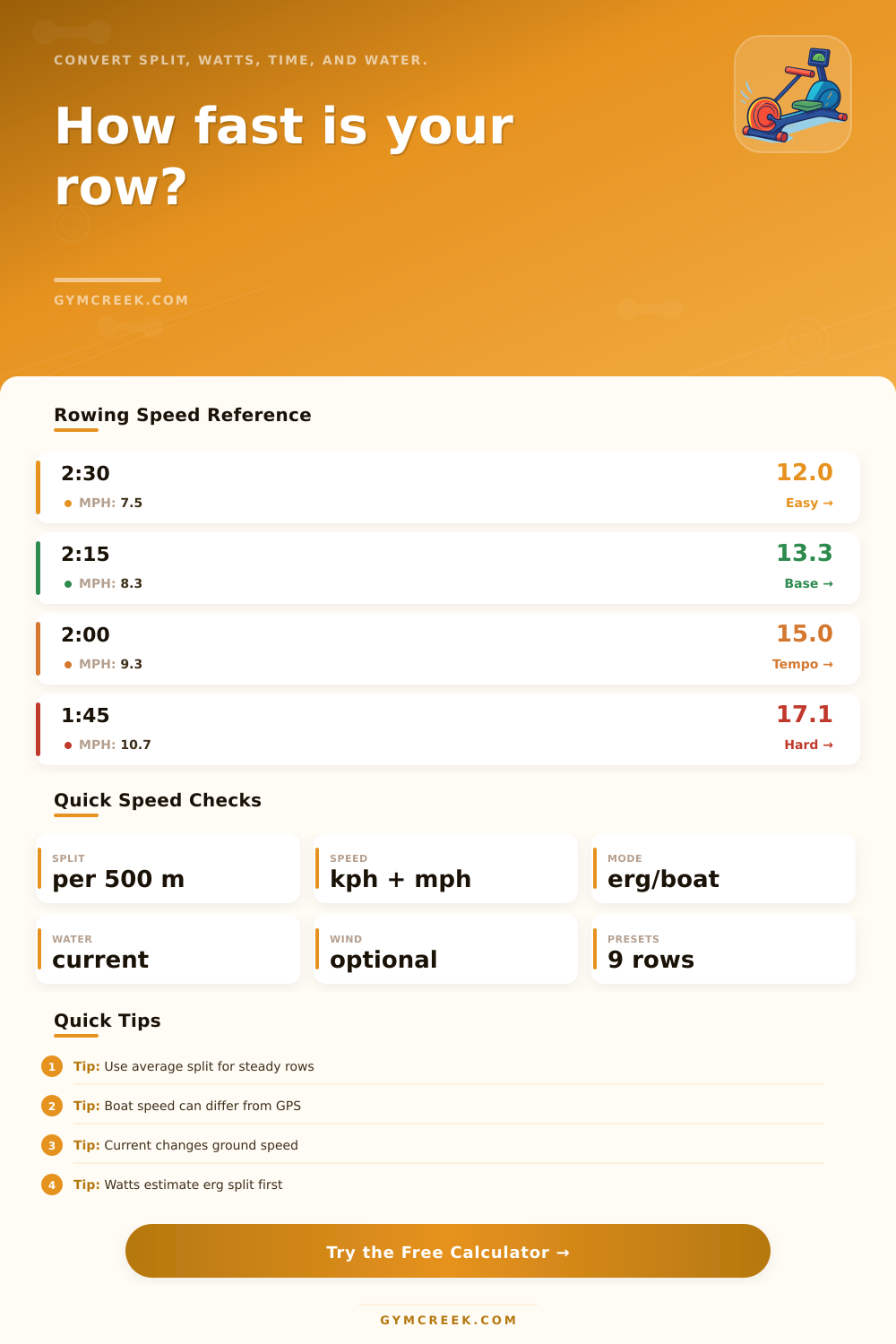
| 2:30.0 | 12.00 | 7.46 | 6.48 |
| 2:15.0 | 13.33 | 8.28 | 7.20 |
| 2:00.0 | 15.00 | 9.32 | 8.10 |
| 1:45.0 | 17.14 | 10.65 | 9.26 |
| 1:30.0 | 20.00 | 12.43 | 10.80 |
| Condition | Input | Speed effect | Best use |
|---|---|---|---|
| Tail current | Current kph | Adds ground | River rows |
| Head current | Current kph | Lowers ground | Upstream rows |
| Headwind | Wind kph | Small penalty | Open water |
| Crosswind | Wind kph | Handling note | Steering check |
| Rough water | Water factor | Boat penalty | Chop context |
| Rate | Speed focus | Check metric | Common use |
|---|---|---|---|
| 16-20 spm | Length | m/stroke | Drills |
| 20-24 spm | Base speed | Split hold | Long rows |
| 25-30 spm | Tempo | Watts | Work pieces |
| 31-36 spm | Race pace | Efficiency | Tests |
| 37+ spm | Sprint | Control | Short bursts |
| Formula | Inputs | Output | Purpose |
|---|---|---|---|
| Speed | Split | m/s, kph | Main result |
| Speed | Distance, time | Average | GPS log |
| Watts | Power | Split | Erg estimate |
| Ground | Water, wind | GPS speed | Boat mode |
| Stroke | Rate, speed | m/stroke | Efficiency |
💡Calculation Tips
Rowing speed are determined by the power of the rower, the technique of the rower, and the conditions of the environment in which the rowing take place. A rower may feel that they are rowing at a high rate of speed, but their speed may be low due to the effects of the wind and current upon the boat. A rower may have a high power score on an indoor rowing machine, but that high power does not necessarily result in a high rate of rowing speed if the rower is aboard a boat.
Thus, it is important for a rower to separate the measurements of the rowing machine from their experiences on the water to understand the concept of rowing speed. Split pace is one of the most common methods of measuring the speed of a rower. Split pace allow a rower to set a target for themselves of the rate at which they wish to row.
What Affects Rowing Speed and How to Measure It
For instance, a split pace of 2:00 means that the rower desires to row 500 meter in two minutes. The split pace can also be converted into a value in the unit of watts, which is a measure of power. Both of these calculations can be performed through the calculator, which is capable of processing split pace, distance over time, and watts.
Another factor that is important to consider is the mode that the calculator uses. Different mode will change the way in which the calculator calculates and displays data. For instance, erg mode will calculate the rowing power while considering only the drag factor and the stroke rate of the rower.
Boat mode will calculate rowing power while also considering the effect of the wind and current upon the boat. The calculator models the effect of tail current or head current upon the boat, so that the rower can understand how each of these factors may impact rowing speed. The calculator models the split pace of the boat separately from the ground speed of the boat so that the rower can understand if the change in speed result from the rower or the water.
Stroke rate and meters per stroke are two indicators of the technique of the rower, and are factors that are not reflected by rowing speed alone. For instance, rowing speed can be achieved by utilizing either a low stroke rate with long strokes, or a high stroke rate with short strokes. The energy that the rower expends will differ in each of these scenario.
Thus, the calculator also models stroke rate and meters per stroke so that a rower can understand if their change in stroke rate has had any effect upon rowing speed. The calculator makes the adjustments for current and wind in a conservative manner. The wind and current does not impact every boat in the same manner.
For instance, a headwind may impact some boats more than others, and cross currents may have more of an effect upon the steering of a boat than upon the speed at which it rows. Thus, the calculator provides the adjustments for current and wind only as an estimate for the rower. In most cases, the split pace will feel different when rowing against a current then when rowing against no current at all.
The tables provided on the calculator allow the rower to understand the concept of rowing speed in context to the other data provided by the calculator. For instance, the split-to-speed chart allow the rower to understand how split pace can affect rowing speed. The condition adjustment guide explains which variables will impact the ground speed of the boat, and which variables will impact the handling of the boat.
A stroke-rate table allow the rower to understand different focuses for different stroke rates. Each of these tables are not substitutes for the judgment of the rower, but they provide the rower with an understanding of how to avoid making mistakes with the data that is provided by the calculator. Rowers utilize Watts mode that use a power meter or who row on indoor rowing machines.
The split pace that the calculator provides using the equation of power is only an estimate to the true split pace of the rower. This estimate is more accurate if the rower enters their drag factor. This adjustment to split pace allow for a rower to compare their power measurement to their target split pace, or to any other split pace that they may have recorded during their rowing session.
Body weight and activity levels is also captured within the calculator. The power of a rower is relative to the power of that specific person. Thus, 225 watts of power exerted by a 68 kg rower is not the same as 225 watts of power exerted by an 86 kg rower.
These factor will not impact the calculation of rowing speed, but may help a rower understand if their stroke was particularly demanding or if adjustments should be made to their recovery period. Rowing speed may be understood the best if the individual uses the tool with some consistency and repetition. For instance, if the rower utilizes each of the factors in the same manner each time they use the calculator, the rower will be able to more easily understand whether changes in rowing speed were the result of the environment in which the rowing sessions took place, or if the changes in rowing speed were the result of changes in the measurements of the rower.
Rowing speed is a combination of the power, length, and environmental factors that impact the ability of a boat to travel at a specific rate. Thus, the calculator make it easier for a rower to understand rowing speed by maintaining each of these factors in the calculator. Through using the calculator, a rower can understand which variables impact rowing speed, and which variables they should focus upon during their rowing session.