Elliptical Speed Calculator
Convert stride length, cadence, resistance, machine type, time, and distance into actual speed, pace, workout distance, and effort-adjusted training estimates.
📌Presets
Each preset loads a realistic elliptical session and calculates speed immediately.
⚙Calculator
Elliptical speed snapshot
Enter cadence, stride length, resistance, and time or distance to calculate the session.
📊Speed Metrics
📑Reference Tables
| Cadence | Stride | Speed | Feel |
|---|---|---|---|
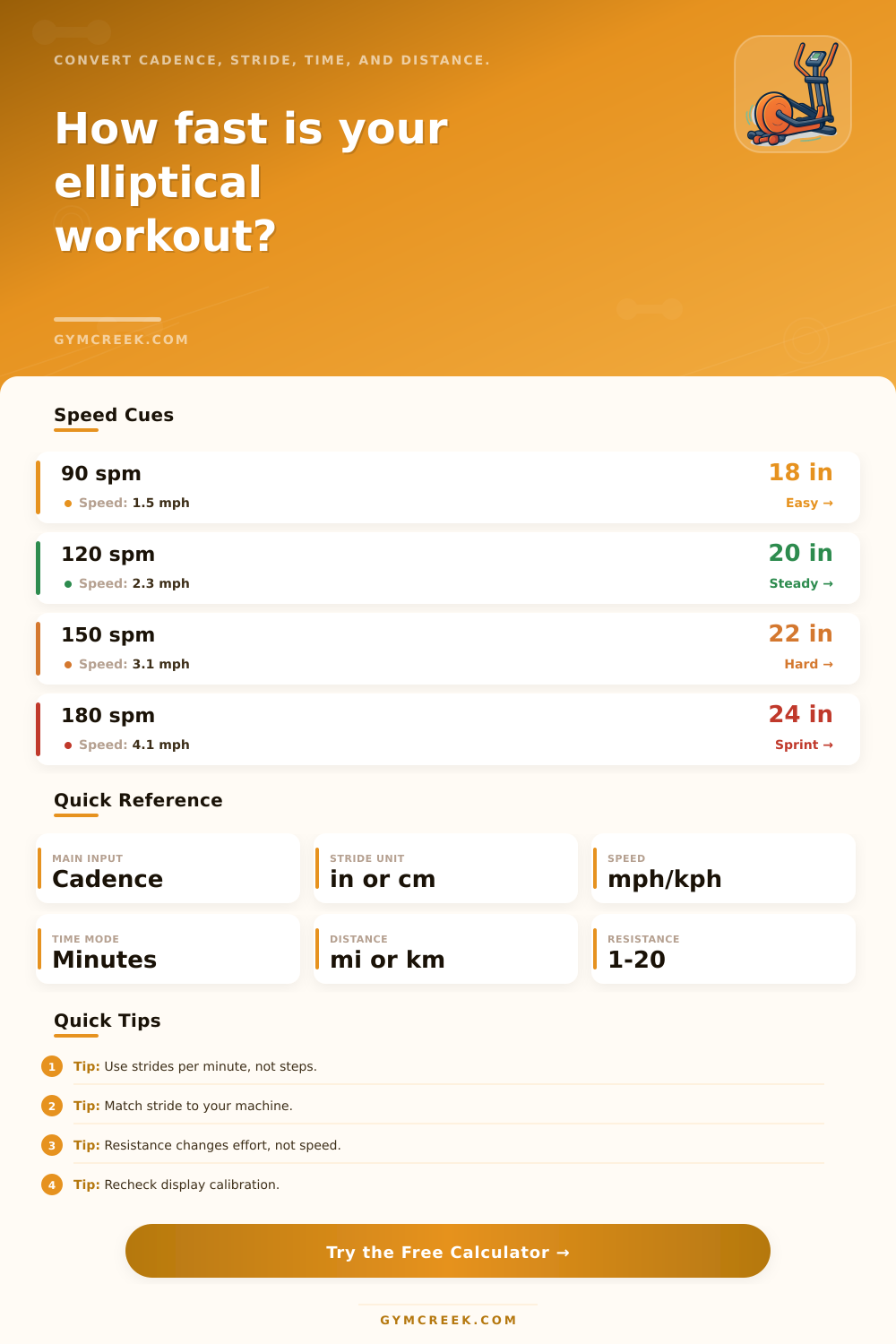
| 90 spm | 18 in | 1.5 mph | Easy |
| 120 spm | 20 in | 2.3 mph | Steady |
| 150 spm | 22 in | 3.1 mph | Hard |
| 180 spm | 24 in | 4.1 mph | Sprint |
| Machine | Factor | Stride cue | Use |
|---|---|---|---|
| Standard | 1.00 | 18-22 in | General |
| Compact | 0.94 | 14-18 in | Small unit |
| Center-drive | 1.02 | 20-24 in | Smooth |
| Arc trainer | 1.07 | Arc path | Higher |
| Goal | Cadence | Resist | Duration |
|---|---|---|---|
| Warm-up | 80-110 | 1-5 | 5-12 min |
| Cardio | 110-140 | 5-10 | 20-45 min |
| Tempo | 135-160 | 8-14 | 10-30 min |
| Interval | 160-200 | 6-16 | 30-90 sec |
| Formula | Variables | Output | Use |
|---|---|---|---|
| Stride x SPM | Length, rate | ft/min | Base speed |
| ft/min x 60 | Distance | mph | Imperial |
| mph x 1.609 | Speed | kph | Metric |
| MET x kg x hr | Effort | kcal | Estimate |
💡Tips
Elliptical machines uses specific variables to calculate the distance and the speed that is displayed on the elliptical machine console. The two main variables that help to determine the distance that is traveled on the elliptical machine are its stride length and cadence. Stride length is the distance that a foot travels in a complete stride, while cadence is the number of strides that are taken in a minute.
By understanding stride length and cadence, it is possible to understand the way that the elliptical machine calculates both speed and the number of calories that are burned during exercise on that machine. Stride length is the distance between the toes of a foot when the foot is held in the most forward position to the most laterally-extended position of that same foot. Because the foot travels each stride, increasing stride length will increase the distance that the exerciser travels on the elliptical machine.
How Elliptical Machines Show Speed, Distance and Calories
Thus, if two individuals of the same weight use the same cadence on an elliptical machine but one individual has a longer stride length than the other individual, the individual with the longer stride will travel a more greater distance on the elliptical. Cadence is the number of strides per minute that is displayed on an elliptical machine. For simplicity, the cadence is measured in the number of full cycling movements of the lower body.
Cadence on an elliptical machine begins at values of 90 strides per minute for new users of elliptical machines and increases to values of 150 strides per minute or more for individuals that are more experienced on the elliptical exercise machine. Increasing the cadence will increase the speed of the elliptical machine at the same stride length. Decreasing cadence will decrease the speed on an elliptical machine at the same stride length.
Ramp and resistance settings on an elliptical exercise machine are two variables that is different than both stride length and cadence. Resistance and ramp settings do not impact the speed that is calculated for an elliptical machine. Instead, resistance settings impact the amount of effort that must be exerted to maintain a certain speed on the elliptical exercise machine.
While many individuals may believe that increasing the resistance will impact the distance that is traveled by the elliptical machine, such an effect will not occur on the elliptical unless the increased resistance impact the cadence of the individual. Therefore, resistance settings are a tool for allowing individuals to increase the effort of a workout without increasing the speed of that workout. Actual speed and effort-adjusted speed are two variables that help to describe the intensity of the workout that is being performed on an elliptical exercise machine.
Actual speed is the calculated speed of an individual based off stride length and cadence. Effort-adjusted speed is a calculation of the actual speed of an individual that also takes into account the resistance and ramp settings. Because effort-adjusted speed considers the actual effort of an individual during a workout session, two individuals that have the same actual speed may have different effort-adjusted speeds if one of those individuals use higher resistance levels than the other individual.
It is important for individuals to monitor both actual and effort-adjusted speed for even performance of workouts so that they are not relying upon the distance that is traveled as the only means of judging the effort of their workouts. The type of elliptical exercise machine that is used can impact the distance that may be covered by an individual. Elliptical exercise machines can be front-drive, rear-drive, or center-drive models.
Additionally, some elliptical exercise models may be compact models or adaptive-stride models. Each model of elliptical exercise machine may impact the stride length of the individual that is using that model; compact elliptical exercise machines may have shorter stride lengths than adaptive-stride models. Due to the fact that the stride lengths of each type of elliptical machine may be different, a calibration factor must be used in calculating distance for each type of elliptical machine.
Pace and total strides are two variables that relate to the duration of a workout. Pace is a measurement of the amount of time that an individual takes to travel a specific distance, such as one mile. Total strides is the total number of complete cycles that an individual performs during a session on an elliptical exercise machine.
For instance, an individual that completes a 30-minute session at a rate of 130 strides per minute will have completed 390 total strides. Total strides is another variable that can be helpful to monitor during a session on an elliptical exercise machine. Total strides is representative of the number of times that an individual hips, knees, and ankles is loaded during a session.
Calories is calculated based upon the speed of the elliptical machine, the resistance settings of the elliptical, the body weight of the individual, and the length of time during which the exercise session was performed on the elliptical machine. The calories calculation is approximated, and the figure will be more accurate with an accurate body weight and resistance setting. The calorie value that is calculated can be too high for some individuals, as the resistance setting for those individuals may be high to allow for a faster rate of burning of calories.
To calculate calories burned on the elliptical, the body weight is multiplied by the MET value of the exercise and the length of time that the exercise is performed. Some of the errors that individuals that use elliptical exercise machine may make include overestimating the stride length and increasing the cadence to the point of counting individual foot moves rather than the number of complete cycles performed by the body; both of these will lead to an overestimation of the speed that is attained on the elliptical exercise machine. Additionally, some individuals may not consider the difference between the distance covered as calculated by the elliptical machine and the actual distance that is covered during those workouts.
The calibration settings on the elliptical exercise machine can help to reveal whether or not the distance calculations for that elliptical are inflating or decreasing the distance of that individual workouts. The goal that individuals that use elliptical exercise machines pursue will affect the variables of stride length, cadence, and resistance that is used during those workouts. For instance, if the goal for an individual is to perform a warm-up for his or her workout, the cadence and resistance settings should be low to minimize the impact upon the bodys heart rate.
For those who wish to lose weight, individuals may use elliptical exercise machines with moderate resistance settings for long durations to maximize the number of calories that are burned. Tempo work on an elliptical exercise machine may feature higher cadence and resistance settings to improve the strength of the legs without altering the form in which the individual performs the exercise. Interval training on an elliptical exercise machine may feature periods of increased cadence and resistance to the desired level for short periods of time, followed by periods of decreasing those variables to allow for recovery of the body.
Some of the factors in the real world that can impact each individual’s perception of the effort of his or her exercise machine include factors like sleep, stress, and hydration. An individual body may feel more effort during one day than another with the same distance and cadence as calculated on the elliptical machine. While the elliptical exercise machine provides a baseline for the individual for his or her workouts, the body is the best means of determining effort during those workouts.
Consistency in the use of an elliptical exercise machine is the most important habit to develop for those individuals that use the elliptical. Each individual should find a stride length that is comfortable for the body and the elliptical exercise machine, and he or she should note the cadence, resistance, and time that is performed. By consistently noting these variables, individuals will recognize a pattern in their body’s performance at different cadences and resistance settings.
By noting these variables, the individual can control the elliptical exercise machine.