Treadmill Weight Loss Calculator
Project treadmill calories, weekly deficit, expected weight change, and sustainability from body stats, speed, incline, session time, frequency, food deficit, compensation, and plan length.
📌Treadmill Weight-Loss Presets
Presets load complete treadmill weight-loss scenarios. They calculate energy and projection math only; they are not workout programs.
⚙Calculator
Treadmill weight-loss snapshot
Enter your body stats, treadmill settings, frequency, and deficit to calculate the projection.
📊Treadmill Projection Metrics
📑Reference Tables
| Mode | VO2 equation | Best used for | Calculator choice |
|---|---|---|---|
| Walking | 0.1 x speed + 1.8 x speed x grade + 3.5 | Most treadmill walking | Under 5 mph in auto mode |
| Running | 0.2 x speed + 0.9 x speed x grade + 3.5 | Jogging and running | 5 mph and faster in auto mode |
| Calories | VO2 x kg / 1000 x 5 x minutes | Exercise energy estimate | Adjusted for handrail support |
| Weight loss | Deficit divided by 7700 kcal/kg | Projection math | Also shows lb equivalent |
| Weekly deficit | Approx loss | Bodyweight signal | How to read it |
|---|---|---|---|
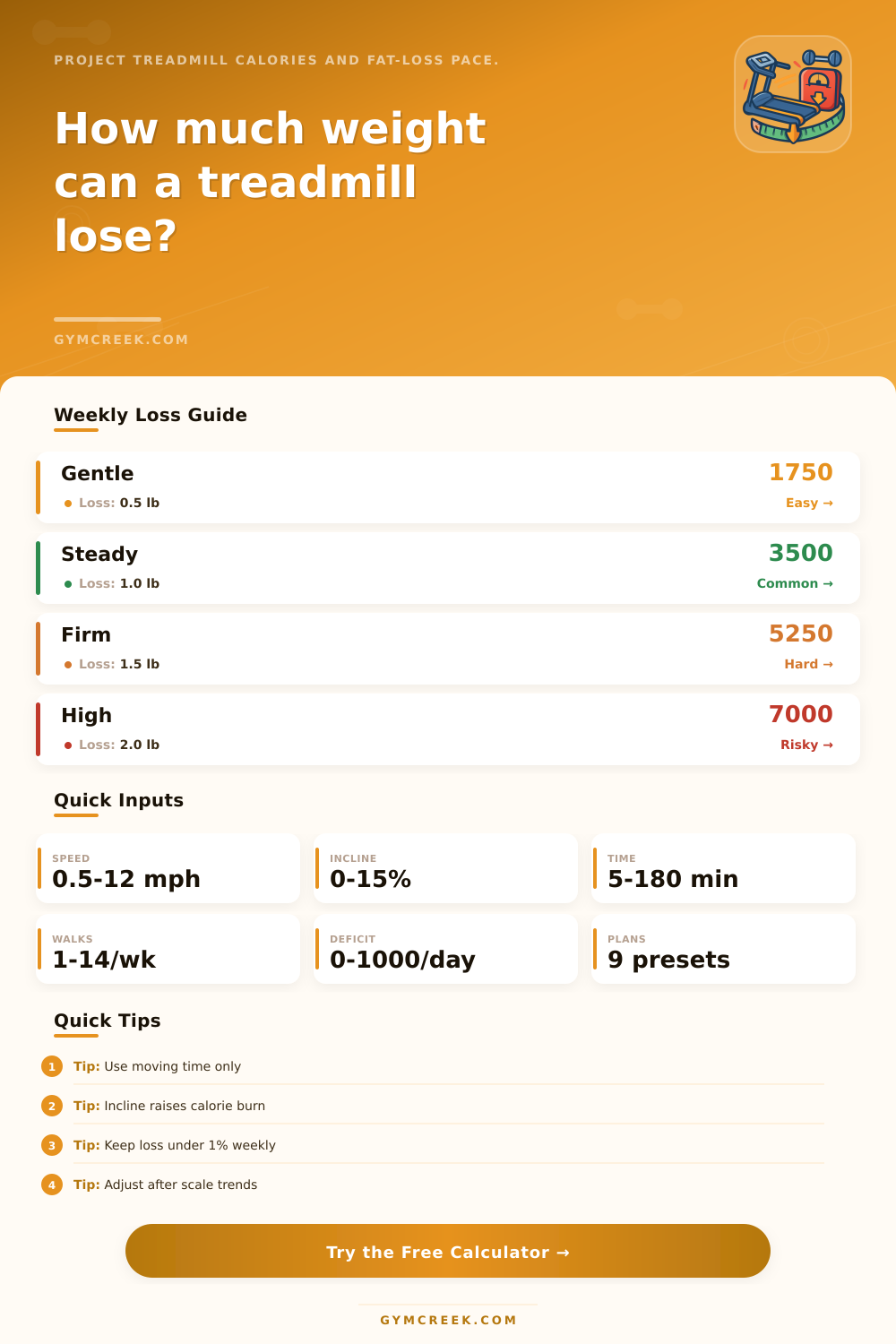
| 1750 kcal | 0.5 lb / 0.23 kg | Usually gentle | Good for long consistency blocks |
| 3500 kcal | 1.0 lb / 0.45 kg | Common target | Often sustainable with recovery |
| 5250 kcal | 1.5 lb / 0.68 kg | Firm deficit | Requires careful appetite tracking |
| 7000 kcal | 2.0 lb / 0.91 kg | Often aggressive | May be too high for many people |
| Setting | Energy effect | Vertical gain | Notes |
|---|---|---|---|
| 0% grade | Flat baseline | None | Distance and pace are simple |
| 1% grade | Small increase | 53 ft per mile | Often used for outdoor feel |
| 5% grade | Large walking boost | 264 ft per mile | Common incline-walk setting |
| 10% grade | Very high walking load | 528 ft per mile | Use moving time carefully |
| Scenario | Treadmill input | Deficit source | Projection pattern |
|---|---|---|---|
| Incline starter | 3 to 4 walks weekly | Mostly treadmill calories | Small repeatable deficit |
| Steady cut | 4 longer sessions | Treadmill plus food deficit | Often near 0.5% weekly |
| Run-focused | Jog or run sessions | Higher exercise burn | More recovery demand |
| Aggressive block | High frequency plus diet | Both exercise and intake | Can exceed a sustainable pace |
💡Calculation Notes
To understand the topic of treadmill weight loss, one must understand the number of calories that the body burn during the treadmill sessions, as well as the calories that the individual burns during the remainder of the day through the food that they consume. A calculator can help to understand this process by taking into account the bodys statistics of the individual, the settings of the treadmill, the number of days per week that the individual plan to use the treadmill, and the number of calories that the individual plans to consume through there diet. Using this calculator will provide a more complete picture of treadmill weight loss than is provided by simply using a single number to represent that concept.
The number of calories that an individual burns during the treadmill sessions can be altered by the body statistics that is entered into the calculator. The speed and incline at which that individual runs on the treadmill are two of the most important variables in the equation. An increase to the incline at which that individual walk will increase the amount of oxygen that the body requires; an increase in incline has a larger effect on individuals that is walking than those that are running.
How a treadmill calculator works
An additional variable in the calculation is whether or not the individual is holding onto the handrail of the treadmill. Many individuals do hold onto the handrails, which reduces the amount of work that the individual’s leg and core perform. Thus, if the individual holds onto the handrails, the calorie count will be adjusted downward to reflect the reduction of the amount of work that is performed.
The length and frequency of each individuals treadmill sessions will