Treadmill Incline Pace Calculator
Convert belt speed and incline into grade-adjusted pace, equal-effort flat pace, VO2 demand, energy cost, vertical gain, and race pace comparison.
Presets fill speed, incline, athlete context, race comparison pace, and session duration. Adjust any field to recalculate.
Equivalent flat pace
Enter treadmill speed and grade to calculate the effort comparison.
| Incline | Typical use | Effort effect | Practical note |
|---|---|---|---|
| 0% | Pure belt pace | Lowest oxygen demand | Useful for speed mechanics and indoor consistency. |
| 1% | Road-like flat running | Small VO2 increase | Often used to offset the easier feel of flat treadmill running. |
| 2% to 3% | Steady hill or tempo | Noticeable grade-adjusted pace shift | Good for aerobic strength without extreme belt speed. |
| 4% to 6% | Hill repeats | High metabolic load | Use shorter reps or reduce speed to control intensity. |
| 8%+ | Power hike or steep climb | Very high vertical cost | Walking equation may be more realistic at slower speeds. |
| Comparison result | Meaning | Training interpretation | Adjustment idea |
|---|---|---|---|
| Effort pace faster than race pace | Incline session is above target intensity | Useful for short reps or controlled over-speed effort | Lower incline, lower speed, or shorten the interval. |
| Effort pace matches race pace | Grade and belt speed mimic target demand | Good for race-specific indoor work | Hold form and watch heart rate drift. |
| Effort pace slower than race pace | Session is below target demand | Useful for easy or recovery work | Increase speed gradually before raising incline. |
| VO2 demand near VO2 max | Very hard effort | Short intervals only for most runners | Increase rest or reduce grade if form breaks. |
| Formula | Equation | Variables | Best use |
|---|---|---|---|
| ACSM running VO2 | 0.2 x S + 0.9 x S x G + 3.5 | S in m/min, G as decimal grade | Running speeds and jogging above roughly 5 mph. |
| ACSM walking VO2 | 0.1 x S + 1.8 x S x G + 3.5 | S in m/min, G as decimal grade | Walking, power hiking, and slower steep treadmill work. |
| Flat equivalent pace | S flat solved from VO2 at 0% grade | Same metabolic mode as selected | Translating incline effort into a flat pace comparison. |
| Energy estimate | VO2 x body mass / 200 | VO2 in ml/kg/min, mass in kg | Approximate kcal per minute from oxygen use. |
Treadmill exercise is different from outdoor exercise in that treadmills provide a smooth surface for running that eliminates the effect of wind resistance on the runner. Because treadmill running eliminates the effect of wind resistance and provides a smooth surface for runners, many people finds that the same speed on a treadmill feels more easy than the same speed outside on a road. Many runners use a small incline on treadmills to provide for the fact that the treadmill doesnt have wind resistance or bumps in the road.
A treadmill incline calculator can convert the speed on a treadmill and the grade of that incline to the equivalent flat distance a person would have to run outdoors. The incline adjustment on a treadmill is important because when an individual runs on a treadmill on flat ground, the treadmill removes the physical force that occur while running outdoors: wind resistance and bumps in the road. These physical forces typically slow a runner down.
How a Treadmill Incline Calculator Works
Thus, by removing these physical force, a runner will typically feel that a given speed on a treadmill is less demanding than the same speed while running outdoors on a road. By adding an incline to a runner’s treadmill, the runner can mimic the physical forces that the flat treadmill setting removes. Adding this incline, however, does not require the runner to adjust the speed at which the person runs on the treadmill.
A treadmill incline calculator allows the runner to enter the speed at which they wish to run on the treadmill, the grade of the incline on the treadmill, and the body weight of the runner. The calculator will output a single number that indicates the difficulty of that particular treadmill session if it were translated to flat ground running outdoors. Being able to compare the number of minutes per mile that can be run on a treadmill to the time that a runner intends to achieve in a race allows that runner to ensure that the runner is meeting their goal with their treadmill sessions.
For instance, if an individual intends to run a race in eight minutes per mile on a road, the incline calculator can help determine if their treadmill session will achieve the same level of physical demand. By entering the individuals goal of eight minutes per mile into the calculator, the individual can determine if their treadmill speed and grade are too easy or too hard to achieve that goal. Additionally, the calculator accounts for the use of the treadmill handrails; if an individual intends to use the handrails to assist with balance and strength, the calculator can adjust for the reduction in physical effort that will occur as a result.
The equations used within the calculator are based off research of treadmills, and those equations change based upon the speed at which an individual is running on the treadmill. At slower speeds, the body incorporates different equations based upon the fact that treadmill speeds mimic walking speed. At faster speeds on the treadmill, the body incorporates an equation that mimics the physical demand of running.
The calculator automatically selects the correct formula based upon the speed at which the user intends to run on the treadmill. However, the user can also manually change the setting to the mode that they desire. The settings that an individual chooses will impact the number that are calculated for the equivalent flat distance and calories burned on the treadmill.
Body weight must be entered into the calculator because the demand for oxygen that the body requires changes with body weight. For instance, an individual that weighs more pounds will require more energy to run at the same speed on a treadmill as an individual of a lighter body weight. Thus, body weight is an essential variable to allow the calculator to determine the demand for oxygen and the number of calories that that individual will burn on the treadmill.
Height is an additional variable in the calculation of calories and oxygen, though it is not used to calculate the equivalent flat distance. Age and activity level are two additional variables that help to provide a more realistic indication of the bodys physical response to the treadmill session. Another variable to consider is the use of the handrails on the treadmill.
Using these handrails will allow the individual to reduce the physical demands on their leg and core to maintain their balance on the treadmill. Thus, using the handrails will result in a reduction in the demand for oxygen by the body. Thus, the inclusion of such a calculation in the calculator is essential to ensure that the individual does not overestimate the physical demands of their session on the treadmill.
Many individuals do underestimate the benefit of the handrails, especially when using the treadmill at a steep incline. An outdoor correction can also be entered into the calculator to account for the fact that a one percent incline on the treadmill is not the same as the incline that occurs outdoors. Outdoor running includes physical forces that treadmills eliminate, such as wind resistance, turns in the road, and different types of terrain.
These physical force increase the demand for oxygen and the number of calories that are burned by the runner. An outdoor correction can be added or subtracted from the percentage of incline entered into the calculator. While many people leave this correction at the percentage of one percent, it is possible to change the outdoor correction to reflect any difference that have been found in any individuals between treadmill and outdoor running speeds.
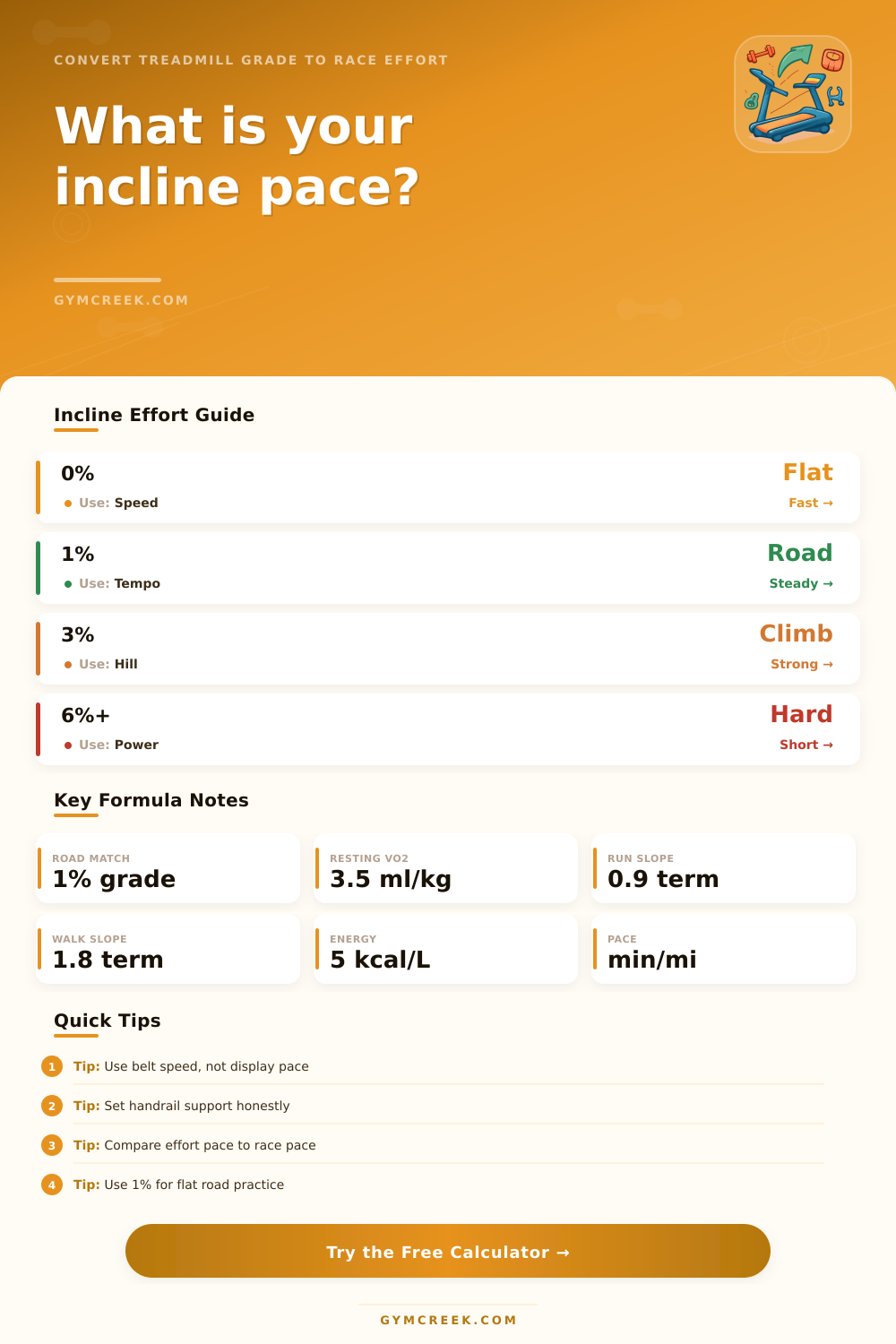
The tables listed on the calculator indicate the changes in equivalent flat distance when the grade of the treadmill is changed. For instance, using a two percent or three percent grade on the treadmill will make the runner feel as if they are performing at a tempo. Six percent or more of an incline will lead to hill-specific running.
Thus, these tables allow individuals to make adjustments to either the speed at which they run on the treadmill or the grade to which the treadmill is adjusted. Being able to compare the distance that an individual can run on the treadmill to the distance that they wish to race allows individuals to avoid mistakes in establishing the type of treadmill session they would like to perform. For instance, if the equivalent flat distance that is calculated for the treadmill session is slower than the target distance for a race, then the runner will feel that the treadmill session is an easy or recovery session from strenuous running.
If the equivalent flat distance is the same as the distance for the target race, then the session is race-specific. Finally, if the calculated distance is faster than the distance for the target race, the session can be considered an interval session. Occasionally, individuals should calibrate the treadmill.
Over time, the treadmill belt may drift in relation to the actual speed at which the treadmill is running. Thus, by entering a percentage of correction into the treadmill incline calculator, the individual can ensure that any result that are calculated are accurate. For instance, if the user enters a percentage of two percent into the calculator, it will adjust each of the variables for that individual to account for the two percent error in the treadmill speed.
Such errors may accumulate over long sessions on the treadmill. Thus, individuals may need to calibrate their treadmill once or twice per year. By using the treadmill incline calculator, individuals can compare different running sessions on the treadmill to one another.
For instance, each individual may wish to compare the demands of each of their treadmill sessions performed on different days of the week. Additionally, those who wish to compare the effects that different grades of treadmill hills may have upon their bodies can use this calculator. These type of comparisons are difficult to make without the use of a treadmill incline calculator.
Though the treadmill incline calculator is an estimate of the demands placed upon an individual by the treadmill, it removes the guesswork associated with the number of calories that will be burned, the distance that can be run in a session, and the demand for oxygen. After becoming familiar with the treadmill speed, treadmill grade, and the equivalent flat distance, the calculator becomes a reference tool that indicates to each individual the purpose of that particular session on the treadmill.