Stationary Bike Wattage Calculator
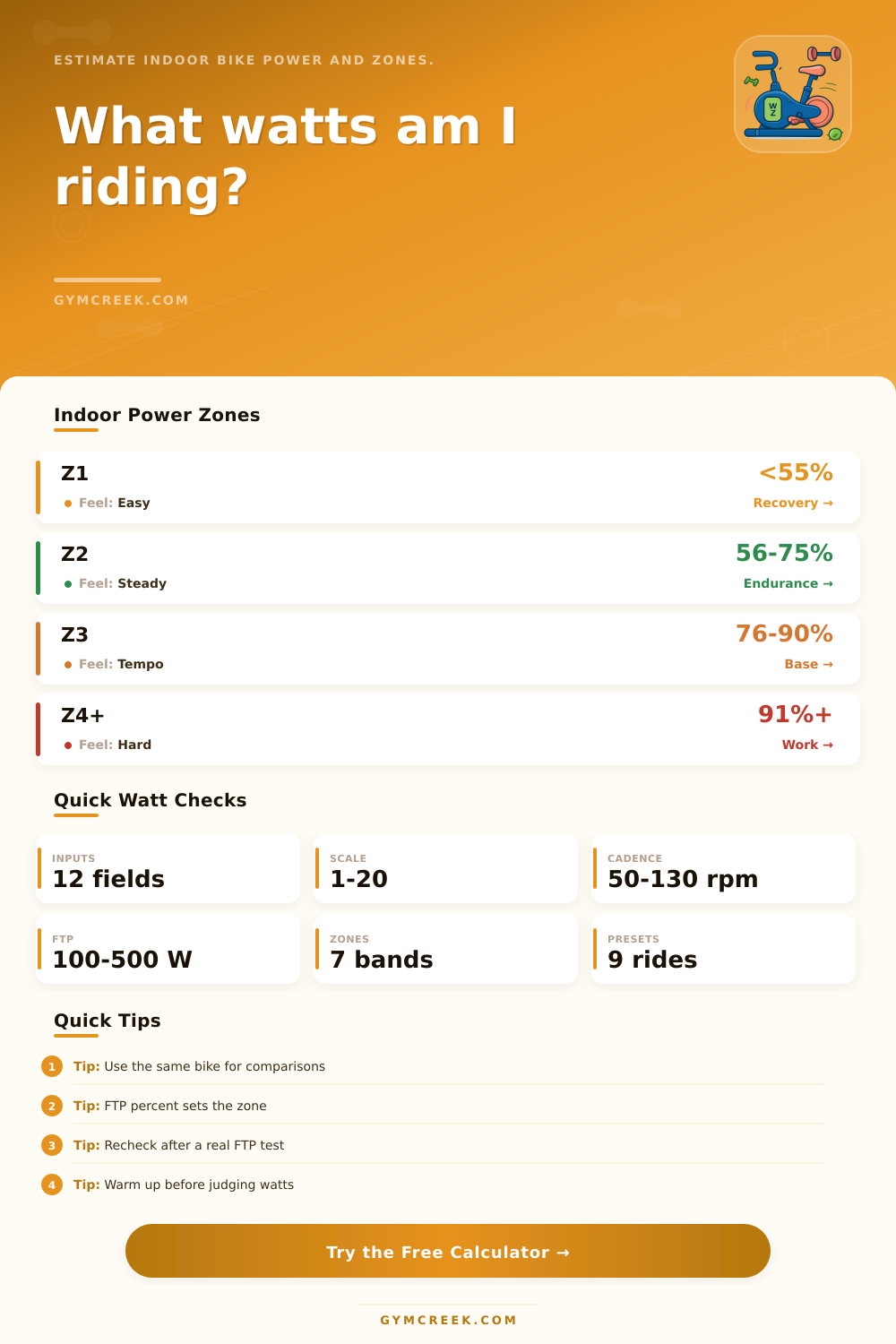
Estimate indoor cycling watts from bike resistance, cadence, rider weight, bike type, FTP, workout duration, and calibration feel, then map the ride to power zones.
📌Indoor Ride Presets
Presets load realistic indoor-bike resistance, cadence, rider weight, FTP estimate, bike type, duration, and calibration settings.
⚙Calculator
Indoor power snapshot
Enter bike resistance, cadence, rider weight, FTP, and workout duration to estimate watts and power zone.
📊Power Metrics
📑Power-Zone Outputs
| Zone | FTP percent | Target watts | Workout use |
|---|---|---|---|
| Zone 1 Recovery | Under 55% | --- | Warm-up, cool-down, easy recovery |
| Zone 2 Endurance | 56 to 75% | --- | Aerobic base and longer steady rides |
| Zone 3 Tempo | 76 to 90% | --- | Moderate pressure and aerobic work |
| Zone 4 Threshold | 91 to 105% | --- | FTP intervals and hard sustained work |
| Zone 5 VO2 Max | 106 to 120% | --- | Short hard intervals |
| Zone 6 Anaerobic | 121 to 150% | --- | Bursts and high-power repeats |
| Zone 7 Sprint | Over 150% | --- | Very short all-out efforts |
| Bike type | Curve feel | Best input | Watt note |
|---|---|---|---|
| Magnetic spin bike | Smooth progressive | Console level | Good for repeated comparison |
| Friction spin bike | Knob pressure varies | Marked level or class cue | Needs calibration feel check |
| Upright exercise bike | Moderate load | Console resistance | Often stable across sessions |
| Air bike | Cadence-sensitive | Damper and rpm feel | Power rises fast with rpm |
| Output | Low | Moderate | High |
|---|---|---|---|
| Absolute watts | Under 120 W | 120 to 220 W | 220 W plus |
| W/kg | Under 1.5 | 1.5 to 3.0 | 3.0 plus |
| FTP percent | Under 75% | 76 to 105% | 106% plus |
| Session energy | Under 150 kJ | 150 to 500 kJ | 500 kJ plus |
| Formula | Inputs | Output | Purpose |
|---|---|---|---|
| Empirical watt curve | Bike, resistance, cadence | Estimated watts | Indoor bike without power meter |
| W/kg | Watts and body mass | Power to weight | Compare rider-relative output |
| FTP percent | Watts and FTP | Intensity factor | Power-zone assignment |
| kJ = W x seconds / 1000 | Watts and duration | Ride energy | Session workload estimate |
💡Practical Notes
Stationary bike are machines that many people use to exercise indoors. However, stationary bikes dont give people an accurate representation of the effort that they are performing on the stationary bike. Instead, most stationary bikes provide information for individuals about the resistance that they are using, their cadence on the stationary bike, and the number of calorie that they have burned during that stationary bike ride.
Because stationary bikes do not show individuals the effort that they are performing, individuals can use an estimate of the wattage that they are performing to monitor their effort on stationary bikes. The resistance settings on stationary bikes are not provided on a universal scale, and they can vary from stationary bike to stationary bike. For instance, a resistance setting of eight on one make of stationary bike may feel like moderate resistance, but the same setting of eight on a different brand of stationary bike may feel like heavy resistance.
How to Measure Effort on a Stationary Bike
This is due to the different ways that stationary bikes provide resistance for individuals. For instance, some brands use magnetic resistance for individuals to create smooth resistance for individuals when pedaling on the stationary bike. Other brands may use friction pads to create resistance for individuals, but the resistance may vary if those friction pads wear down over time or if they are at a different temperature than when the individual first rode the stationary bike.
Additionally, some brands of stationary bikes are air bikes that do not use a resistance knob for individuals to control the effort of resistance that they feel while pedaling; instead, the effort that individuals put in while pedaling moves the air within the stationary bike. These different forms of creating resistance result in individual producing different amounts of power on different brands or models of stationary bikes. Thus, individuals must account for the type of stationary bike that they are using when measuring their wattage for these bikes.
The cadence that an individual produces while riding a stationary bike is another factor in measuring the effort of the individual. Cadence is the rate at which an individual pedals on the stationary bike. An individual can produce different amounts of force with their legs depending on their cadence.
For instance, if an individual is pedaling at a high cadence, their legs may have to produce more force with each revolution of the stationary bikes pedals. Thus, an individual that is performing at 80 revolutions per minute (rpm) may be performing less work than an individual that is also using the same resistance settings but is performing at 100 rpm. An example of the impact of cadence is that an individual’s performance at 80 rpm cannot be directly compared to their performance at 100 rpm.
Another factor that individuals who are using stationary bikes must consider is the weight of the individual. While the wattage for an individual that is using the stationary bike indicates the amount of power that the stationary bike requires, the wattage per kilogram for that individual indicates the amount of power that the individual is producing relative to their body mass. As a result, one individual may be producing a higher absolute wattage than another individual due to their body mass; however, if each individual compares the wattage per kilogram for each individual, each individual can more accurately compare the performance of their stationary bike relative to each other over time.
Functional Threshold Power (FTP) for stationary bikes is another value that is used to calculate performance on stationary bikes. The FTP for an individual on a stationary bike can be used to define the different training zones for that individual. Training zones are ranges of wattage for an individual that represents different demands on the body during stationary bike riding.
As a result, knowing the FTP of an individual can help that individual to understand how hard they are riding their stationary bike and avoid injuries to their body. The last factor that must be considered when measuring effort for stationary bikes is the duration of that ride. An individual can calculate the total amount of work for an individual by multiplying the average wattage for that individual by the length of the stationary bike ride; thus, if two individual rode stationary bikes at the same average wattage, but one individual rode for twenty minutes while the other individual rode for one hour, the individual that rode the stationary bike for one hour would have performed more total work.
Furthermore, the amount of mechanical energy that stationary bikes create is measured in kilojoules, and the amount of mechanical energy that is created increases with the increase in the length of the ride. Additionally, the amount of metabolic energy that the individual uses increases as the length of the ride increases. Thus, the shorter the amount of time that an individual rides a stationary bike, the more fatigue will develop in their body relative to an individual that cycled for a longer amount of time.
Another factor in the estimation of wattage for stationary bikes is the calibration settings for the bikes. Because stationary bikes are not made alike, they do not necessarily exhibit the same amount of resistance for the same calibration settings for their bikes. For instance, one stationary bike may feel lighter than another of the same make and model due to differences in the tension of their belts, the mass of their wheels, or how well they are maintained.
Thus, calibration settings for stationary bikes allow individuals to adjust to these differences between stationary bikes. The position at which an individual while using a stationary bike and the effort level that they utilize while riding those bikes can also impact the amount of work that they perform on those stationary bikes. For instance, an individual may feel like they are exerting more effort when standing on the pedals compared to when they are not.
Thus, effort and position for stationary bike rides can create feelings of differences in the performance of two individual stationary bike rides while both individuals display similar amounts of wattage on their data for the bikes. The overall purpose for estimating the wattage of stationary bikes is to allow individuals to compare one stationary bike ride to another individual’s performance on stationary bikes. By calibrating each individual’s stationary bike rides to be comparable to each other in terms of the factors discussed above, individuals can better recognize the changes in their fitness over time.
For instance, if the wattage that an individual can produce with a certain resistance and cadence increases over time, that individual can be certain that their strength and endurance on the stationary bikes is increasing. Additionally, if the wattage that an individual is producing as a percentage of their FTP decreases over time, that individual can also be certain that their strength and endurance on stationary bikes is increasing. Thus, by using wattage to determine the intensity of each individual’s rides on stationary bikes, those individuals can turn what used to be an inactive form of exercise into a measurable aspect of each individual’s fitness routine.
It should of been noted that more practice makes it actualy easier to track.