Cycling Recovery Time Calculator
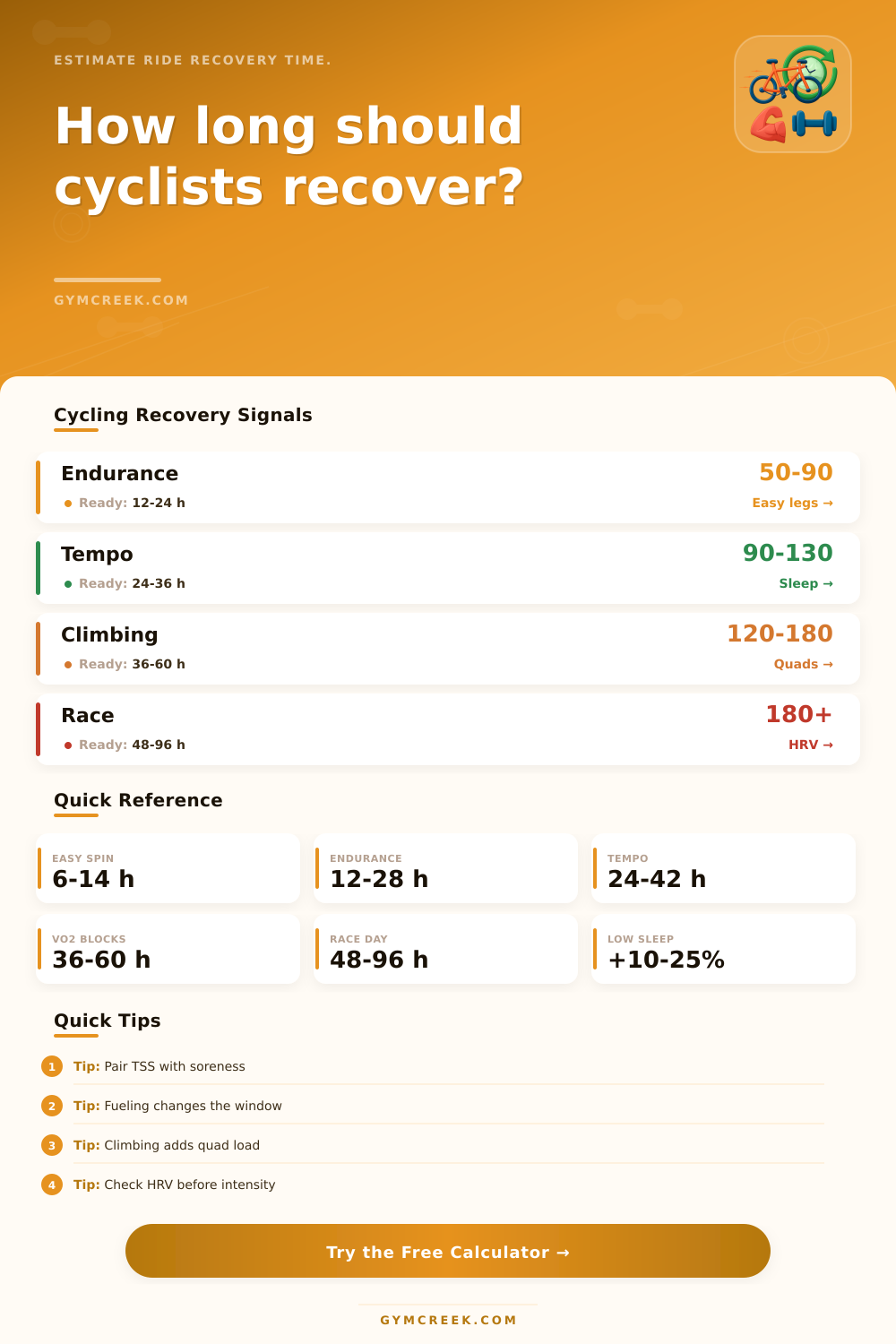
Estimate how long to recover after a ride using duration, TSS or RPE, intensity type, elevation gain, sleep, soreness, HRV, resting heart rate, fueling quality, and the ride planned next.
📌Presets
Choose a cycling scenario or enter your own ride. TSS gives the strongest estimate, while RPE mode uses duration and effort to approximate ride stress.
⚙Calculator
Cycling recovery snapshot
Enter ride load and readiness markers to estimate recovery.
📊Cycling Metrics
📑Reference Tables
| Ride type | TSS cue | Typical recovery | Watch point |
|---|---|---|---|
| Recovery spin | Under 35 | 4-12 hours | Keep cadence smooth |
| Endurance | 45-100 | 12-28 hours | Check leg heaviness |
| Tempo | 80-140 | 24-42 hours | Fuel before repeating |
| Threshold | 100-170 | 30-54 hours | Watch HRV trend |
| VO2 or race | 130+ | 36-96 hours | Delay intensity if flat |
| Readiness marker | Green | Caution | Red flag |
|---|---|---|---|
| Sleep | 7-9 hours | 6-7 hours | Under 6 hours |
| Soreness | 1-3 | 4-6 | 7-10 |
| HRV trend | Normal or up | Slightly low | Low for you |
| Resting HR | Normal | +3 to +5 bpm | +6 bpm or more |
| Next ride | Buffer | Best use | Change if tired |
|---|---|---|---|
| Rest or mobility | Shortest | Reset | Keep it light |
| Recovery spin | Short | Circulation | Cut duration |
| Endurance | Base | Aerobic volume | Drop intensity |
| Tempo work | Longer | Quality aerobic | Move 24 hours |
| Race or intervals | Longest | Performance | Prioritize sleep |
| Formula factor | Input | Effect | Use |
|---|---|---|---|
| Ride load | TSS or RPE | Base hours | Core stress |
| Intensity type | Zone profile | Neuro load | Hard sessions |
| Elevation | Feet or meters | Muscle load | Climbing days |
| Readiness | Sleep, HRV, HR | Multiplier | Daily choice |
| Nutrition | Fueling quality | Glycogen bias | Long rides |
💡Tips
The timing of the recovery window is another important factor for cyclist. The timing of this recovery window will determine if you are prepared for your next training session. If the recovery window is too short, you will feel flat during your next interval session or race.
However, if the recovery window is too long, you will lose the fitness gains that you have worked to building up. A calculator can help you to determine the length of your recovery window based off your ride load, climbing efforts during your ride, feelings of soreness in your legs after your ride, the quality of your sleep, and the type of ride that you plan to perform after your ride. The ride stress that you can expect to experience will not be measured in the number of minute that you spend on your bike.
How to Use a Rest Time Calculator for Cyclists
Instead, the intensity that you incorporate into your ride will impact the load that is placed upon your body. For example, a ride that incorporates more threshold or VO2 effort will place more stress upon your neuromuscular system than a flat, easy ride. Therefore, the calculator will ask you for the intensity types of your ride so that it can separate the impact that your neuromuscular system will experience from the depletion of glycogen that your body will experience during your ride.
The elevation that you ride will add to the load that is placed upon your body, leading to fatigue during your ride. For instance, climbing will involve concentric efforts of the muscles as you increase in elevation, yet will also cause eccentric loading of the quadriceps as you descend during climbs. Therefore, the same number of training stress points can be logged during a flat and hilly ride, but your legs will experience different types of fatigue from each of these types of rides.
Therefore, the elevation field allows the calculator to account for these types of efforts without requiring that you manually add time to account for the climbing effort. Recovery isnt based solely upon the efforts of your ride. Recovery also incorporates factor like sleep, heart rate, and heart rate variability in the calculations of when your body will be ready for another session.
For example, if you took a long time to recover from a ride and slept for six hours after your ride, your body may require the same period of recovery as someone who rode the same amount of distance but slept for eight hours. Additionally, a soreness slider will allow you to account for your current feelings of soreness in your legs after your ride. The soreness slider is an important factor in that your legs may feel heavy after your ride even with a low training stress score.
Your nutritional inputs will impact recovery due to its impact upon your glycogen store. If you did not fuel your rides apropriately, your body will create more debt with glycogen stores and muscles, leading to more fatigue. The calculator accounts for the glycogen stores and the impact that your fueling quality has upon your ride as a multiplier.
Many cyclists will feel that their ride is over after they save the ride file, yet if they did not fuel their ride properly, their recovery window may have begun prior to the end of their ride. Additionally, your next ride is another required input in the calculator so that it can account for different types of recovery windows for different rides. If you plan on taking a spin recovery ride, for instance, your recovery window will differ from if you planned to ride another hard interval session.
The calculator includes a field for your next session to determine your easy spin window, your hard ride buffer, and your overall recovery load score. These three factors will help you to determine whether you should of had a rest day, a spin day, or a full training day the following day. Finally, an important factor that determines recovery is the training age of the cyclist.
The training age will impact the bodys ability to clear that load created during your ride. For instance, a new cyclist will take longer to clear that load than an amateur cyclist. Therefore, the adaptation factor for training age allows the calculator to ensure that new cyclists do not plan another high-load day too soon.
The reference tables that exist on the calculator are for quick checks and do not provide precise measurements of the recovery time that you may require. The reference tables provide a general understanding of the relationship between training stress and recovery, as well as the relationship between various indicators of readiness and your training status. These tables will allow you to quickly review the impact of your various inputs to ensure that your recovery time is as appropriate as possible.
However, the true value of the calculator will come from the ability to track your performance over the weeks, instead of each individual calculation that you generate with the calculator. Additionally, there are some mistakes that many individuals will make with the calculator. For instance, many individuals will not recognize that their bodys feelings of soreness are an important variable in the calculation.
Although it may feel good to feel great after a ride, low soreness does not always mean that your body is ready for the next session. The calculator does not account for each of the variables, but does force the cyclist to consider each of those variables. By providing appropriate numbers for the sleep, soreness, and fueling of your body, your recovery window will be adjusted to account for how your legs feel after your ride.
Another of the errors that some riders may make is planning their next ride before they have completed their current ride. By asking for the planned next session for the rider, the calculator can account for the demands that the next session will have upon the body. This will prevent the planning of a hard ride when the body is feeling flat.
Over time, with the use of this calculator, the rider will become accustomed to their body and will begin to understand what ride variables will impact their recovery more then others. For instance, they may notice that their body always needs an extra day of recovery if they included climbs in their ride, or that the fueling of their body has a greater impact upon their performance than a missed meal. The goal of the calculator is not to create an exact recovery time for each cyclist.
However, the goal is to force the cyclist to consider the various variables and to use the calculation to make better decisions regarding their training. If the recovery time calculated for the cyclist is longer than they would of liked, they should accept that longer recovery time instead of forcing the body to perform their next ride.