Cycling Hydration Calculator
Plan ride fluid, bottles, sodium, carbohydrates, and aid-stop timing from duration, temperature, sweat rate, intensity, body weight, and bottle size.
📌Ride Presets
Presets load realistic ride duration, heat, measured sweat rate, intensity, bottle size, sodium concentration, carb target, and aid-stop interval.
⚙Calculator
Ride hydration plan
Enter a ride profile to estimate fluid, sodium, carbohydrates, bottle count, and aid-stop timing.
📊Ride Metrics
📑Reference Tables
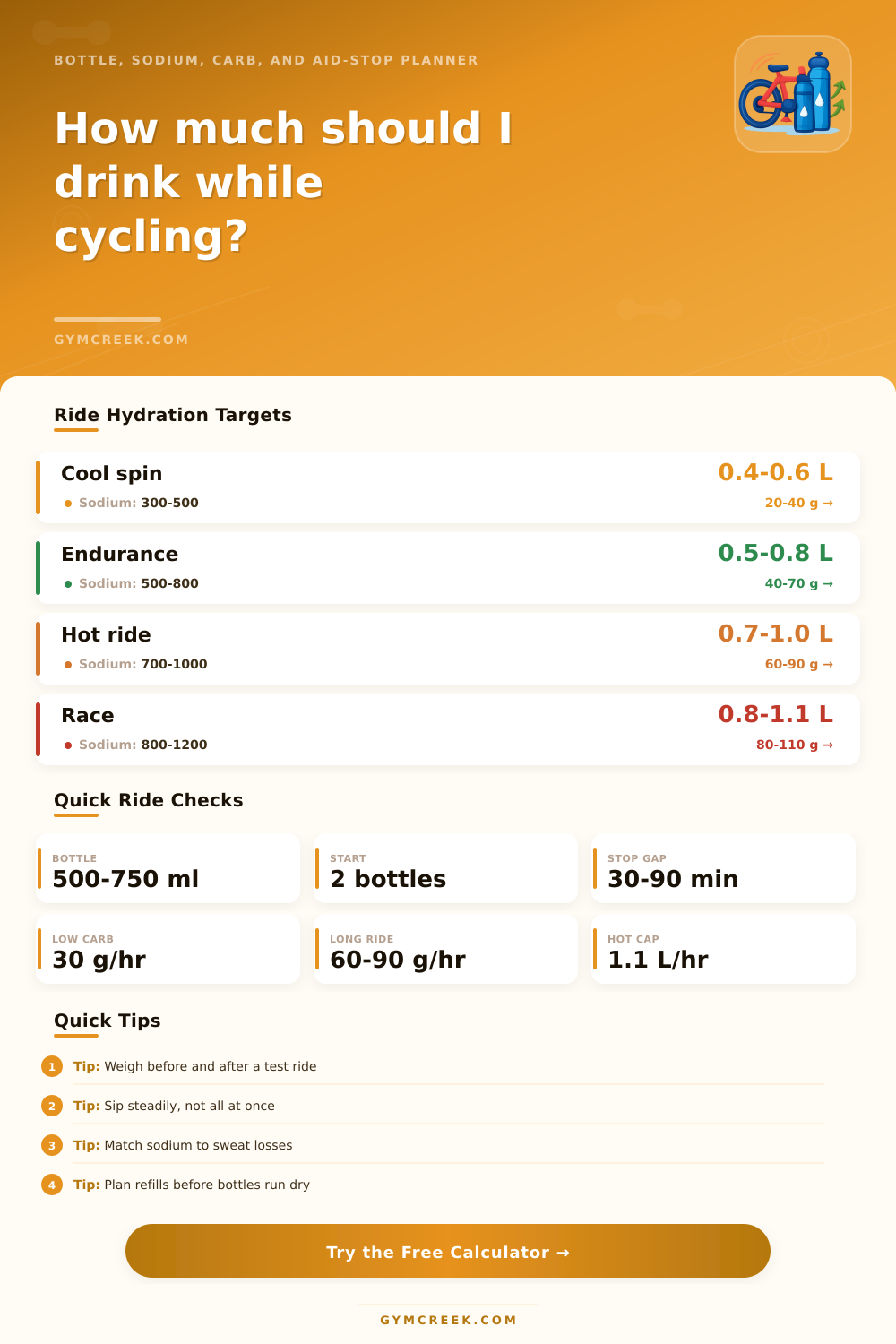
| Ride condition | Typical target | Useful check | Plan cue |
|---|---|---|---|
| Cool easy ride | 0.35 to 0.60 L/hr | Low sweat loss | One bottle may last longer than an hour. |
| Moderate endurance | 0.50 to 0.80 L/hr | Most steady rides | Drink small amounts every 10 to 15 minutes. |
| Hot or humid | 0.70 to 1.00 L/hr | High sweat loss | Use planned refills and check sodium. |
| Race effort | 0.75 to 1.10 L/hr | High intensity | Keep bottle changes simple and predictable. |
| Ride length | Sodium guide | Carb guide | Notes |
|---|---|---|---|
| Under 60 minutes | Usually optional | 0 to 30 g/hr | Water may be enough unless it is hot. |
| 1 to 2.5 hours | 300 to 700 mg/hr | 30 to 60 g/hr | Practice steady sipping and fueling. |
| 2.5 to 5 hours | 500 to 1000 mg/hr | 60 to 90 g/hr | Mixed carb sources are often easier. |
| 5 hours plus | 600 to 1200 mg/hr | 70 to 110 g/hr | Use aid stops to reset bottles and food. |
| Temperature | Sweat factor | Replacement bias | Result meaning |
|---|---|---|---|
| Below 55°F / 13°C | 0.88 | Lower | Cool air reduces the drink target. |
| 55 to 70°F / 13 to 21°C | 0.98 | Moderate | Normal endurance target range. |
| 71 to 85°F / 22 to 29°C | 1.14 | Higher | Refill timing becomes more important. |
| Above 85°F / 29°C | 1.32 | Highest | Expect faster bottle turnover. |
| Aid spacing | At 0.60 L/hr | At 0.85 L/hr | Practical setup |
|---|---|---|---|
| 30 minutes | 0.3 L | 0.43 L | Top off only if bottle capacity is small. |
| 60 minutes | 0.6 L | 0.85 L | Common two-bottle road setup. |
| 90 minutes | 0.9 L | 1.28 L | Carry two bottles or a larger reserve. |
| 120 minutes | 1.2 L | 1.70 L | Requires extra capacity in hot conditions. |
💡Planning Notes
Hydration is another factor to consider when cycling in warm weather. Hydration becomes more dificult as the weather becomes more warmer. While it may feel comfortable to performing a ride at the start of the day, those that perform lengthy rides will find that they may lose a significant amount of fluids after they begin to perform their ride.
This is due to the bodys need to produce sweat in response to hot weather in order to help regulate its body temperature. Therefore, a rider must consider these factors in relation to how much fluid is lost in order to plan for hydration according to. The most important factor in establishing a hydration plan for a ride is to determine the rate at which an individual rider will sweat, referred to as the sweat rate.
How to Stay Hydrated on Bike Rides
A riders sweat rate will fluctuate based off a variety of factor, such as the temperature of the weather, the intensity of the ride, and the size of the rider. Therefore, determining the rate at which an individual rider will lose fluid by performing a test ride will help to establish a more accurately plan for how much fluid that rider will need to consume during the ride. By using the fluid rate that is measured during these test rides, the rider can ensure that they dont either consume too little fluid on hot days or too much fluid on cool days.
The temperature at which a rider performs their ride will impact the amount of fluid that they will sweat. Hot summer days will require riders to consume more fluid then mild spring days. Therefore, the fluid target that is established for each season will not be applied to each season; adjustments will need to be made to account for the impact of temperature on fluid loss.
The intensity of the ride will also impact the fluid that is lost by the rider. As the intensity of the ride increases, the amount of fluid that is lost by the rider increases, as well. Increased intensity leads to increased core temperatures and breathing rates, both of which contribute to the loss of fluid by the rider.
Thus, fluid needs to be accounted for according to the intensity of the planned ride. Body weight is another factor that will impact the fluid that is lost by a rider. As body size increases, the amount of fluid that can be lost before dehydration becomes an issue increases.
Additionally, the fluid target that is established limits the amount of fluid that may be targeted to prevent the body from getting too much fluid and becoming uncomfortable from drinking so much fluid. Another factor to consider is the size of the bottles and how much fluid that is currently in those bottles at the start of the ride. The calculator can calculate the number of bottles that will be needed for the entire ride, as well as the length of time that the starting bottles of fluid will last.
This information will help the rider to decide if any fluid refills will need to be performed prior to the start of the ride. An essential factor in creating a proper hydration plan is the amount of sodium that is consumed by the rider. Sodium is an electrolyte that naturaly occurs in the fluid that is lost in the process of sweating.
As with fluid loss rates, the amount of sodium that is lost by each rider can vary. The calculator can compare the amount of sodium that will be consumed to the amount of sodium that is lost in the riders sweat. If the amounts are significantly different from one another, the rider may need to make adjustments to their fluid supplement.
Another factor to consider is the amount of carbohydrates that is consumed by the rider during long rides. Carbohydrates provide the body with fuel. By setting a goal of the amount of carbohydrates that will be consumed by the body in grams per hour, the rider may be able to establish a plan for how those carbohydrates will be distributed into the bottles of fluid.
The concentration of carbohydrates in each bottle should not be too high to avoid slowing the absorption of the fluid by the body. Another factor to consider is the spacing between aid stops. The spacing between aid stops will impact the amount of fluid that will have to be carried by the rider during the ride.
If the distance between aid stops is great, the rider will have to carry enough fluid to ensure that the rider can complete those distances between aid stops. The calculator can calculate the amount of fluid that will be needed for each segment of the ride, and the rider can compare that to the amount of fluid that they are currently carrying. If the calculation states that the rider will be without fluid during a segment of that ride, the rider will have to either change the distance between aid stops or carry additional fluid with themselves prior to the ride.
There are a variety of mistakes that riders may make in relation to their hydration plan. One of the mistakes is to only drink fluids when they feel thirsty. Rather, riders should drink fluids prior to feeling thirsty.
Additionally, all bottles dont need to be loaded with the same fluid supplement; the supplement will change with the temperature. Additionally, fluid needs are not just related to the total amount of fluid that is consumed; the amount of sodium and carbohydrates that are consumed will change with the length of the ride. The rider can avoid these mistakes by using the calculator.
There are a variety of factors that may exist outside of the calculator that will impact the needs of the rider in relation to hydration. Factors like headwinds, illnesses, the amount of training that is performed, and sleep can all have an impact on the amount of fluid that should be consumed by the riders. As such, while the calculator can establish a plan for the rider based upon the numbers that are entered, these plans will not account for these changing factors each day.
The output of the calculator is just that; an output. It should not be treated as the plan that is applied to all rides that are performed. Rather, prior to each similar ride, the rider should perform the calculator to determine what the plan should be.
By testing the parameters of the plan, making adjustments, and retesting the parameters according to the success or failure of those adjustments, the rider will eventually find a hydration plan for each rider that will reflect their bodys response.